There are thousand of resources out there in teaching phonics to our early readers and it can be quite overwhelming seeing all these materials.
I am sharing a few resources that we used to teach Marya. It might or might not work for your child. You might need to go through a trial and error process in finding the suitable one. But whatever materials you choose, consistency is the key!
Make lots of Dua’ that Allah ease your child’s learning journey and that he/she enjoys every step of it inshaAllah.
1) This reading mama (www.thisreadingmama.com)
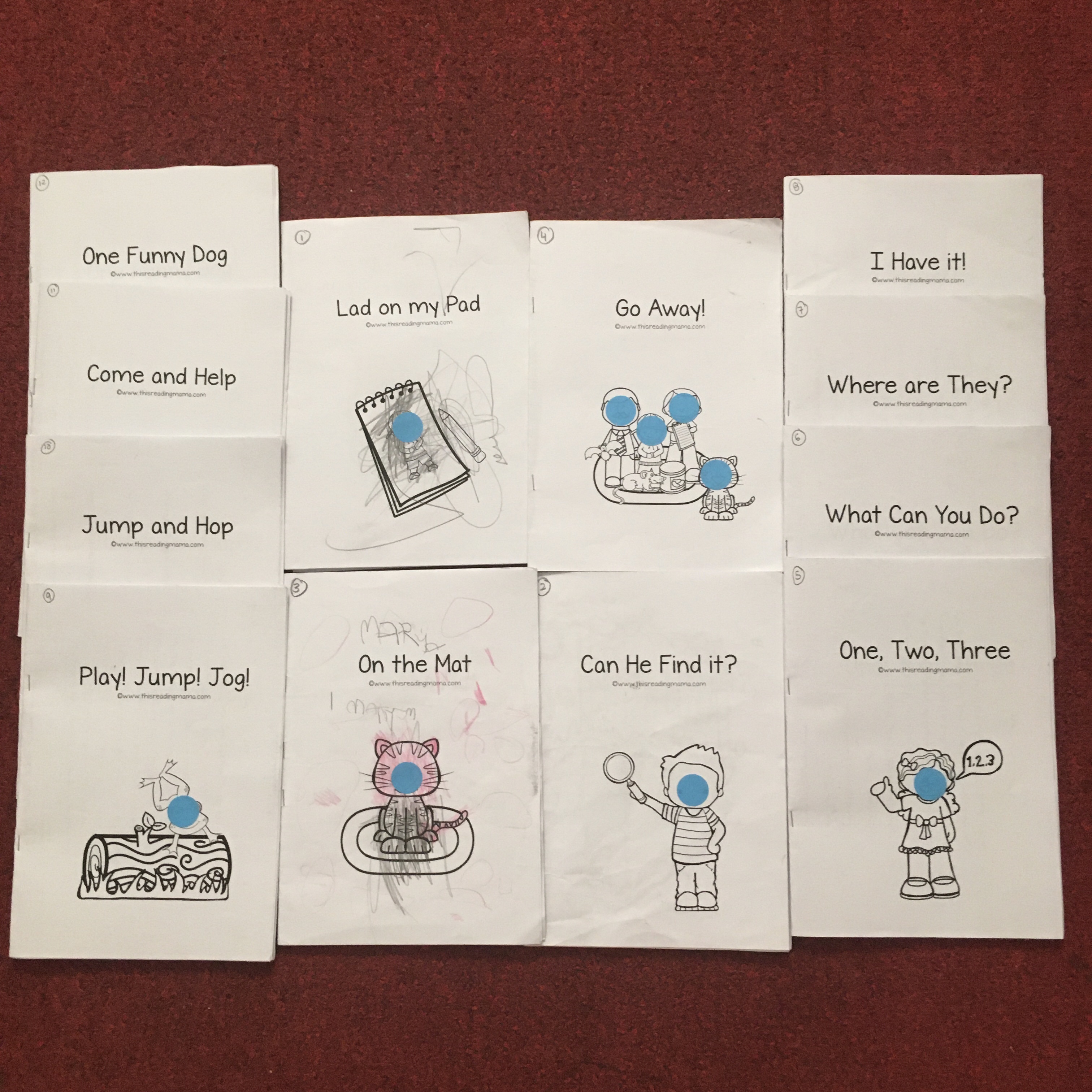
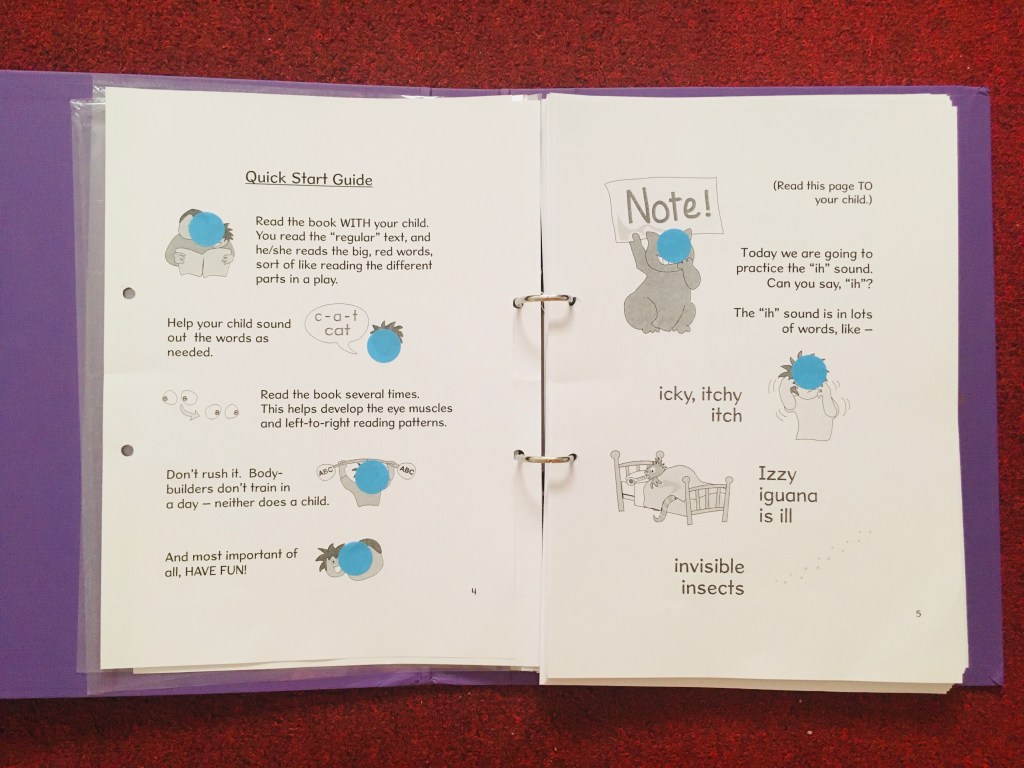
Becky Spence from This reading mama is a blogger,author and speaker who is very passionate of literacy and she homeschools her children. Most of Marya’s worksheets and printables were from her blog. Our favourite printable is definitely the word family books for short vowels.
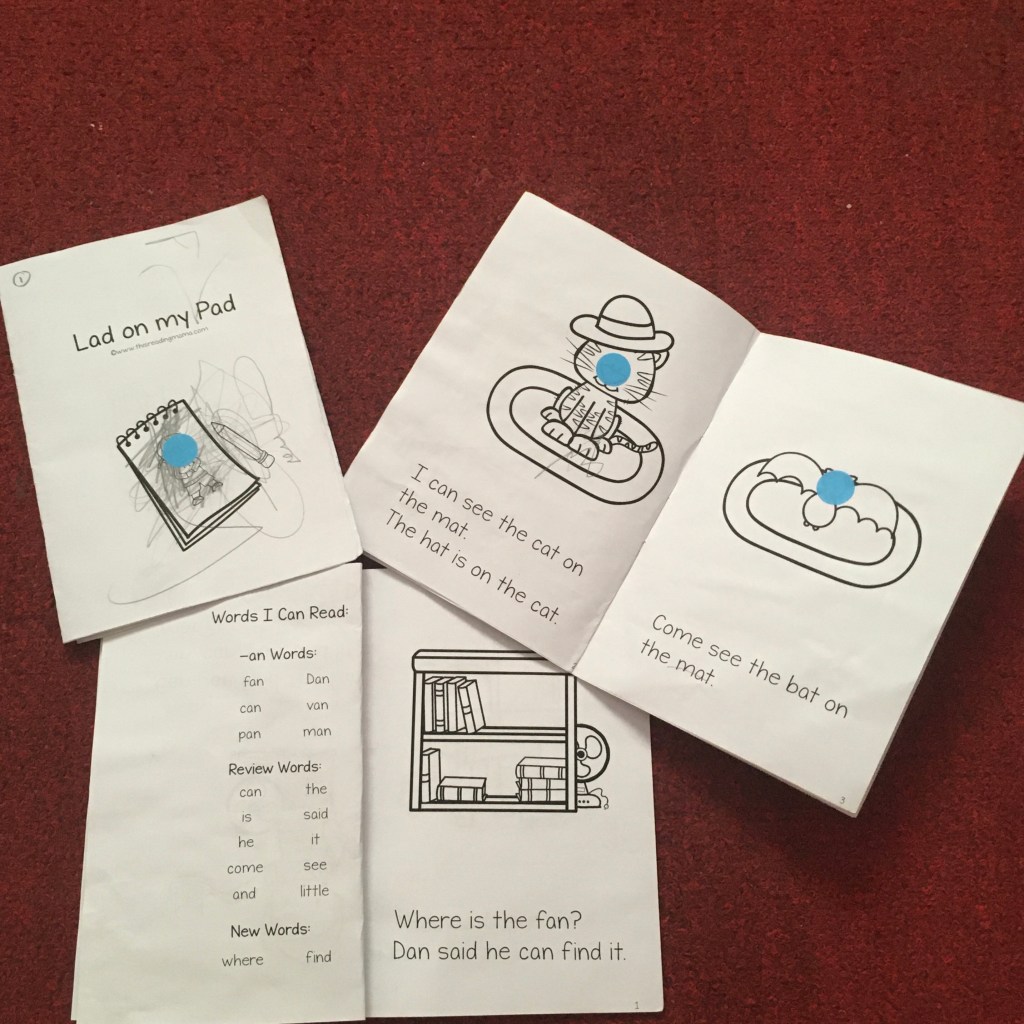
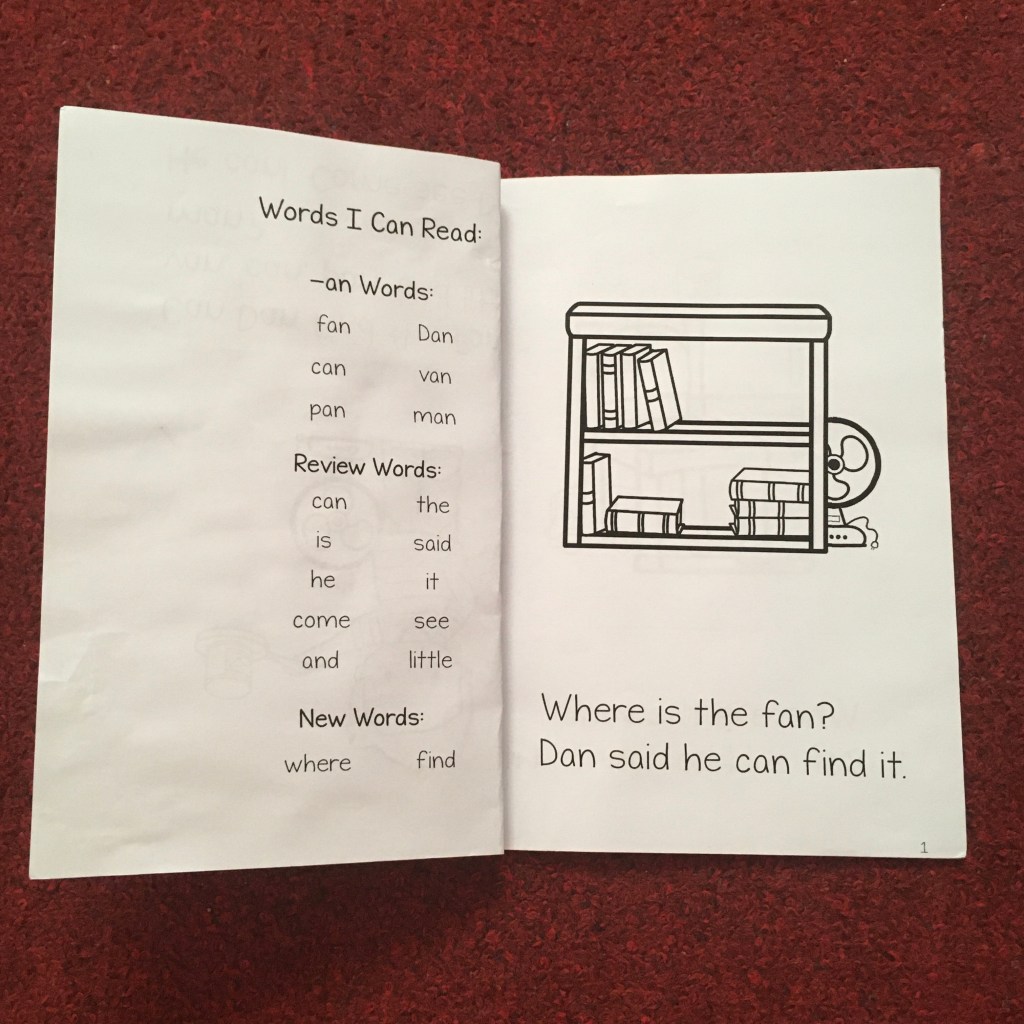
These books are simple and fun to read with a very predictable structure. There are also sight words featured in every book.
I usually read with Marya for the first time. She will then try to sound out the words and read after a few reading aloud sessions together. Marya enjoys reading these books because they are easy and the best part is she can colour in the drawings. If you are not comfortable with images, simply do as we always do, cover the faces with dot stickers.
(Our copies are not so neat anymore because the kids always try to get their hand on the books and Adik enjoyed scribbling on the book behind my back
I love this program because it offers free printables! It is like a one stop reading program that is easy and fun
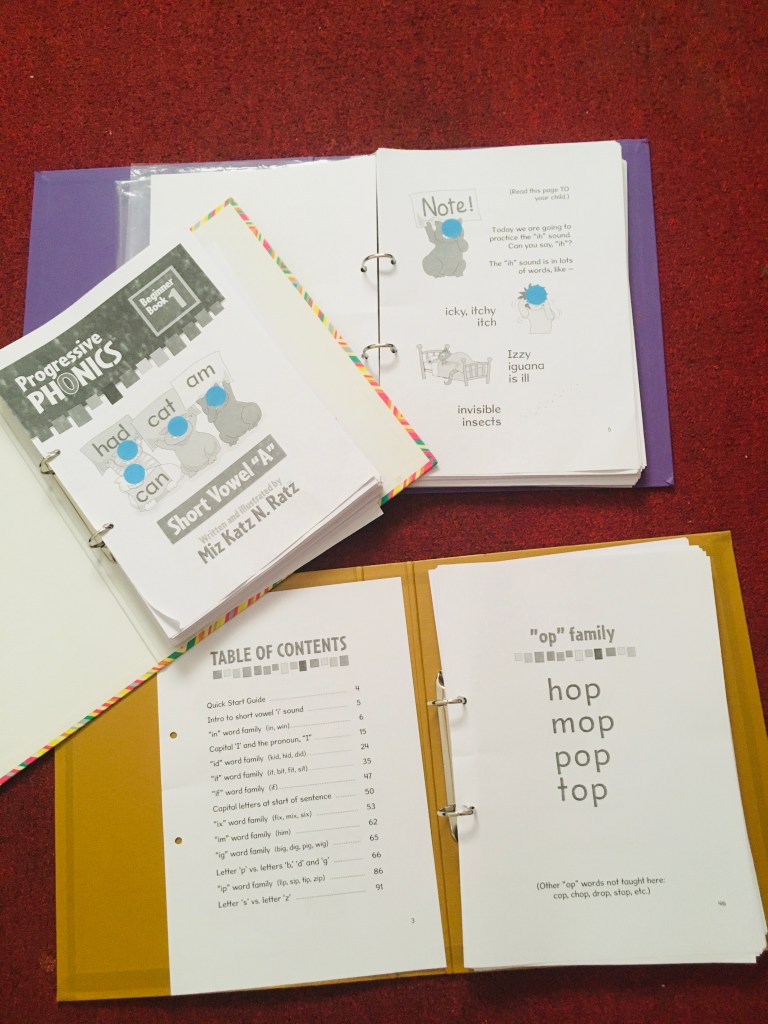
The phonics reading program is divided into 3 levels, beginner, intermediate and advanced levels.
We are in the beginner level, and this level has 5 phonics books!(each book is at least 60 pages).
Beginner level touches on the short vowels families. Most of the stories are funny with illustrations and easy to read.
We printed all 5 phonics books and bind it all in 3 huge ring-file binder.
If you do not wish to print, simply download it to your devices/tabs and you have a massive e-books collection for your kid.
3) Islam based phonics curriculum from an instagram account (unqualified teacher)
An amazing work by sister Amina from unqualified teacher. There are 10 learning packs in this curriculum which have the Al-Quran and Sunnah as reference.
Personally, I don’t use this with Marya because she has passed most of the lessons (except maybe the reading cards). Most of the hands on activities are used with Maryam, like the puzzles and alphabets flashcards. We are working on it slowly but there are no personal photos of Maryam using these resources because Maryam is the kind who would run away whenever I bring out the hp’s camera so, go to unqualified teacher to browse through her amazing resouces!
4) The helpful garden (www.thehelpfulgarden.com)
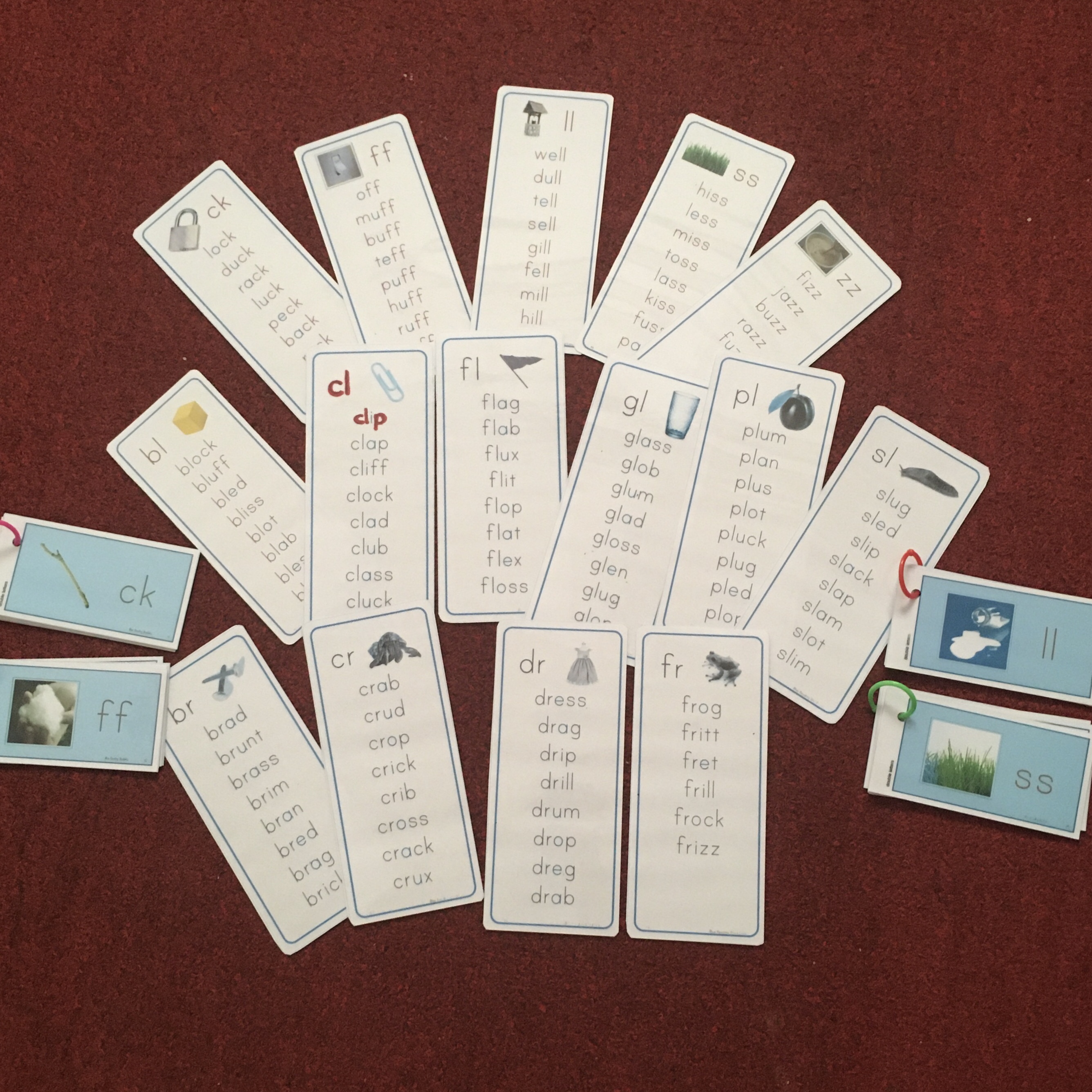
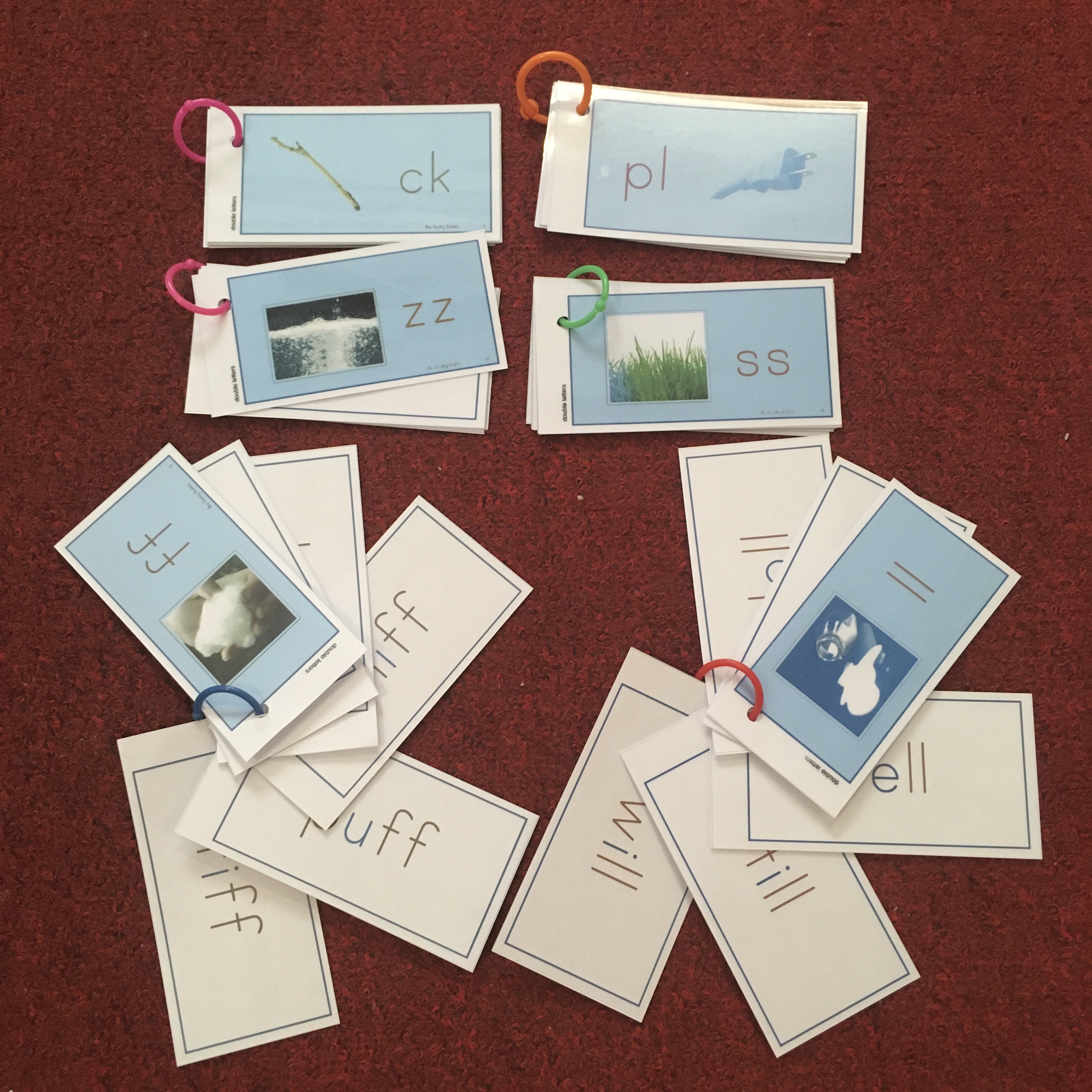
If you are following the montessori method, thehelpfulgarden is definitely a keepsake! A major resourceful blog which offers free printables for phonics reading using the montessori method.
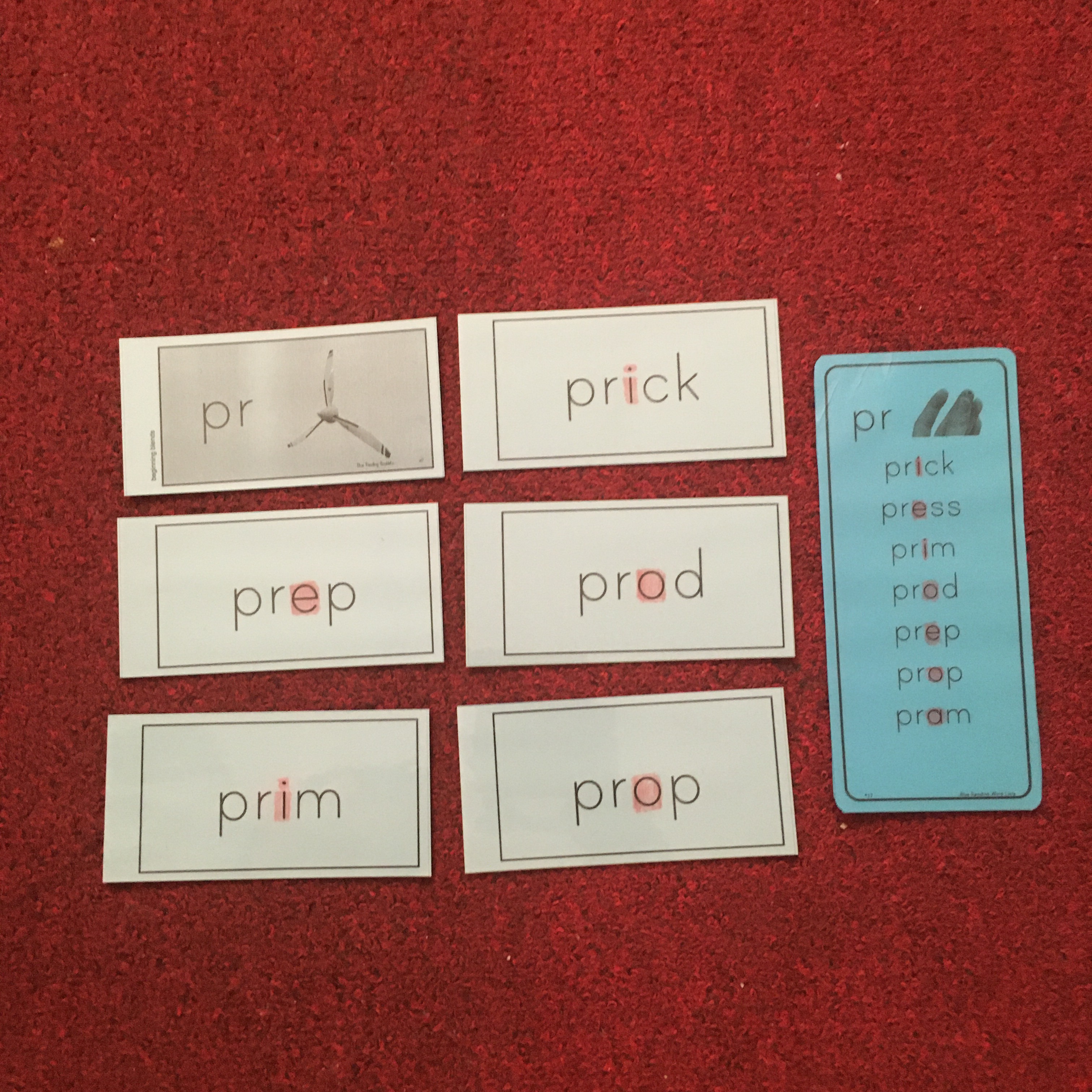
I printed the blue reading series for Marya and we are halfway through it. There are word booklets, word strips, picture to sentence matching cards and many more.
She also documented on her blog on how to teach using her resources.
So yes, her blog is definitely worth subscribed to!
So that is about it, some resources that we used for now. Do you have any other resources worth sharing? Feel free to comment on this post! I would love to hear from you!
From the website of (www.brillbaby.com) : Glenn Doman is a physical therapist and a pioneer in the field of child brain development.
In 1955 he founded the Institutes for the Achievement of Human Potential (IAHP), a non-profit organization providing teaching programs and books designed to improve and accelerate the mental and physical development of normal as well as brain-damaged children.
He wrote a few books on early learning. Some of his famous books :
How to teach your baby to read
How to teach your baby math
Basically, he believed that as parents, we have an important role to maximise our baby’s brain potential to learn about everything. Early learning is important because the first years of life lay the neurological foundation for intellectual growth into adolescence and adulthood.
So how does it work:
The Doman program covers everything from reading, math and encyclopedic knowledge to physical excellence. Lessons are presented at speed using flash cards to facilitate right-brain learning.
Flash cards are either physical or virtual and bear either pictures, words or numbers. These cards are shown to the children as young as possible at a very high speed.
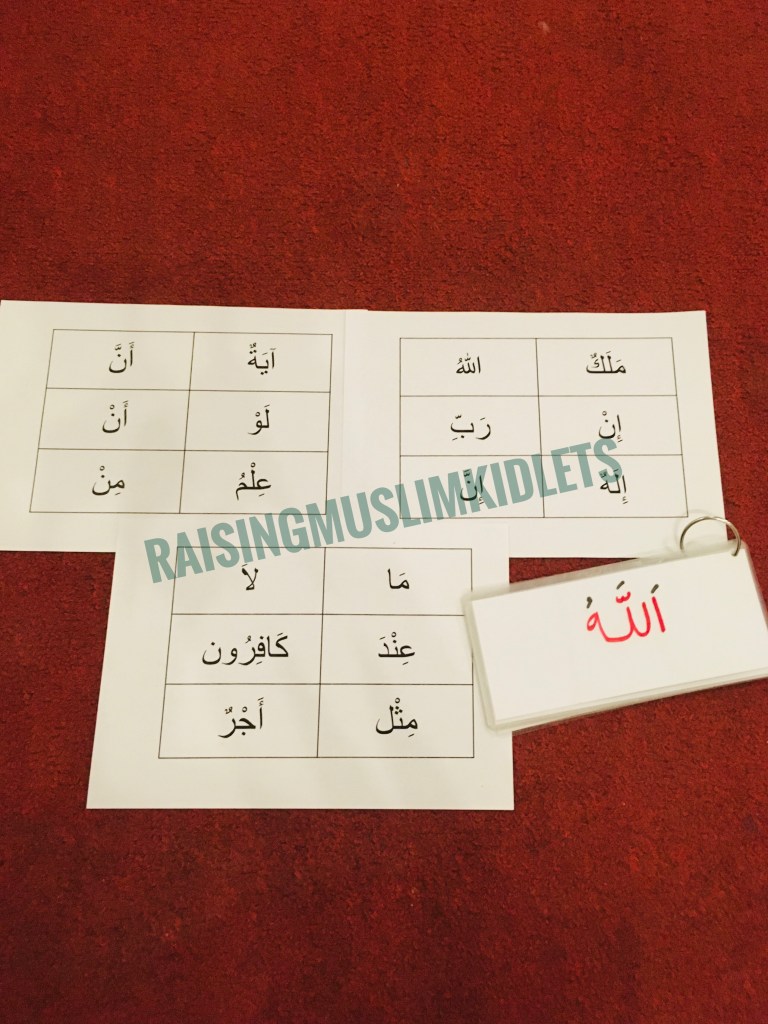
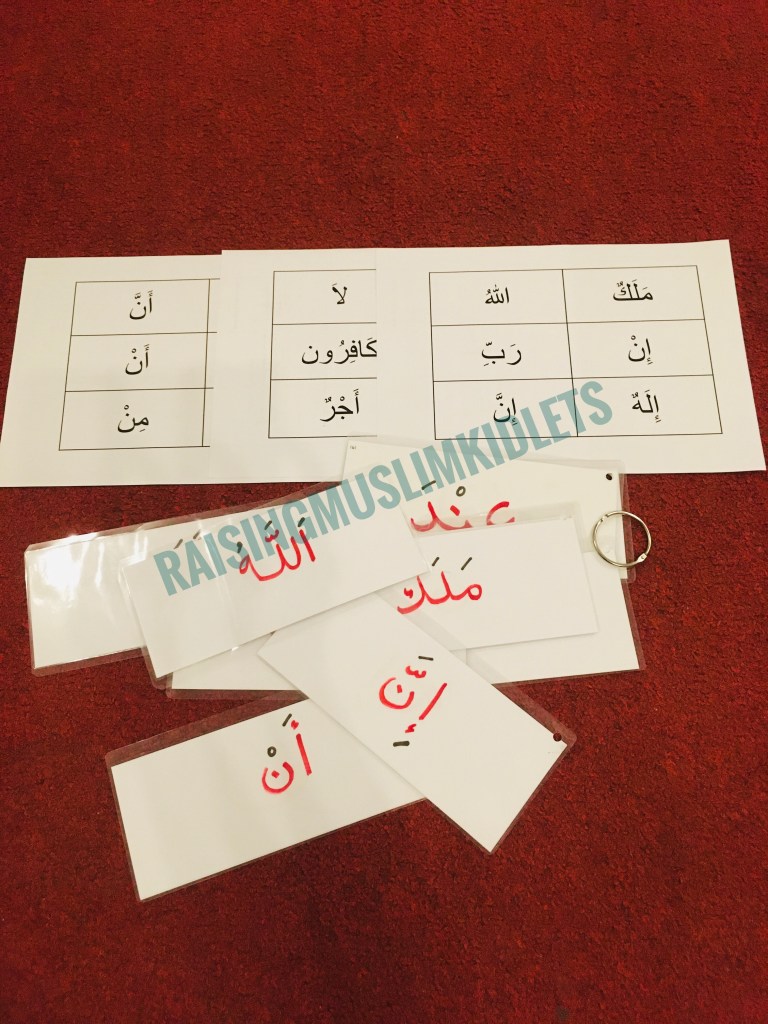
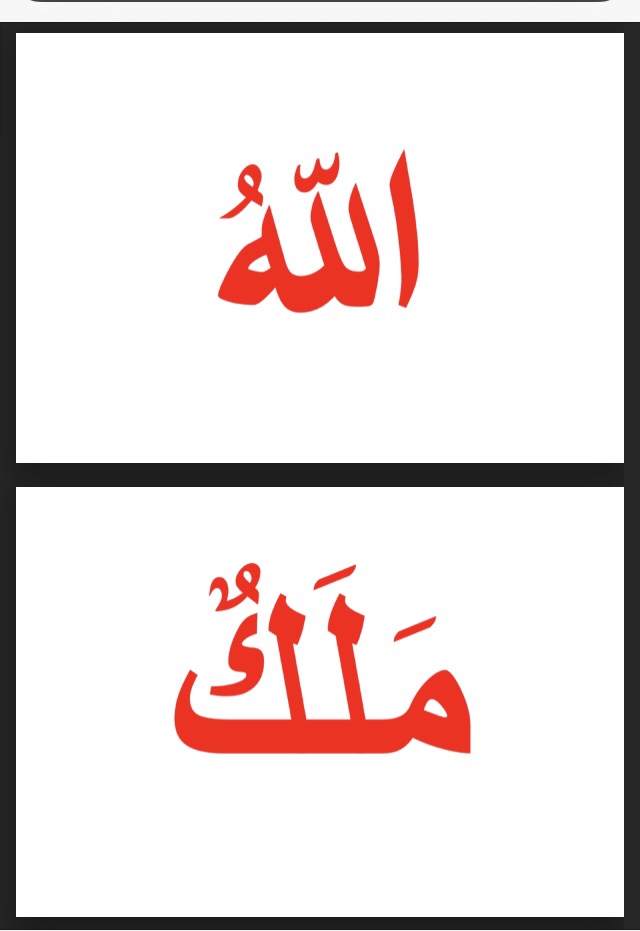
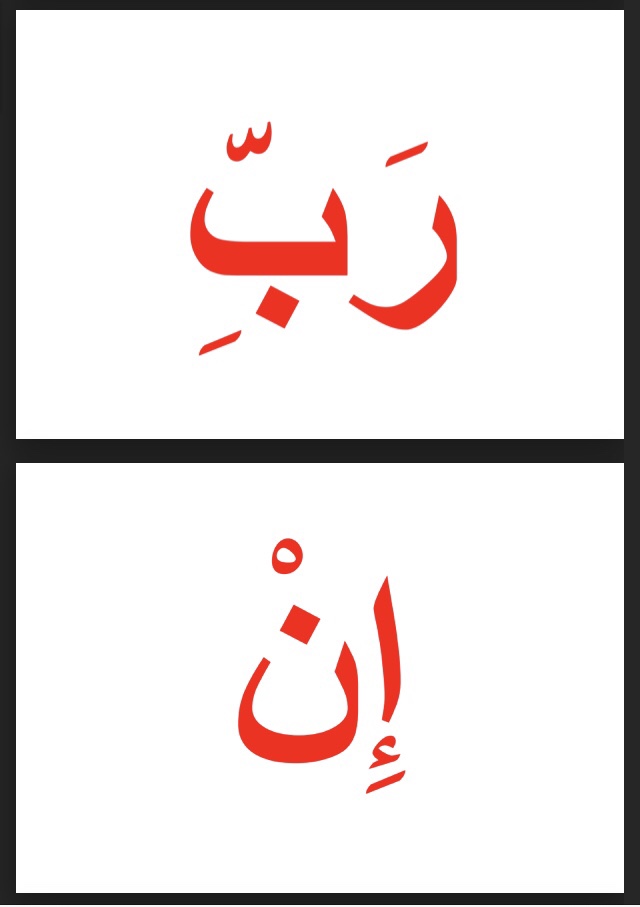
Physical flash cards are usually printed in large fonts in red. It can be presented to your child in a relaxed environment.
Each session does not last more than 10 minutes. The most important thing for me personally is to stop when your child starts to get distracted.
What does it mean with high frequency words?
High frequency words are the most commonly used words in texts(books etc). It can be read phonetically –unlike sight words(which does not follow the normal letter sounds).
High frequency words in the Holy Quran simply means words that are mentioned a lot of times in the Quran.
You can search for these words and its frequency from the internet.
How do I introduce the high frequency words in the Holy Quran to my daughters?
I collected almost 100 high frequency words in the Holy Quran and wrote it in a large red font. Everyday, during our learning session, I flashed to her ten words. So this means, I divided all words into 10 sections. Each section-which consists of 10 words- are read to her for 2 weeks. After that, we move on to a new section.
I started this method with our first born as early as her being 18 months. Does she respond to it? Admittedly, no.
Yes, she looks at it, but only after she can finally talked , she repeated after me. And now at the age of 4, Alhamdulillah She memorised most of the 100 high frequency words ( She just started reading arabic writing a few months back but not as fluent of course) Allahuma baarik.
So yes, it does take time (A very long time!), but hey who said tarbiyah is easy??
If you ask me, why do I focus on teaching these high frequency words in the Holy Quran to my daughters?
My answer would simply be, I want to cater to her Quranic memorisation journey and make it as smooth sailing as possible. I want my children to start memorising the Quran as early as possible even before they can read the Quran.
I want her to get familiarise with the words in the Quran so that when she comes across these specifics words, she remembers it instantly and does not need to spell it out.
I want her to remember the words, know the meanings , feel them and learn to love the beautiful words of Allah.
That is why I strongly believe that, together with learning to read the Quran, learning these high frequency words need to go simultaneously.
It takes a whole load of patience and consistency in teaching your child especially if you are using the Glenn Doman method. But once your child can read, learning feels such a breeze mashaALLah.
May Allah makes our offsprings the coolness of our eyes and make them love and live the words of Allah in their hearts and actions. Ameen
If you would like to see a sample of my high frequency words in the holy quran, here is the link:
“Allah will raise those who believed among you and those who were given knowledge, by degrees” (Quran, 58;11)
Undoubtedly, the verse above refers to Islamic knowledge, but we cannot deny the fact that throughout history, seeking knowledge and striving to learn have been the most vital aspect in Muslim world.
And one of the main ways to learn and educate oneself is through reading.
The first revelation (wahyu) sent down to prophet Muhammad PBUH by the angel Jibreel is that he commanded the prophet PBUH to READ.
If we look back to the Islamic history, there were once a time where Muslims were scientists, astronomers, mathematicians and many more. I always believed that in order for us to relive in that glorified period of time, we need to first and foremost, nurture and cultivate the love of learning in our children- because they can be the future Muslims scientists and explorers, discovering new things inshaAllah.
Children need to read , learn, gather information to discover the wonders of Allah’s universe.
Children need to read because it is the first step to comprehend Islam, our religion, to help others to learn the teaching of Quran & hadith.
Children need to read because it is the most natural thing ever!
So here are a few ways that we can cultivate the love of reading in our children
Parents- You are the role model!
We are raising the future ummah here parents! Do not expect your child to pick up a book and read by themselves if you are not doing the same thing. Remember, children learn best through observation.
They watch, look and observe because that is the first stage of education for them. And they take the example of those who they look up to. The first individuals –which are their parents. So if we were to spend most of our time with our phones, it would be difficult if we suddenly ask our children to read a book while we scroll down on our social medias.
You do not even have to call your child to read. Just pick up a physical book, sit on the couch and open up the pages, your child will obeserve and do the same.
Find a specific time to read. For example between maghrib and isya, dedicate that time to read Quran together. Your child might play around you. It is okay! Continue reading and let them listen to your recitation while they are playing. Sooner or later or when they are older, they will sit down and pick up a book and read too inshaAllah.
I always suggest parents to use physical books rather that E-books downloaded on your gadgets. Because, yes you are reading a book, but your child won’t know the difference do they? They would say “oh Ummi is just playing with her phone” So one way to let your child imitate you is you yourself pick any books,magazines,newspapers anything and read it.
2)Start them young.
There is no minimum age to start reading. The love of reading must be instilled as early as possible. I think the most powerful and heartful image is when a baby who had just learn to sit up, sit and leaf through a book. He might not understand anything yet. But to let your baby learn to hold a book, leaf the pages would go a long way for their reading journey.
For babies, choosing books with large print can help them recognize the words easily. Read to them slowly and clearly. Board books are a great way to start with high contrast images.
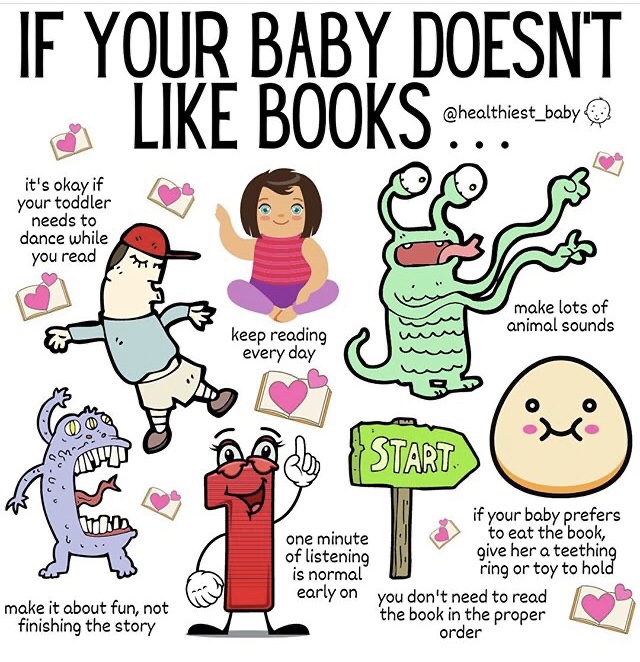
Don’t worry if the baby is not looking at the book, just make the experience a good one.
3) Read aloud session.
“One of the greatest gifts adults can give – to their offspring and to their society – is to read to children.” Carl Sagan
Reading aloud provides a number of opportunities and benefits for children of all ages. Among them:
a) Expands vocabulary
b) Strengthens cognition
c) Increases attention span
d) Promotes bonding between you and your child
e) Provides a safe way to identify strong emotions
Children loves to hear stories, one way is to read aloud to them. As you read, stop and ask about what is happening in the story, listen to their side. Discuss new words and the meanings.
Choosing a rhyming book that has repetition words is great because younger children can join in too.
Something that I do to my kids when they were a bit younger, I don’t usually read the book by text. I would use simple words and point at the pictures/images instead and prompt them with question. For example a page showing a farm. I can say “Look, that is a duck, duck waddles” “What sound does a duck make?” and I will wait for my daughter to answer. Make it fun and easy. An enjoyable moment between you and your child.
And yes, kids get easily distracted! It doesn’t matter if you read only 2-3 pages and your child loses interest. Try again next time. The key here is consistency!
I read somewhere that said young babies will only listen for a minute. But this time will stretch as the months go by. Do not expect to read a book from beginning to end or even in the right order. Your toddler may want you to start in the middle and jump around. Follow her lead.
4) Setting up an environment that cultivates the love of reading
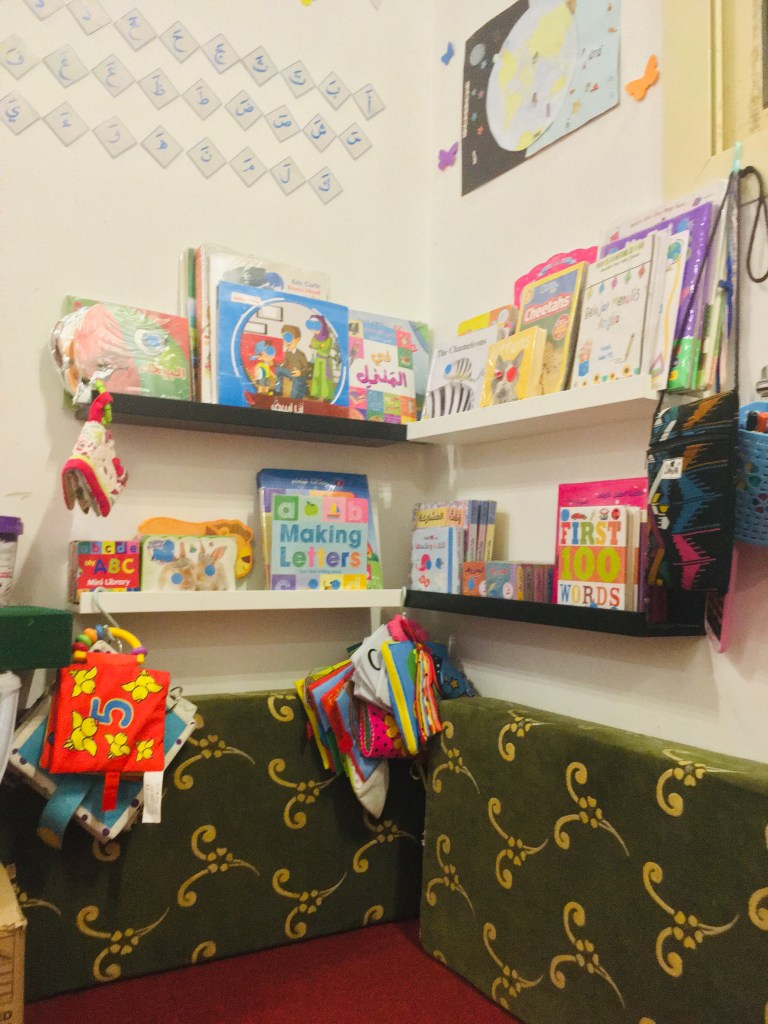
You do not need to buy so many books for your children or need a big space for them to read. Choose a comfortable spot or set a reading corner where you have low shelves to prop the books so it is easily accessible for them to choose.
Make a trip to the library as often as possible. There is nothing more exciting than having a new book in your arm.
Another way to make reading fun is to have a “reading tea time” You can make some tea for your older kids and read books together around the table or bake something to munch on while you read to them.
If you happen to have quite a large collection of books, do not put it all up on the shelves. This is to avoid boredom as the kids will feel like they have read all the books already or they might even be overwhelmed with the large quantity of books.
Instead do a “book rotation” Choose a few books that you want to put up on the shelf and keep the rest. Rotate and change the books after a month or two. Kids will feel excited to see “new” books on the shelf and they will get more interested in reading it. Plus, you save money from buying more new books!
A front facing book shelf is also a great idea so your kid can choose the books easily.
5) Provide reading resources and materials which resonates our Islamic method of Tarbiyah (upbringing)
I always choose what kind of books that enter our house. That means, no books that promotes shirk/disbelieves, fairy tales or sorcery, books that supports immorality or simply does not have any values.
So whenever we go to the library, even if I let my child to choose any books, before leaving, I will always do a second check to make sure the books are suitable in the eyes of Islam.
This is quite difficult to be honest living in a secular environment. But we really need to protect our children from any harm.
6) Make the book ‘alive’.
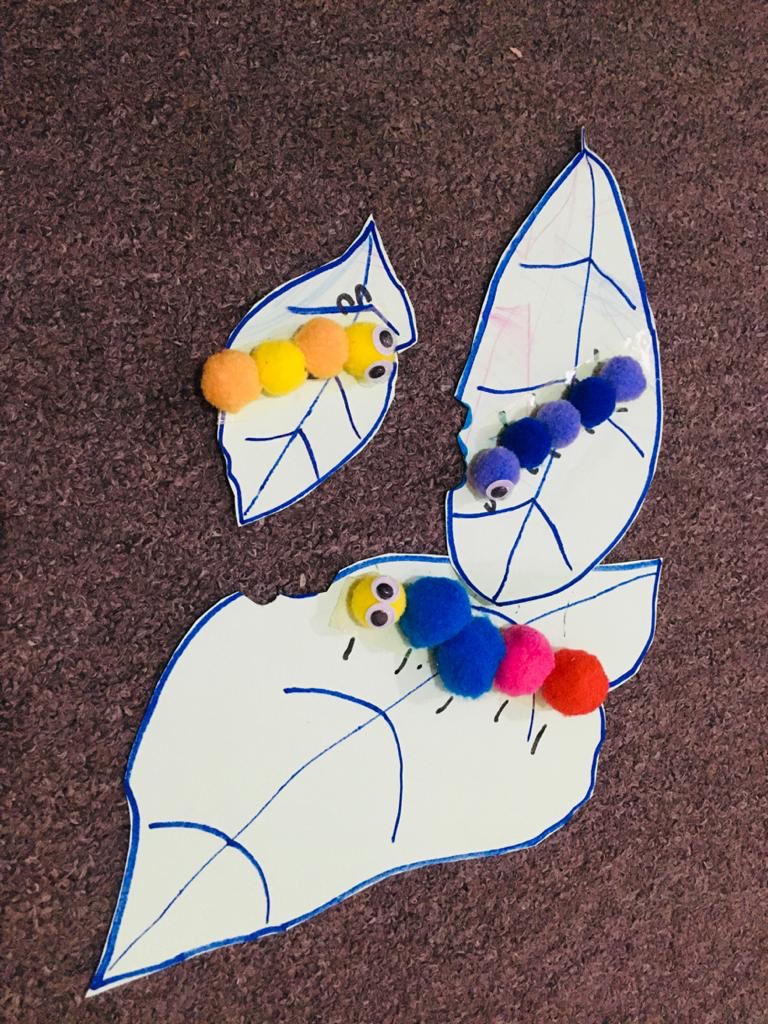
There are many ways to do this. You can role play the story from the book. So the kids can enjoy it more. Make a ‘bookish’ play for example, we read about the life cycle of a caterpillar. After we were done reading, we then make our own caterpillar using pompom balls and discuss the different parts of the caterpillar’s body. This way kids can retain the information better.
There are many times where we bring our books outdoor. For example if we read a book where the character goes to the beach, we bring the book and go to the beach too! We try to make reading as light and enjoyable as possible.
Reading is definitely a powerful tool to gain knowledge and enrich our children’s lives. We are the ummah of Iqra’! (Read) and may we uphold that responsibility strongly and lead our children together with us ameen!
In a Montessori philosophy, children are seen as individual beings-just like adults- in their own journey of growth and development. Everyday is a learning process for them and this learning is so natural and spontaneous. Thus the main role of an adult is to support this natural process and inspires to children to connect to this knowledge and skills. Adults need to captivate the children’s interest and motivate them to explore more. We don’t necessarily fill the children with our own knowledge. Teaching is not only about us the adults. We don’t interfere in the children’s knowledge. They will develop their skills. The only thing we need to do is to sit back, observe your child and let them learn. This might be difficult for us in the mainstream world where we are so used to being the ‘superior’ being over our children. We feel the need to follow the national curriculum, setting targets on what the child should achieve. And when the child is not ready, the stress looms in. we feel that our child is behind and is not developing like their normal peer.
So how do we do it?
1)Observe your child.
We need to build the capacity in ourself to observe our child. See what they are interested in, what attracts them. Have a deep-seated trust in your kids that they have an inner drive for learning and development. Throw out all the conception and expectation that your kid needs to achieve a certain target at a specific age. Every kid blooms at their own pace.
2) Keep the interest of learning alive.
Interest is the key factor to development. In a Montessori philosophy, a child is guided within themselves by an ‘inner teacher’. It urges the child to pay attention to a specific aspect of the environment.
There are many things in the world that that a child can learns from, but this inner drive within them is what guide them to something. There are no 2 children that have a same interest at the same time.
You might see that your child is so deep in thought looking at the clouds, there could be a million of questions running inside their mind. You can follow this interest and facilitate it, you can teach them the different type of cloud, who created it etc etc.
This interest comes and go. That is why we need to observe our child carefully. Try to find something, anything that captures their attention and learn with them.
Why do we fail to follow this interest? Because we have this wrong conception that children do not like to learn or that learning needs to be a sit-down moment in a classroom.
Every single child has the inner interest in learning and they are born with that.
Look at your new born baby. He learns how to drink milk from you, he learns how to kick and crawl and so on. If we allowed them to learn by themselves this skills from young, why do we interfere with their learning and development when they are older –setting targets and aims?
It is so common that we as parents are so eager to introduce specific things to our child, that they lost interest in something that they really loves. Worst case, they won’t lead us to their interest because we are not observing and pushing stuffs that we –parents- want them to do.
3) Preparation of the environment.
If your kid spends most of your time at home with you, make sure your house’s environment supports each child’s learning and development. This way they learn more freely and we are less stress. Imagine this situation, if we want to make our child be independent, we can try having low shelf for their books/toys so they can access to it easily without asking for help from us every single time.
Or have their towel rack at their height so they can hang their towel by themselves; have a mirror at their eye level so they can comb their hair by themselves.
Making the kitchen child-friendly is another way too. Your kid can do simple chores like spread butter on their toast, set the table for dinner and so on.
It is all about how we help to prepare the surrounding to make it more easy and accessible for the kid to learn and explore.
Islamic point of view:
Parents need to be spiritually prepared to raise their kids. We need loads of patience in helping our kids to grow.Children interact best with us if they gain respect and trust from us. So be there to support your children in their learning journey.
Raising kids is not an easy feat, ask Allah for guidance always. We need to ensure their interest is in the right direction and does not deviate from Islam. A child is born with an innate fitrah. If a child suddenly shows interest in taking stuffs that does not belong to them or they are start to learn bad words, that is not fitrah! That is not an interest that we should supports. It could be an external factor- the environment around them or what they take up from the TV or internet.
Thus it is our job to channel their interest in their right path and assist them in this exciting life-long journey of learning.
NOTE: I am not a Montessori certified teacher, this series is simply my insights and personal opinion and how I apply it to our children’s education method. Most of the points in this series are based on my reading and attending online Montessori courses.
Credit : For this particular post, most of the points are from Madam Nusaybah from Rumi Montessori (https://instagram.com/rumi_montessori?igshid=uq1btjbsj6f3 ) She oftens make IGLive at her instagram page and has a whole load of Montessori Parenting Series there. The way she presents her points is very concise and clear and it is so beneficial, I recommend everyone interested in Montessori to follow her instagram page. Barakallahu feeki Madam Nusaybah for developing Islamic Montessori school in Malaysia and making such a big big change in early childhood education in Malaysia.
Credits must also be given to Esraa Haidar (https://instagram.com/esraahaidar?igshid=197gc0k25fv7t ) a Montessori trained guide from Lebanon living in USA. She inspires me to teach Arabic to my kids and developing the love of it from an early start. She was invited by Maktabatee ( https://instagram.com/maktabatee?igshid=g9779b8dlsim in their Maktabatee Talks: Using the Montessori method to teach Arabic. Do follow them in Instagram for amazing ideas and resources. Jazakumullah khairan.
Arabic Language is neither my first language nor my husband’s. Fortunately however, we began learning Arabic Language when we were both in elementary level. But it was just that. No one spoke with us in Arabic at home. Even in classroom, most of the time the Arabic teacher used either Malay or English as a medium and Arabic vocabulary is peppered somewhere along the lines. It was just limited between the walls of the classroom. We studied simply for the yearly examination. So when we further our studies in the Middle East, it was then the love for Arabic Language finally blossomed.
Hence, when we had our first born, we agreed to cultivate Arabic language into our children’s lives.
Raising bilingual kids the Montessori way.
Children have an absorbent mind. Which refers to the mind’s capacity to take in information and sensations from the world that surrounds it.
A baby is born without language, and with few skills other than their survival instinct. From birth to three years they use their senses (hands, eyes, ears, nose, and tongue) to soak in everything that surrounds them. The child does this naturally, and without thought or choice. Maria Montessori referred to this period as the ‘unconscious creation’. Hence, how they can involuntarily learn to kick their legs, crawl etc; they can also absorb languages during this time.
Start as early as possible. It is this crucial time that we introduced any language to our children’s everyday lives. Never ever baby talk with them! It can cause detrimental development in the language part. Don’t be scared to use big words. Yes, they are sill young to respond. But language is about expression and communication.
What we can do is, one parent can choose one specific language and the other parent with another language.
The child usually associates one language with each parent, and will communicate with each of them in their corresponding languages. It is not recommended that a parent attempt to teach their child a primary language they are not familiar with, without exposing them to any other. This can result in confusion and language delay in the child.
In our case, my husband focus on conversing in Arabic language with our children while I communicate with them in English. Try not to mix between these two. The key here is Consistency. Be consistent in your chosen language; it might cause a lot of confusion in the child if you mix it up.
Conversing in more than one language would not cause speech delay if the parents are consistent in their own corresponding language.
Imagine this scenario, If I have always been using English with my 1 year old daughter and one day I speak to her “ Marya do you want halib “? (halib= milk in Arabic) while holding a cup of fresh milk. The child might or might not understand, she might think “Hmm, is Ummi offering me milk (Since she can see the cup in my hand) or something else”? What does halib means”? So there is where the confusion lies.
It is then our responsible to be consistent every day. Personally, this is quite a struggle for us. We tend to slip off and use the wrong language. But with persistent and dua’ everyday to Allah, everything will go smoothly.
Experts also suggest using sign language to expand our young children’s vocabulary. Hand gesture with repeated and consistent word can go a long way to develop the child’s language.
Introducing Arabic in a Montessori way.
But first, why Arabic?
For one simple reason, to learn the language ofthe Quran immensely.
There are 3 basic Montessori principle in teaching children- Experience, explore and expression.
So what we did was, we introduce Arabic language to our child as early as possible. We create a beautiful relationship between the child and the language- no pressure, no pushing but slowly articulating every sounds with love . Let them experience the love of Arabic Language themselves. Speak/Sing/Talk/Read to your children in your corresponding language.
Next let them explore and express their feelings with Arabic language using materials and resources you have around the house.
Starter: Language box.
We have small items and miniatures in a basket and we introduce it to our child. For example a small lion miniature toy; we then present it to our child and say “Marya, haza asadun” (this is a lion).
What we need to do is spark the interest in our child. Simplify the process by presenting few pieces at one time so that they can be familiar with it. Break down the process into smaller pieces so that your child would not get overwhelmed.
Note: You do not need to go out and buy all the materials. Find alternatives around your house; look at the resources you have, be aware of the Montessori principles and just apply it! Start with whatever you have.
Next: Introduction to hijaiyah letters.
Sandpaper letters.
In Montessori, sandpaper letters are always used where the child would use their fingers to trace and ‘feel’ the letters.
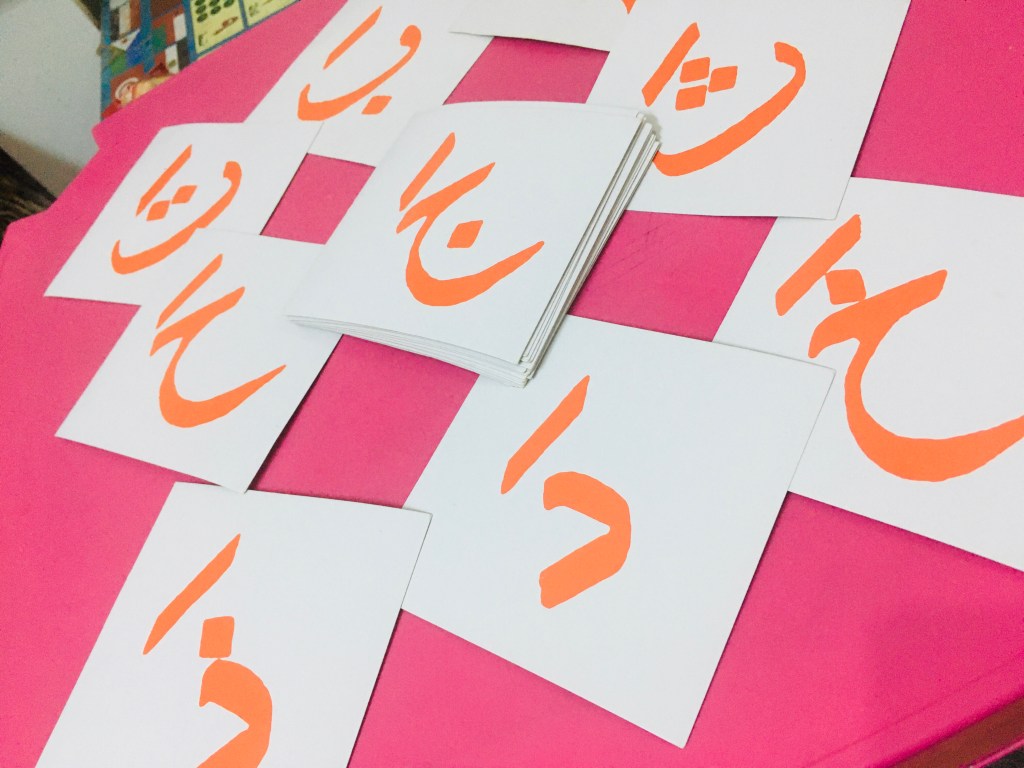
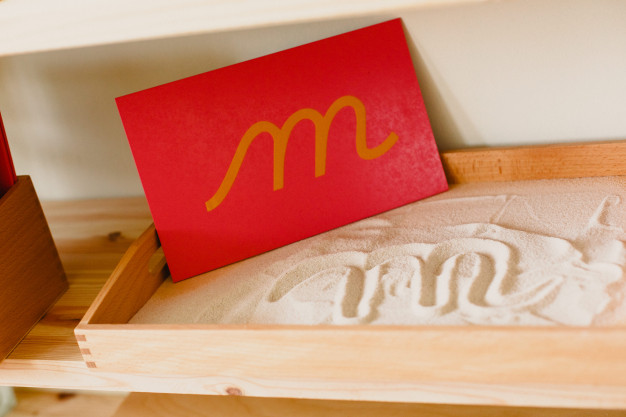
However since we don’t have that, we used a felt flashcard instead. We then show our daughter the letter one by one and let her touch the word and sound the word to her.
2. Sensory writing tray.
Next we introduced the Montessori sensory writing tray. This lesson involves sight, touch and sound. Children love to touch and feel different textures, and the fingertip is the most sensitive part of the body. Each fingertip has thousands of touch receptors. When the receptors are stimulated by touch, neurons fire signals via nerves to the spinal cord, brain stem, thalamus, and finally the cerebral cortex for processing.
We presented our child with a tray filled with sand, she then proceed to follow the shape of the letter by “writing” on the sand.
And at the same time, we paste around the houses small hijaiyah letters at her height so she can always see it. We also use flashcards.
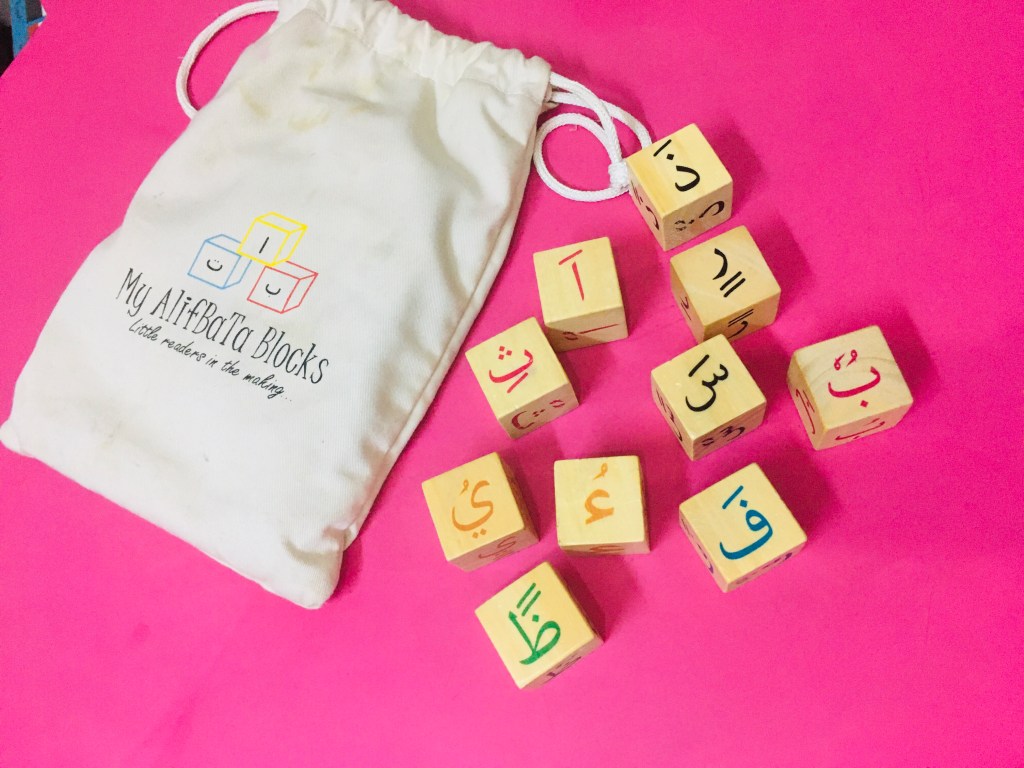
We also use manipulatives such as this amazing hijaiyyah wooden blocks
3. Moveable alphabet letters.
What is moveable alphabet letters?
A moveable alphabet is a tool used in a Montessori learning environment to teach reading, spelling, and writing. It is a wooden box containing 26 wooden letters. Vowels are inblue and consonants are in red.
Thus, using the same principle, moveable hijaiyyah letters are produced too. See pictures from google:
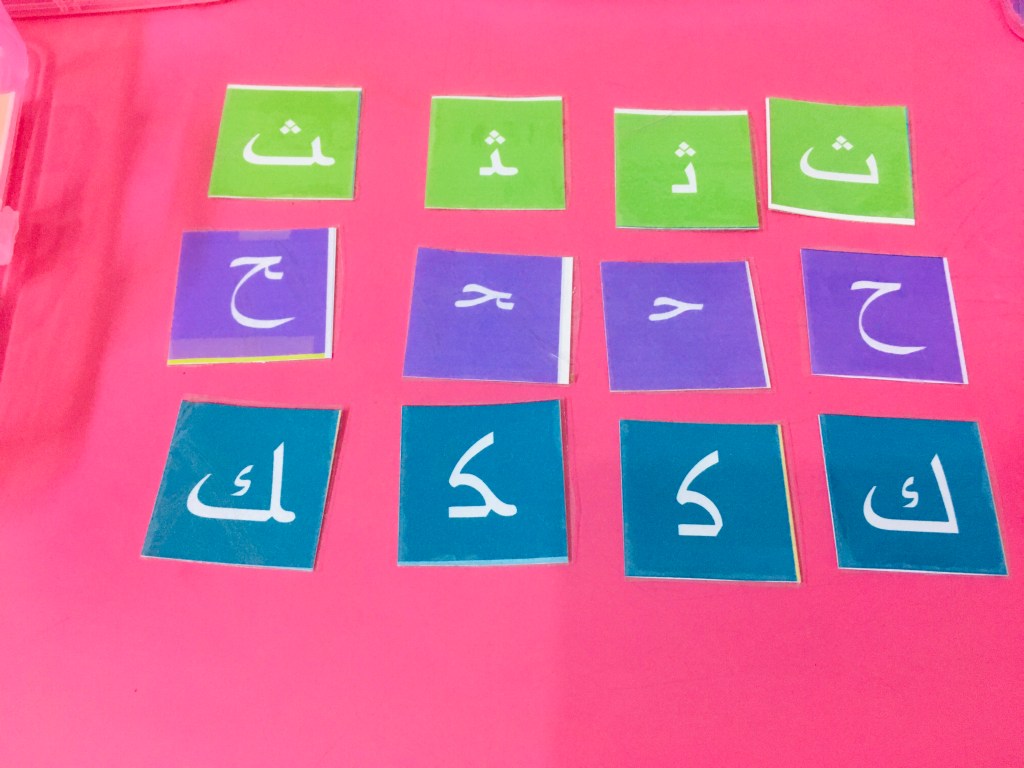
A cheaper version of the wooden moveable hijaiyyah letters, this printable is amazing because it not only offers separated hijayyah letters, it also comes in different positions of the letters – initial, middle and end position.
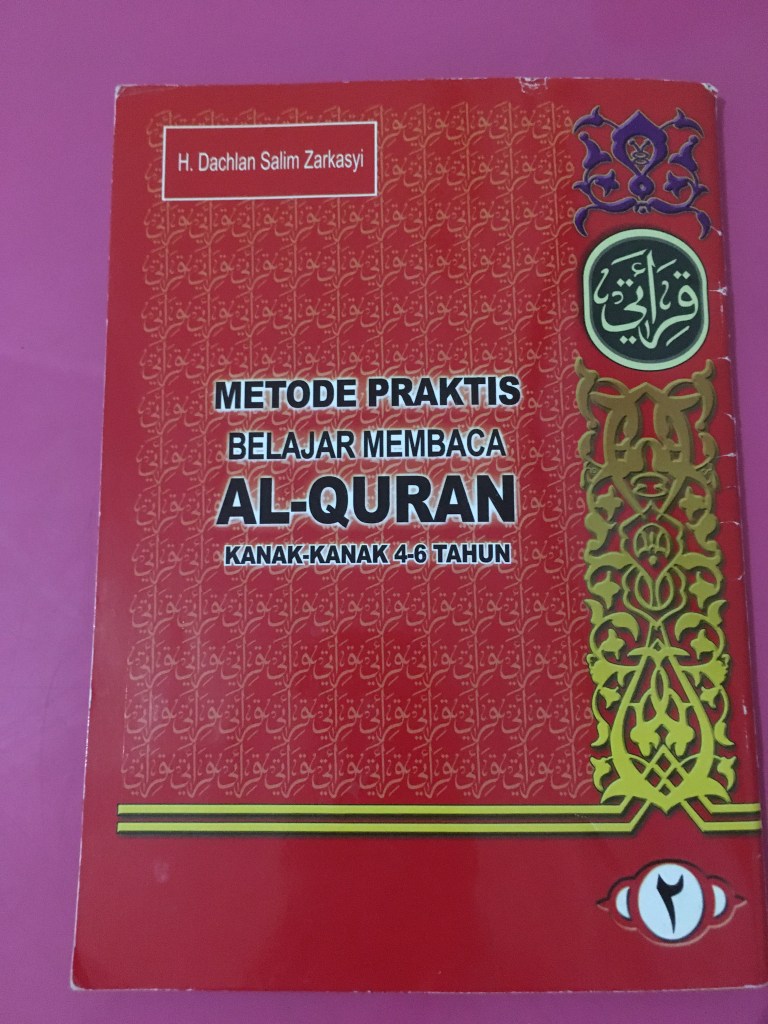
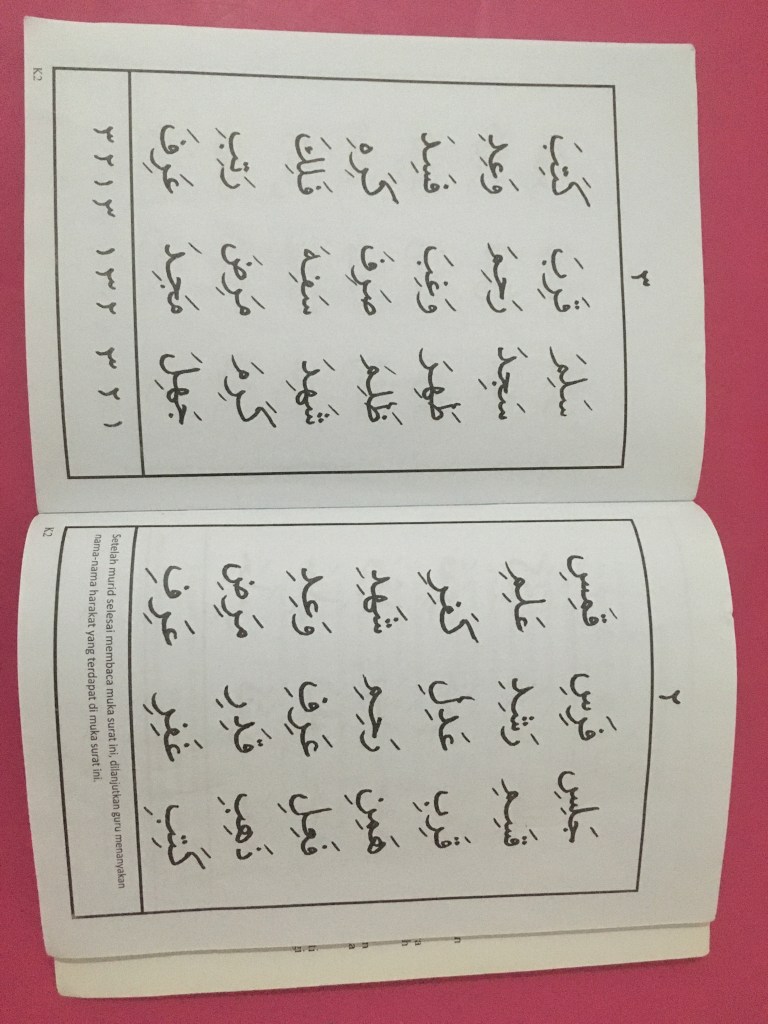
After our daughter has familiarised herself with all the letters, we begin reading Qiraati book with her. This Qiraati series has 6 levels beginning from beginners all the way to advanced levels. The beginners level start with 3 separated hijaiyyah letter, then it moved to combining those letter with fathah as its tashkeel. And so on so forth.
Apart from that, we make some practice papers and activities to spark more interest in her and just to keep the learning more fun.
Conclusion: As much as our daughter is learning everyday with all these materials, unravelling the beauty of Arabic language, I believed this learning journey is equally shared with me and my husband. Every single day, we learn something new, Alhamdulillah and every single day we affirm our intention of learning Arabic language together as a family just for the sake of attaining Allah’s blessings and His ridha.
In the next part of this series, I hope to share on how we teach Al-Quran to our child , inshaAllah.
We were introduced with Montessori teaching by my aunt when I told her that we wanted to start teaching my then 2 years old firstborn to read. We were gifted by her the Montessori pink series language. I researched quite a lot , from reading books, searching from the internet, video binging at Youtube and enrolled myself in a few short courses. And I still feel overwhelmed with all the information. In a good way of course. It resonates well with out parenting method and educating our children. I am not a Montessori qualified teacher. I am just a very passionate home-maker trying to incorporate Montessori in our life . I am still learning but I wish to share with you the readers what Montessori is all about and how you can apply it too.
Introduction: The Montessori method is named after its founder Dr Maria Montessori an Italian physician. She first developed her teaching in Rome when she was researching and working with special needs children. From there she opened her own school Casa Dei Bambini in 1906. And her method has been used ever since around the world. Maria Montessori believed that children learned best by “doing” , by being active in their hands-on learning activities. Dr Montessori emphasised a lot in sensorial and developing important life skills. She created her own resources and materials to help children learn. Most of the designs are adapted to ensure children can developed independency and learning at a young age. Dr Montessori divided the children’s learning development into four different stages called “planes of development”: Ages 0-6 7-12 12-18 18-24 And sensitive periods. Sensitive period is when children acquired natural inclination or interest towards learning a new skills.
In this series I am going to focus solely on 0-6 planes of development. And there are 4 areas in a Montessori 3-6 class:
Sensorial, practical skills, language and mathematics.
Some misconception: Montessori is all play.
Well, Dr Montessori did say that “play is the work of a child”. From an outsider’s view, it does seems like kids in Montessori environment spend most of their learning time “playing”. But what Dr Montessori meant is that learning is incorporated in every “play”.
Each materials have their own purpose. It reveals the concepts to the child through hands-on, uninterrupted exploration, after an introductory lesson from the Montessori teacher. For example, the Pink Tower contains multiple concepts, including height, volume and sequence, squares of numbers and cubes of numbers, among other abstractions. There are dozens of pieces of Montessori- designed materials that help the child in educating the senses of hearing, seeing, smelling, touching, and tasting. Other Montessori materials aid the child in acquiring skills in maths, reading, writing, geography and many more.
Montessori is expensive.
Sadly, yes most materials are expensive because Dr. Montessori emphasized beauty and high quality of materials. The cost of materials for the classroom as well as specific furniture for the classroom contributes greatly to the cost of Montessori. Materials are not manufactured in a factory (or shouldn’t be) and are made with enormous quality of care. Montessori avoid using plastic hence often defaulting to wood so the material is more long-lasting. But personally for me, i DIY-ed most of the materials – suiting my budget and as long as the purpose of the materials used for learning is achieved, i am satisfied Alhamdulillah. You do not need to have a complete Montessori curriculum or all the Montessori materials in order to apply Montessori principles.
Montessori gives too much freedom that the classroom look unstructured with kids doing their own work. “Freedom within Limits” – The concept of allowing freedom within limits is a crucial idea in Montessori philosophy. To the casual observer, or new teacher, freedom may appear to allow a child to do anything he or she would like. Freedom is limited by the level of ability and responsibility a child has. The child is given the freedom to move freely about the classroom. This freedom may be taken away, if the child uses the freedom to go around hitting other children, disrupting other’s work, damaging materials, or otherwise not choosing a purposeful activity that will lead to a normalizing event. The child is free to act within the limits of purposeful activity.
Conclusion:
There are many misconceptions around the Montessori method. You might want to research and look around and see if it might appeals you.
Whatever method you wish to apply on your children, always try to equip yourself with enough information. Research and research and see what is the most suitable way to apply it. In the next part of this series i will be sharing on how I teach Arabic language using the Montessori method inshaAllah
3. Providing a positive environment with attached parenting
Have you had days when you feel like your child is plainly unresponsive, cranky or having a bad day? Recently my husband and I sat down and discussed about our children and we realised that our children’s mood for the day is majorly affected by how we-the parents- start the day. I noticed that if I were rushing around on that day trying to tick off the household chores or even feeling downright lazy and not giving enough attention to the children, the children would definitely act up, messing up their toys for example, not wanting to share etc. That is their way to grab our attention. It could be that they are still young and don’t know how to express their feelings but they definitely want us to turn and look at them. But as parents sometimes we tend to forget that children are young so when they started to misbehave, we begin scolding them or asking them things beyond their capacity. That would definitely not help shape the kids’ upbringing.
An important point from my husband, he shared that if the day begins with him praying fajr at the masjid, spending some time reading the Quran or simply reading the morning dhikr, he noticed that the whole house’s mood is lifted. Like the kids are manageable, I’m less cranky myself (oops!) and the day goes by easily with the help from Allah. Subhanallah!
A positive home environment personally for us is where we shower the kids with love, care and connect with them individually –especially when they are young- because when our child feels safe and loved, he will listen and cooperate with us better in terms of learning and behavior.
If we want to raise our children to be among the pious servants with strong aqeedah, obviously the first step starts at home. A home where the remembrance of Allah is echoed endlessly through actions and words. A home where the kids feel safe to learn from their role model. A home where kids are raised to be Muslims with strong positive characters.
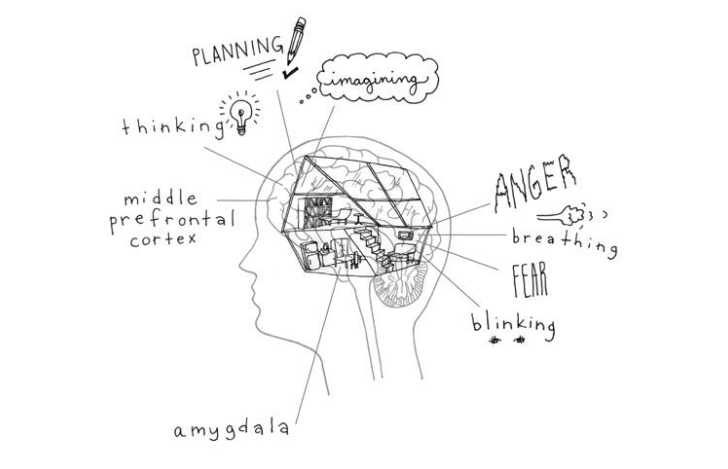
Dr Dan Siegel, the author of “The whole brain child” book mentioned that the brain is like a house with both upstairs and downstairs. And a child can only live downstairs- filled with emotions. Downstairs is responsible for basic functions like breathing and blinking, for innate reactions like fight and flight and for strong emotions like anger and fear. Our upstairs brain is completely different. It is more evolved and can give you a fuller perspective on your world. It is filled with decision making, empathy, concentration etc. Because the “upstairs” is still under renovation, kids need their parent’s help. Our job is to teach them and help them build up the “upstairs brain”
How?
By being involved in their life. That is what an attached parenting means. A ‘present’ parent in the children’s lives who helps them by being loving, understanding, patient and empathetic figure and lead the children to the right path (siraatul mustaqeem).
4. Education
A very important aspect in raising the children with strong creed is through education. Every single parent in this world wants to provide only the best education for their children. But for muslims, we need to prioritise what type of knowledge we need to provide first.
Abu Ameena Alias said in his website:
“We ought to pursue spiritual knowledge, especially what every Muslim needs to know in order to practice the religion correctly, but we also need scientific knowledge that can benefit our community and humanity at large. Classical scholars, such as Al-Ghazali, designated the natural sciences, particularly medicine, to be a collective obligation (fard al-kifayya) upon the Muslim community”
Introduce the Quran and Sunnah to your children when they are still young. Read Quran to them, let them listen and memorise to your recitation. Tell them the stories of the prophets. Teach them about their Lord.
The love of learning should be cultivated as early as possible. Yes, it is important to learn how to read, how to decode the sounds of every letters, learn about mathematics and sciences.
But isn’t beautiful to hear your 4 year old recite the whole of juz Amma from the Quran and that he knows about his Lord and how to be a good servant?
An important point to note: It is the duty of the parents to provide materials and resources that follow the real manhaj-that is, ensuring its authenticity (from the Quran and Sunnah). Get your resources from our scholars. They have written a whole loads of authentic information.
I strongly believe that parents should learn and equip themselves with enough resources from the Salafs so we will be better prepared to simplify the information to our children according to their level of understanding
5. Remove from our house things that are associated with shirk and kufr
Raising kids with strong creed means removing all things that can influence their upbringing. For example no music or any from of negative entertainment that can caused them to have bad influence. Choosing story books are important too. Don’t let fairy tales books, witchcraft and all that sort to enter your house. It might be harmless but it certainly have an effect on your children’s aqeedah. Imagine you trying to teach about the greatness of Allah and how we need to seek help from Him solely, but at the same time, your kid is reading a book about a fairy with magic wand that can grant your wishes anytime??
So choose wisely what goes into your house.
6. Include Aqeedah in your daily learning journey
Secular education always stresses on hands-on practical daily activities for young kids. Kids learn better this way as they can see how it is integrated in their lives. So I believe that learning Aqeedah should be like that too. Engaging and fun.
For example if you go for nature walks with your children, collecting dried leaves so you can do some painting at home. Why not talk to your child too during those walks? Tell him Allah is Al-Musawwir. Teach him the beautiful names of Allah. Allah has given us this beautiful nature and it is our responsibility to preserve it. Always find the opportunity to apply Aqeedah teaching in our children’s daily learning.
Conclusion
Raising our kids in this era has their own challenges, what’s more to raise a child with strong aqeedah. Both the father and mother need to work hand in hand to achieve it. Educate ourselves first and foremost, pray sincerely to Allah, be strong spiritually and may Allah guide us in every footsteps we take to gain His redha (pleasure) and blessings.
I have a confession. I absolutely love random stuffs. Bottled caps, cereal boxes, paper towel rolls, eggs carton and the list goes on. At the back of my mind, everytime I want to throw it away, the plan always backfired!. “Oooh my daughter would love this” “another sensory play for the kids” “this can be another DIY or art and crafts project” I can think of various reasons. My husband thinks I am a hoarder. Sometimes i am worried too! But to be honest, I try to keep everything in just one big container. So i will limit my recycled material collections to just that.
Exploring and creating with recycled materials do have its own benefits. Recycled, or “found,” materials represent an abundant, sustainable and affordable resource for young children’s creative self-expression. It is a great reseources to generate creative thinking and problem solving.
With this open ended materials,children’s physical development is enhanced when they explore found materials. They not only build their eye-hand coordination and fine motor skills but also their ability to discern sensory input including sight, touch and hearing as they notice how found materials look, feel and sound. Children also gain important knowledge about tools and materials as they learn techniques and practice skills like joining, adhering, cutting, stapling, taping and gluing.
So for today, I am sharing an idea on what you can do with bottled caps. This idea is suitable for toddler age 2 years and above
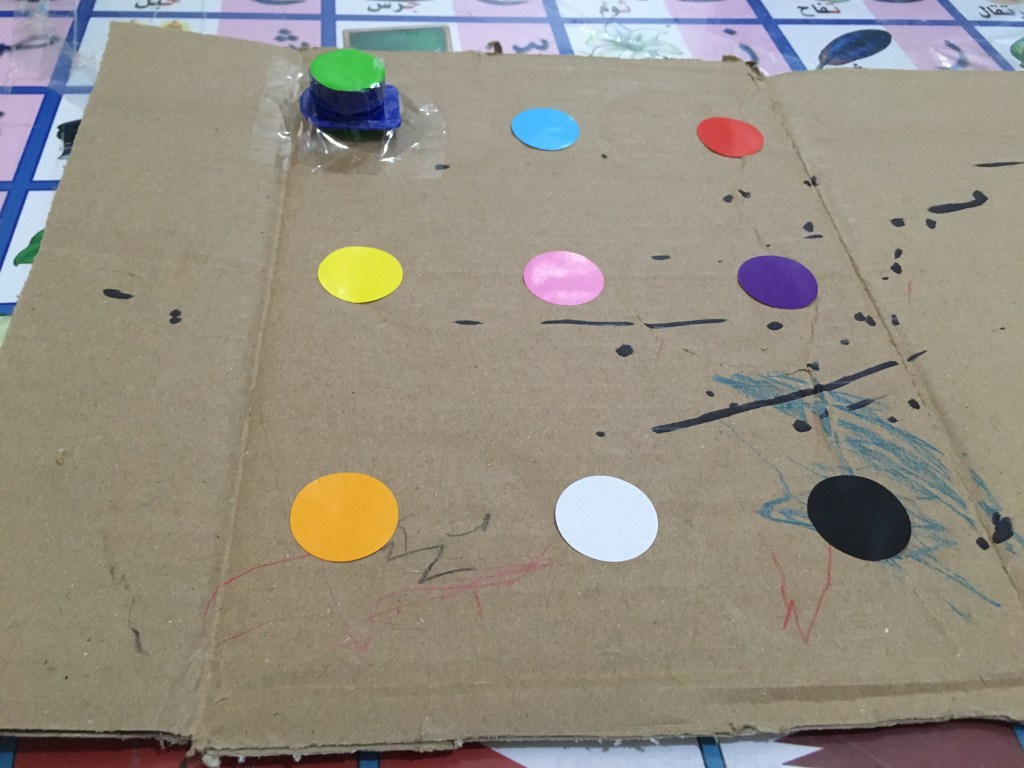
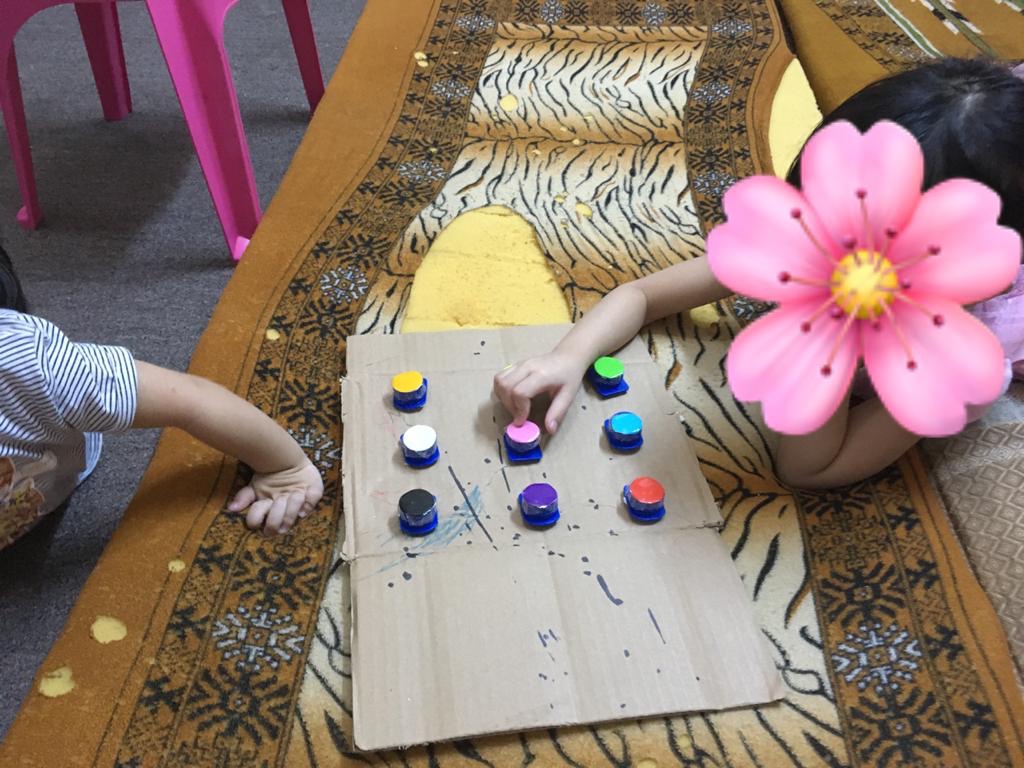
Matching colours using bottled caps
What you need:
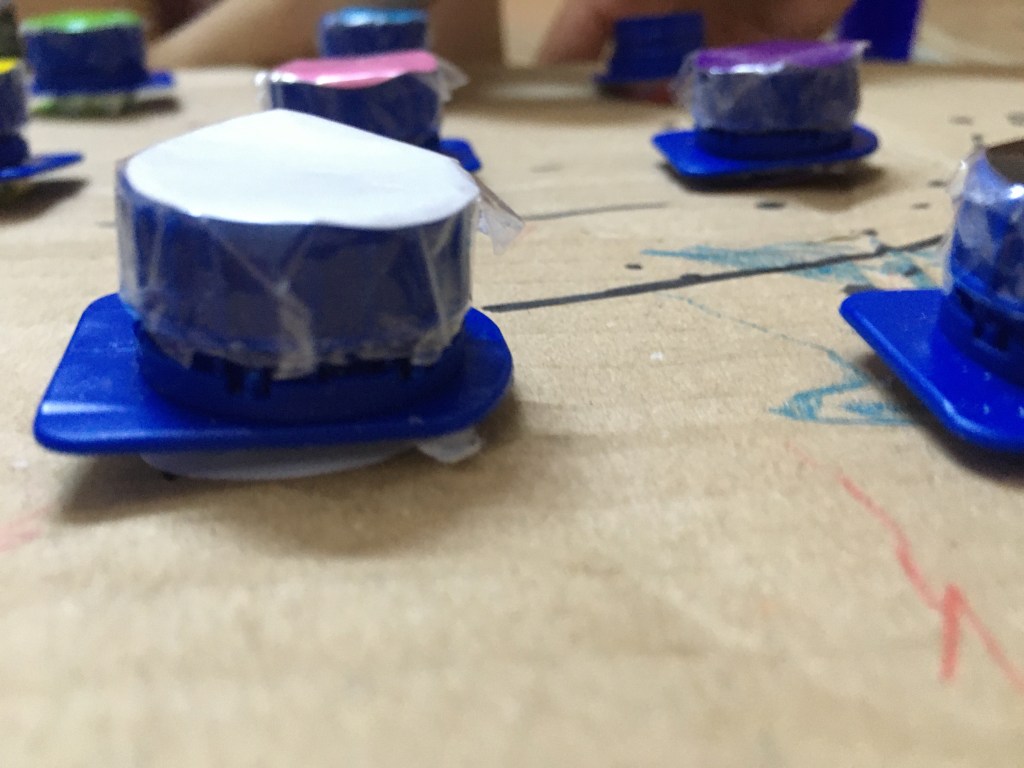
-colourful dot stickers. (If you don’t have it, you can just colour or paint your bottled caps)
-bottled caps
-cardboard or cardstock
-penknife/scissor
-strong adhesive glue or tape
Instructions:
Choose what colours you want to introduce to your child.
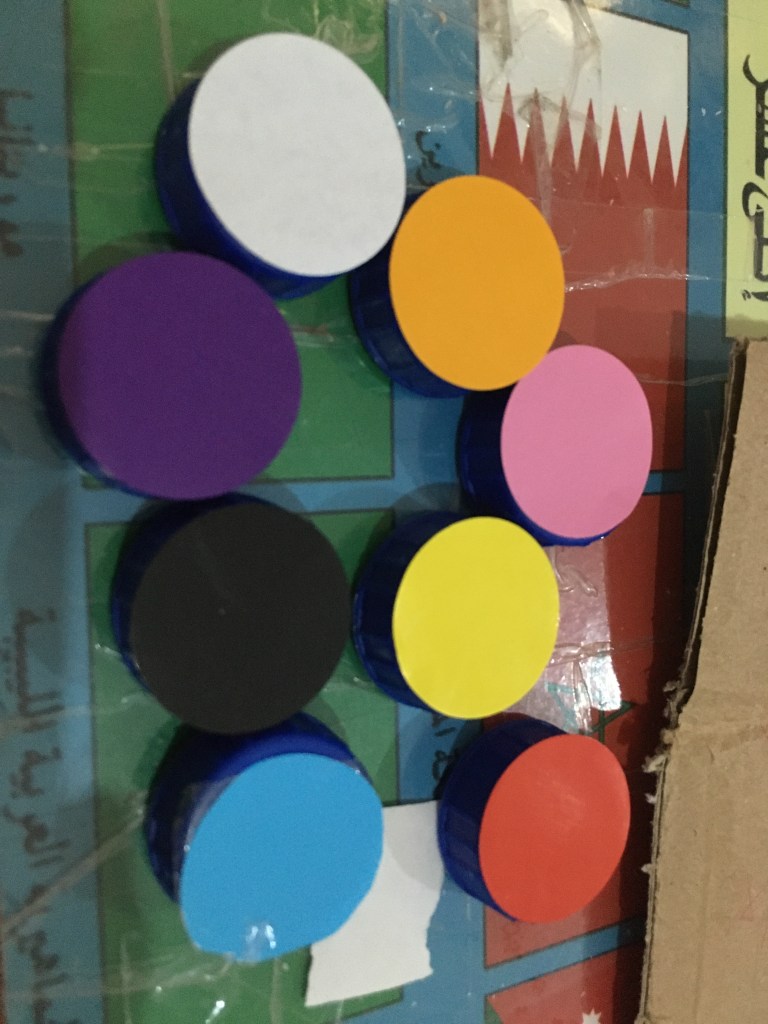
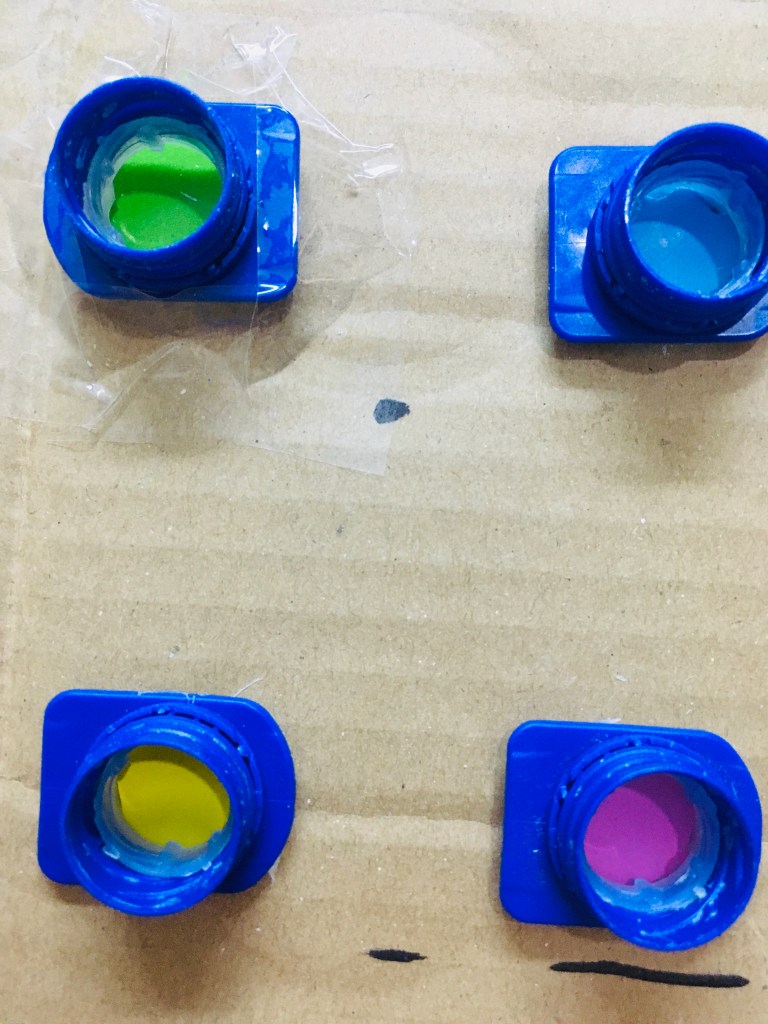
I chose 9 basic colours. For every colours, I took 2 each. One to be sticked on the bottled caps and the other one on the cardboard.
Once you sticked your desired coloured stickers on the board, glue the lid on top of the stickers.
Important: you need to use strong glue for this.
The first time I made this activity, I only used normal tape and it doesn’t work because everytime my daughter try to screw the bottled cap onto the lid, the lid came off! So she gets frustrated and refused to continue playing. So yeah, use a strong hot glue to make sure the lid is intact.
Invite your child to match the coloured bottled caps with the same colour stickers underneath the lids.
Tips:
-Expand your child’s vocabulary by talking to her while playing. Example : “Where is the red colour, show me the red one!” “Red in arabic is ahmar, can you find ahmar?” Or “What is your favourite colour” etc
-“I spy” game. You can invite your child to play this game, for example you can say “I spy with my little eye a small blue bottled cap” and ask her to match it with the sticker on the board. Next, ask her to find other blue coloured things around the room.
-If your child is not ready for colours matching yet due to his age, allow him to just screw on and off the bottled caps. And at the same time, you can just say to him “Oooh is that green you are holding? Oh amazing, green is my favourite colour, trees are green” Even if he seems unresponsive, it is okay, the child’s mind is like a sponge absorbing even if it is subsconciously.
And remember kids learn best when they are having fun and in a relaxed environment. So have fun doing this activity with your kidlets!
Do you have any recycled material projects that you have done before? I would love to hear from you!
Early 2020 saw how the world was inflicted by the Covid-19 pandemic. Every countries started to impose lockdown, major activities such as workforce and schools were forced to closed down, world economies were badly affected. Daily activities that were deemed normal before were halted. On a personal level, our normal outdoor outings were cancelled, no more going to the playground, play dates are a big no-no. We tried to explain the situation to our 4 year old- what is Covid all about , how the virus spread and what are the things we should do. Alhamdulillah she took it well albeit the fact that we used to go out almost everyday. We took this difficult time as an opportunity to instil some important aqeedah lessons to our daughter.
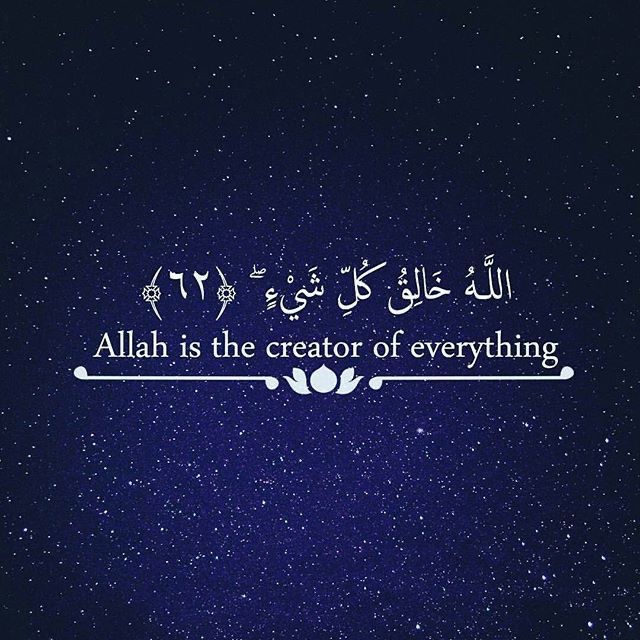
Allah created everything and He knows everything.
We start of by sharing with our kids that Allah is Al-Khaliq, The Creator. Every single amazing creations are by Him- from the magnificent mountain to the smallest tiniest virus/germs that you can’t see with your naked eyes.
And He is Al-Aleem, The All-Knowing. He knows every single thing that happen. He knows how the leaf falls from the tree, He knows how the virus spread, and by His will too , the virus will stop spreading inshaAllah.
2) Seeking protection from Allah.
We introduced this beautiful hadis to our child :
Ibn Abbas reported: I was riding behind the Messenger of Allah, peace and blessings be upon him, when he said to me, “Young man, I will teach you some words. Be mindful of Allah and he will protect you. Be mindful of Allah and you will find him before you. If you ask, ask from Allah. If you seek help, seek help from Allah. Know that if the nations gathered together to benefit you, they will not benefit you unless Allah has decreed it for you. And if the nations gathered together to harm you, they will not harm you unless Allah has decreed it for you. The pens have been lifted and the pages have dried.”
It can be found in the 40 Hadis of Nawawi –hadis number 19. We told her that as much as we try to protect ourselves from the virus by doing self-distancing, practicing personal hygienes etc, the most utmost protection comes from Allah. If Allah has decided that one of our family members to be inflicted with the virus (Nauzubillah) then it is a decree by Him and a test for us. But if Allah has decided that we are going to be safe from the virus, then we must always pray that Allah will always protect us and at the same time continue making effort of avoiding the virus.
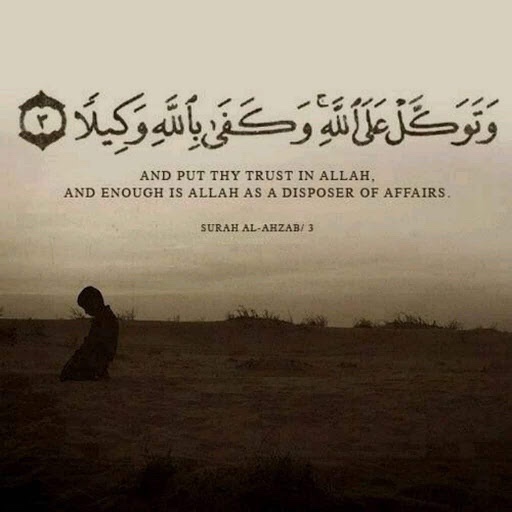
3) Putting our trust in Allah (Tawakkal).
This point links heavily with the previous point. After doing our responsibilities of taking care of ourselves and our family members, we put our whole trust to Allah to protect us from all sickness.
Tawakkal without putting much any effort is futile. Both effort and tawakkal needs to go hand in hand. Just like how the prophet Muhammad-peace and blessing be upon him said “Tie your camel and put your trust in Allah” . Source: Sunan al-Tirmidhī 2517
Grade: Hasan (fair) according to Al-Albani.
4) Allah is Ar-Razzaq (The Most Provider)
During this pandemic, our small family is away from our home country, we are far from our loved ones. My husband is currently doing his doctoral studies in KSA. So schools were shut down and the government imposed an almost 24 hour curfew. Were we worried? Definitely! Going out to do groceries is difficult as our monthly allowances were limited and my husband is out of job.We started to ration our food but Subhanallah Ng, not a day that goes by with us starving or not having anything to eat. Almost every week we received food supplies from either different organizations or anonymous givers leaving food at our doorsteps.
We told our daughter that this rizq is from Allah alone and that He will always provide us abundantly if we were to obey His commands.
5) Islam is in our heart.
Before this pandemic, going to the masjid is a daily routine for us as we have our Quran recitation halaqah. But it all stopped. Our daughter kept asking when we can go to the masjid again. We told her that even if we are not allowed to go to the masjid, we can still perform our solah together at home, reading quran etc. This Ramadan especially had a different feeling to it. Most of the Muslim families spent their quality time at home doing terawih and enjoying a nice iftar together.
Now, as the world slowly adapts to the ‘new normal’ phase, I hope, as we look back at the difficult and hard times we went through, our Eeman continues to become steadfast and that we become more patient and thankful to Him and May Allah protect us from all the sickness and pain.
Shapes are everywhere. Learning shapes not only helps children identify and organize visual information; it helps them learn skills in other curriculum areas including reading, math, and science. For example, an early step in understanding numbers and letters is to recognize their shape. Learning shapes also helps children understand other signs and symbols
Learning shapes is an important task of early childhood. Toddlers and preschoolers can learn to recognize a variety of basic shapes, and older kids will add to their shape knowledge through early elementary school.
Young kids would enjoy doing hands- on activities.
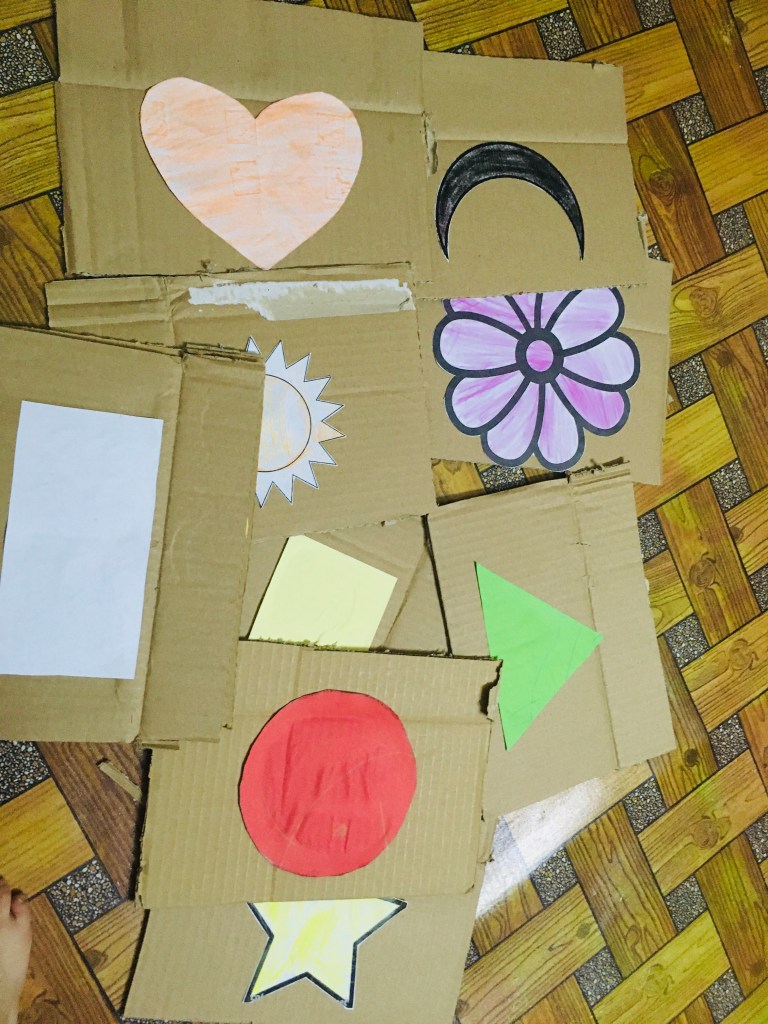
So today we did a DIY shapes puzzles. A very simple no-hassle project using materials that can easily be found around your house.
Materials needed:
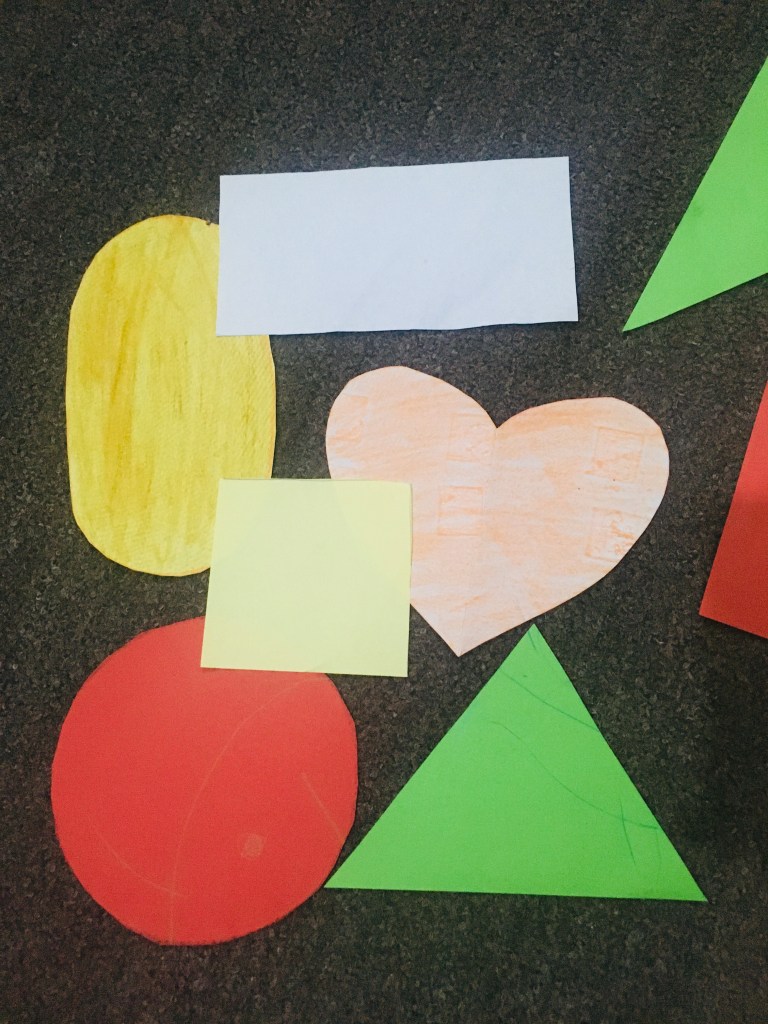
-Shapes print-out (can be drawn or printed)
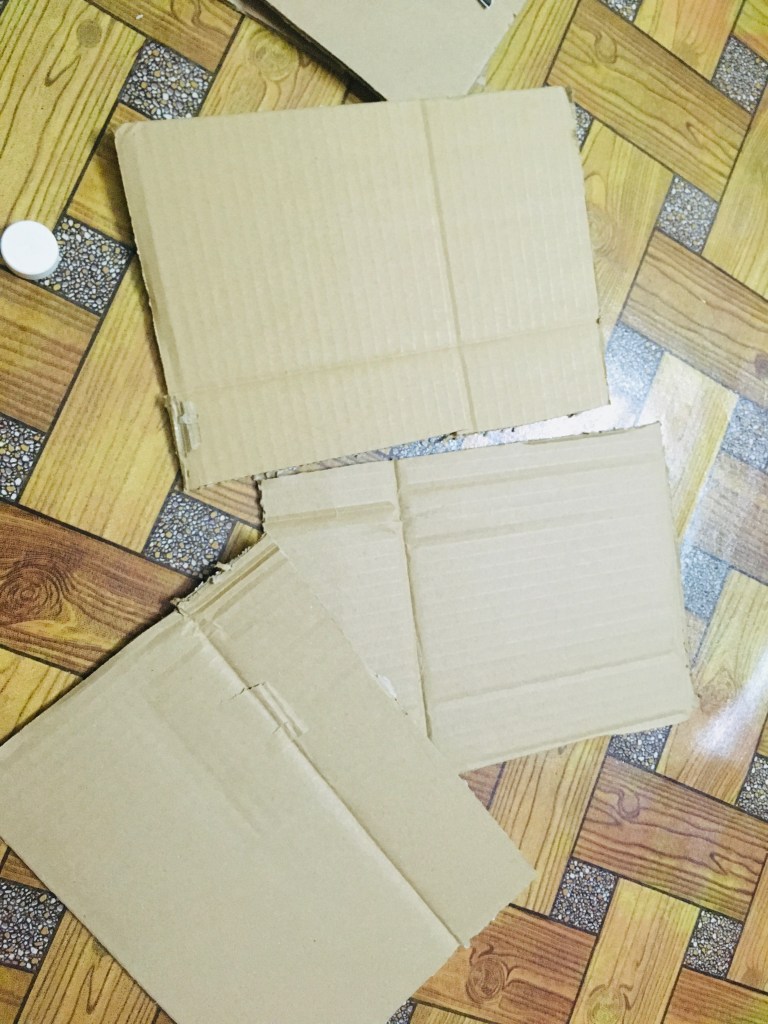
-cardboards or cardstocks (Something which is not flimsy and durable for those chubby hands to hold to later!)
-Glue, Scissors/Cutter.
Firstly you print out or draw the shapes that you wanted. These puzzles are meant for my 2 year old toddler so we are doing only basic shapes
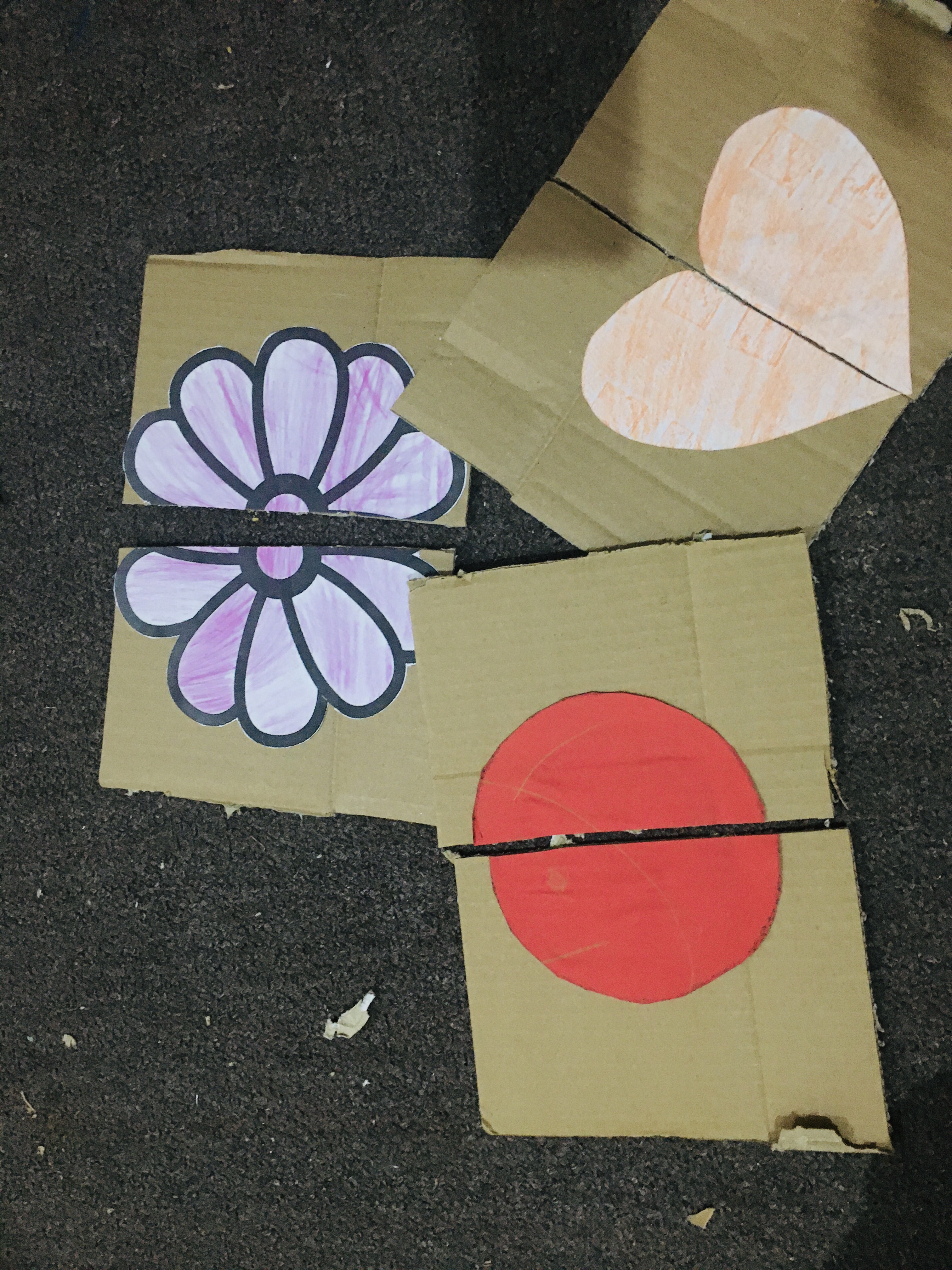
Paste the shapes in the middle of the cardboard. Optional : you can outline the shapes with a marker just to make it more bold.
Cut the cardboard into two and it will be something like this :
Tadaa, your 2 pieces puzzles are ready !
2 pieces puzzles can be easily bought at your local stores but hey if your budget is tight and enjoy doing some DIY, why not try this idea?
You can make it more challenging for your older child by cutting the puzzle into 4 and turn it into a 4 pieces puzzle. Or you can add more 3-D shapes.
Some tips:
1)Try making the shapes in different colours so your child can learn not only shapes but colours too.
2) I added some other pictures like sun, moon and stars so while doing the puzzle with your child, you can ask him “Who created the sun?” “Allah! Allah created the sun, Allah created everything “
3)If your child has begins to read, you can write out the name of the shape at the back of the puzzle. We are trying to teach our children both arabic and english so we wrote both of it.
4)Treasure hunt. After doing the puzzles,we can encourage our children to go around the house to find the similar shapes. Make it fun!
5)Bookish play. Books are an important aspect in the upbringing of a child. (I’ll write on that later inshaAllah). After a read-aloud session with any books on shapes or colours, you can bring out the puzzles and let your child match the puzzle with the ones shown in the book.
If you have any interesting ideas to share, feel free to comment below so more people can benefit from it inshaAllah.


















 Raising muslim kidlets