Last year, I wrote about how we taught our children Arabic Language in our house.
In that post, I shared on some montessori inspired ways to incorporate Arabic Language in our home.
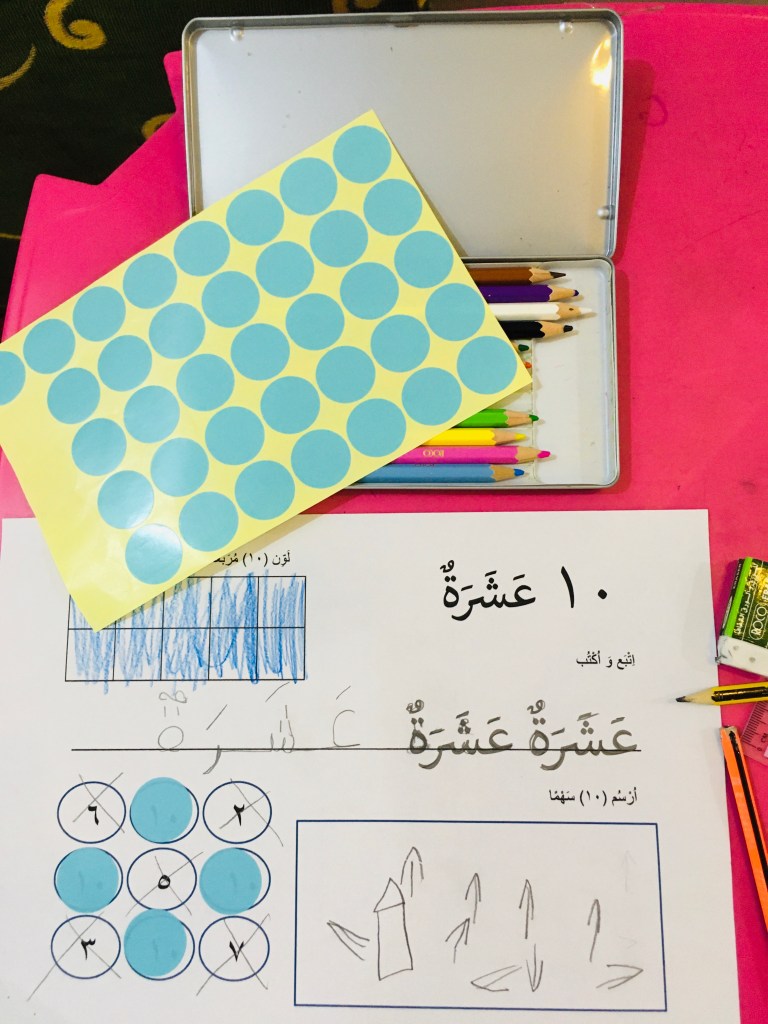
As my firstborn grows older, our learning approaches are expanding too. So in this post, I will be updating on our daily Arabic journey inshaAllah.
Communication.
In my post on acquiring language, one major point is speaking the language.
https://raisingmuslimkidlets.wordpress.com/2021/03/07/acquiring-language-part-1/
We have been doing the one parent one language method. Though it helps a lot, it occurs to me that my daughter’s vocabulary is not expanding as much as we hope. Also, she had been trying to avoid using Arabic language whenever my husband speaks to her. Which I think is because of her lack of confidence and maybe she sees how both of her parents communicating to each other in Malay. So she came to a conclusion “oh I am going to speak in Malay/English too since that is what I heard mostly in this house”
So we restrategise.
Continue with the one parent one language method. Consistently!
Pique their curiosity.
This is actually my husband’s plan. Both he and I try to speak Arabic at some random time of the day. We will break into arabic language in a middle of a conversation. Like randomly. Make the “staged” conversation as lively and funny as possible. You should see how the kids literally dropped their toys,come closer to us and went “what did you say to Ayah?” Or “why are you laughing??”
And then we just continue the act.
The idea is to make them listen . Kids are inquisitive people. (Mine especially) They want to know every single stuff that happens around them. They want to be included. So we always tell them, “ok lets try to talk in Arabic so you will understand what we are talking about.”
The other day, my husband said to me in arabic that he wants to go buy some ice-creams. The kids were playing legos and Marya literally shouts “i want one too!” So i think this tip might works!
Introduce “speak only arabic” day on weekends.

Exposing her to new arabic immersion environment. How does it works?
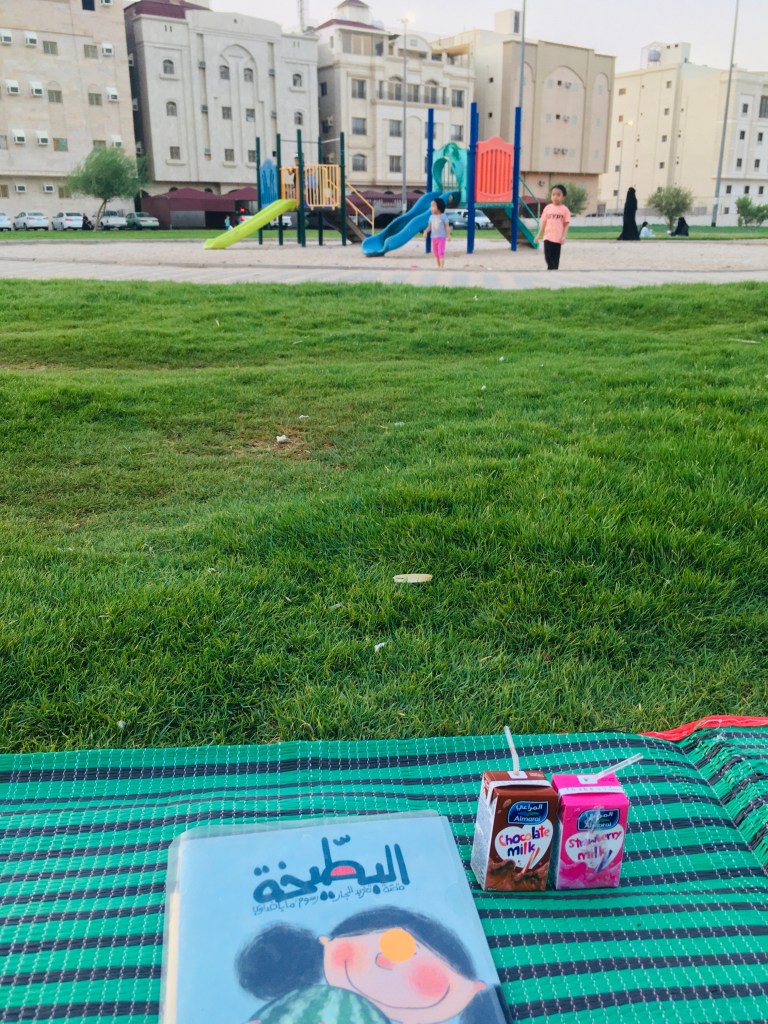
Fortunately walhamdulillah, we got an offer to move to an apartment building which houses students from Islamic University of Madinah. Most of our neighbours are native arabic speakers (mainly from Egypt, Yaman, Lebanon, Algeria). There are a few non native speakers too. So every evening, the children in this building will play at the roof-top together. So that is how my kids acquire Arabic language – speaking and listening. The progress from this method is so much faster compared to our other previous methods. This is due to the same age peer communicating in a fun playful environment. (Learning is easier when it is fun!) 2 weeks of only playing with the neighbours, my daughters came back home every day spewing arabic words / phrases . They made mistakes but are more confident in speaking and responding. MashaAllah tabarakallah.

This new method reiterates my view that you can teach your child by doing “sitting down” works, flashcards drills, daily worksheets. But kids must still be allowed to be immersed in an unstructured play and be in a laid back environment.
We also have allocate a 20 mins screen time where the kids can watch arabic shows. We hand picked and checked/verified these cartoon shows before showing it to our kids. These cartoon shows must have : minimal music, use proper arabic language (fusha), no violence/shirk contents. Difficult? Yes! But there are a few reliable ones in youtube alhamdulillah.
Reinforce read aloud session.

Read aloud sessions are a must in our house. However this time round, we allocate more time and revamped our book shelves. This means that :
1)more arabic books are displayed on the shelf (as compared to english books)
2)choosing arabic books with simpler texts and good illustrations.
Below I will share some snippets that I got from a workshop organised by sister aisha from arabicwithkids(instagram)

Takeaways from “storybook reading strategies for non-native families” workshop by arabicwith kids.
One way to teach arabic language is to expose them with arabic story books. So they will be familiar with arabic texts.
In choosing books: choose books that are designed for us to learn the language well.
(Think: simple repetitive texts and engaging illustrations)
If you want to focus on arabic language, place the books that are accessible for your children. Choose where to display them in such a way that the arabic books are not mixed or “overshadowed” by books with other languages.
Read beforehand . To familiarise yourself with the storyline and practice on your own’s pronounciation.
Start reading. Put down the pressure of them sitting down in front of you to read. Just read out loud even if they seems unattentive or playing (passive exposure)
There is no need to translate word by word. The idea is to let them hear arabic words more.
Use finger to point. This way the more you repeat the story, the more they are familiar with the word.(indirect way of learning vocabulary through sight words)
Illustrations are important. Make use of the illustrations (if you do not understand the meaning, let the picture helps to explain the storyline. talk to your children about the picture, include in simple phrases)
Include books in study unit. (Bringing the story out of the book).
Lastly, we are trying to implement Brave writer method in our homeschooling.
See here: https://bravewriter.com/getting-started
Brave writer method bu Julie Bogart is a program that helps both parents and child to be ‘writing partners’. It guides parents to be their children’s writing coach.
So the first natural stage of growth in writing is the JOT IT DOWN program aimed at 5-8 years of age.
This program encourages parents to transcribe whatever the child says.

Have something exciting to share?
Grab a pen and paper and write it down!
Went on a holiday? Jot it down!
So what I did was, whenever we went out as a family outing, I invite my daughter to recount her best memory of the trip and I write it down for her. I then make it into a mini-book.
An example : a picnic at the park written by Marya Noura
The words are hers , i merely transcribed her words. There are grammatical errors and sometimes she forgot certain words. But I encourage her to continue telling me her story.
She will then draw or colour in the pages and when she is satisfied, we read it together.
I do not change her storyline. I leave it as how she recounts it to me. If she is stuck, I prompt her by asking questions. I do however make grammatical changes ONLY and AFTER she is done.
So that’s about all. Hopefully my little sharings benefit us all. If you have ideas on how to make learning language more interesting, share it with me!
 Raising muslim kidlets