I discussed two major points at the first part of this topic which can be read here: raisingmuslimkidlets.wordpress.com/2022/02/23/help-i-dont-want-to-yell-at-my-child/
Moving on,
3. Figure out the signs that make you angry.
In our effort of being a more mindful parent, before we start yelling at our child, we can try to recognise some of the early signs .
Some examples would be:
Breathing heavily, tensed muscles, Heart beats faster.
Even nagging can be an early sign! (This is totally me! I realised that if I start nagging- even though it seems harmless at the first place, it can lead to me yelling at my kids soon after!)
Imagine this situation. You just got off from an online meeting, you turn around and the room is turned upside down with toys and books strewn everywhere. You start to nag “Girls, what have you all done”? “That toy is supposed to be in that basket” “Can we all clean up”?
Pretty harmless right? but the nagging does not stop. In fact it gets longer!
“Girls come on! your father will be back soon. I need to get dinner ready. Your class will start in an hour’s time. Help me out here. I cannot do everything by myself”!
And on and on and on.
And the children are ignoring you.
And you finally yelled at them for not listening.
See what I mean?
If only you have stop and identify what are the early signs that your body or mind try to show you- you would have manage the situation better.
Have you heard the term “Fight, flight and freeze response” ?
When someone feels threatened or angry, his body and mind involuntarily went through physiological changes in order to react/reflect or feel safe from any danger.
So when you feel threatened or under stress, you body went into a:
Fight mode : You try to eliminate the danger
Flight mode : You try to escape from the danger
Freeze mode : Your mind and body become blank (unable to respond)
Researchers / Scientists named this as acute stress response.
This response caused your body’s autonomic nervous system to be activated. This nervous system is the one that controls rapid, unconscious responses, such as reflexes. It sends message to the body to be prepared and respond to the situation.
That is where the heavy breathing, tensed muscles and rapid heart beat come in.
So once you recognise the early signs, you can minimise yelling and tell your body “Look, this is not an emergency, no one is getting hurt, there is no need to go into the fight flight freeze mode. I can handle this situation calmly with a clear mind and heart “
You can also try to :
–practice deep breathing like I mentioned in the first point.
-Find a calm place away from the chaos so you can think better.
and so many more.
4. Letting go of the past.
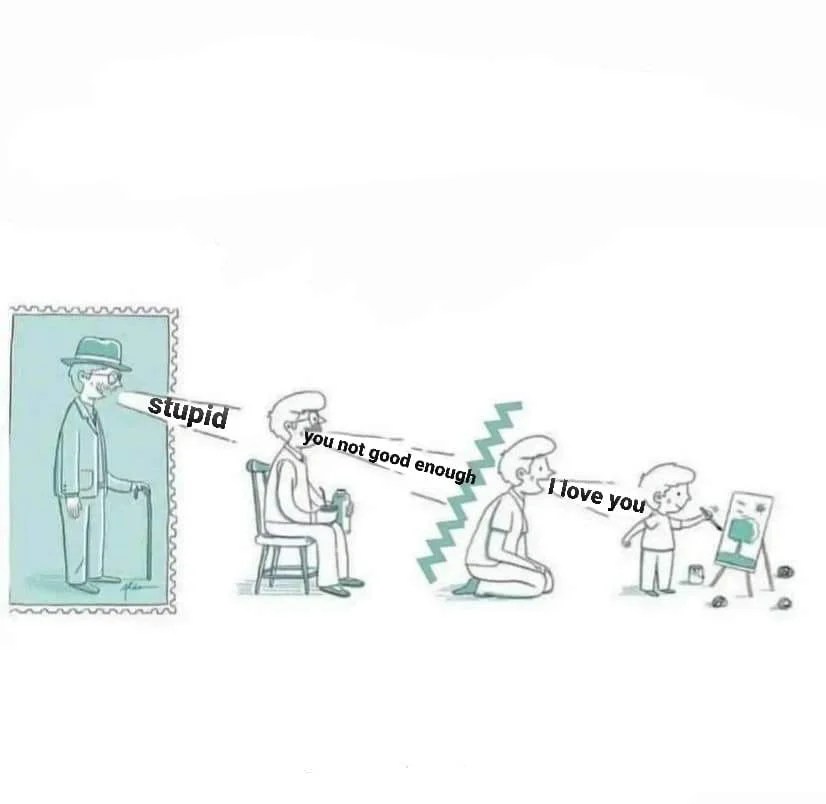
People may or may not realise that our behaviour is influenced heavily by how we were raised up. Sometimes we get triggered by past unsolved childhood experience.
Lu Hanessian said ” Unpack your emotional baggages, do not let your child carry it “
The brain is receptive/ open to new ideas at a young age. This means that our experiences (good or bad) will have a large impact on our emotional routines.
The parent’s early childhood memories may affect the early interaction with his child. So for example, if one were raised by parents who are fierce/ showing love in a tough way or choose physical punishments ( spanking or beating) to discipline, He will grow up either
a) resenting his parents
b)becomes timid and have low self-confidence
c) have anger issues
Which all these ultimately affect how he sees the world and thus affect his parenting style.
Have you heard the term “inner child”? For instance, you see a toy that you used to have and enjoyed it very much but have long forgotten about it- and suddenly it reminisces you with all the good memories? Your inner child is that part of you that still reacts like a child. That inner child who had experienced both good and bad memories may have buried some deep feelings that continue to shape his views.
That is what I meant by how we are indirectly influenced by how we were raised. Those past experiences lead us to how we are now. So imagine if you are raised in a violent household, that mindset continues even if you have your own children.
Solutions:
a) make peace with your past – accept the fact that you cannot change your past.
b) forgive your parents – they were from different generation thus different way of parenting or nurturing.
c) reflect on the consequences
d) break the cycle – “I was raised in a negative environment, I cannot change the past. Though it had shaped me, I HAVE THE ABILITY TO CHANGE MY WAY OF PARENTING.
5. Instead of solving the problem, find the root cause.
The most important point that I will stressed on is that, before we “blame” ourself on why our children are misbehaving, we need to realise that children communicate through their behaviours when they cannot find a way to verbalise it.
It could be that they are hungry, feeling tired, in need of sensory outputs, wanting attention from us, the list can go on! fulfilling their needs can help alleviate all those big feelings inside them. Teaching them how to express their feelings/emotions in a correct way can help them feel less overwhelmed/angry or irritated.
A 10 minutes undivided attention is enough to fill their emotion cups rather than an hour of us sitting with them -but with our hands scrolling down the phone.
Lastly, in Islam, while the parents have certain responsibilities towards the children (teaching correct Aqeedah, learning about the Deen upon the correct manhaj), they are not responsible for what their children do. Yes, parents get rewarded for their effort in raising their children. But to blame the parents if the children are astray (nauzubillah), that is not upon us to say that because ultimately Allah knows our intention and He is Al-Hakeem – The ultimate Judge.
May Allah help us to be a better parent and aid our journey. And remember even if you think you fail in parenting today, there is always tomorrow for you to learn and relearn inshaAllah.
 Raising muslim kidlets