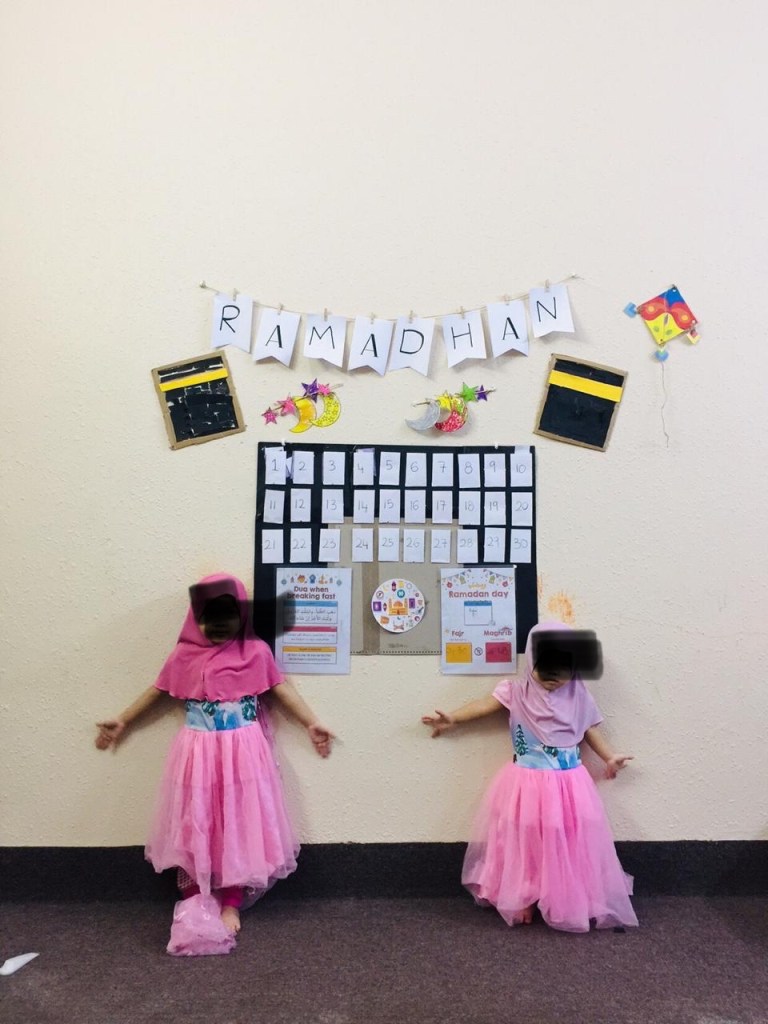
Feeling the post- Ramadhan blues?

Every year, Muslims get super excited welcoming Ramadhan- the month of mercy. We list down deeds (ibadah) that we would want to achieve during this period; we execute it diligently (or not?) and when Ramadhan finally draws its curtain, we felt a bit lost? confused? Sad that it had come to an end, guilty of not maximising the time, a bit of a failure for all the unachievable goals.

Some call it the post-ramadhan blues.

The fasting, the masjid-hopping for tarawih, the daily Quran recitation, the taddabur of the Quran.

do all this end when Syawal comes?

The deeds during Ramadhan should not be considered as a stop button- where you stop everything you did once Ramadhan ends.

Or a shut down button where you completely leave everything behind

The deeds of Ramadhan could be your reset button. A restart button.

Where it could be your new starting point. Your new beginning.

كونوا ربَّنيين و لا تكونوا رمضانيين

Be the servant of your Rab; and not the servant of Ramadhan

To keep up with the Ramadhan momentum, I share 4 easy & doable tips here:

1. List down the things that you have achieved in Ramadhan.

I have always advocate for celebrating small wins– be it in homeschool or parenting. Just to motivate us and keep us going. Listing down the deeds that we have done in Ramadhan help us to actually visualise what actions that we can continue doing it outside of Ramadhan. Even if it is a small one!

Narrated by Abu Dhar :

– ‏ عنه قال لي النبي صلى الله عليه وسلم‏: ‏ ‏ “‏ لا تحقرن من المعروف شيئاً ولو أن تلقى أخاك بوجهٍ طليق‏”‏ ‏(‏‏(‏رواه مسلم‏)‏‏)‏‏.‏

Abu Dharr (May Allah be pleased with him) reported: The Prophet (ﷺ) said, “Do not belittle any good deed, even meeting your brother (Muslim) with a cheerful face”. [Muslim].

Riyad as-Salihin 121

2. Do small but consistent

For this tip, I was actually inspired by my daughters request to continue going for the congregatory prayer in Masjid. During Ramadhan we will go for Taraweeh at a nearby masjid and during weekends, we will do masjid-hopping.

Once Ramadhan ended and normal routine resumes, the masjid trip stopped.

We might not be able to go to the masjid everyday but we can do a weekly family trip one.

(note: congregratory daily prayers in Masjid (Solat Jamaah )are obligatory (wajib) on healthy men)

We can also continue fasting on Mondays and Thursdays or fast on the white days (Ayyamul Beid) which are on the 13,14 and 15th of every month.

Aisyah Radiyahhu Anha narrated :

حَدَّثَنِي مُحَمَّدُ بْنُ عَرْعَرَةَ، حَدَّثَنَا شُعْبَةُ، عَنْ سَعْدِ بْنِ إِبْرَاهِيمَ، عَنْ أَبِي سَلَمَةَ، عَنْ عَائِشَةَ ـ رضى الله عنها ـ أَنَّهَا قَالَتْ سُئِلَ النَّبِيُّ صلى الله عليه وسلم أَىُّ الأَعْمَالِ أَحَبُّ إِلَى اللَّهِ قَالَ ‏”‏ أَدْوَمُهَا وَإِنْ قَلَّ ‏”‏‏.‏ وَقَالَ ‏”‏ اكْلَفُوا مِنَ الأَعْمَالِ مَا تُطِيقُونَ ‏”‏‏.‏

Narrated `Aisha: The Prophet (ﷺ) was asked, “What deeds are loved most by Allah?” He said, “The most regular constant deeds even though they may be few.” He added, ‘Don’t take upon yourselves, except the deeds which are within your ability.”

Sahih al-Bukhari 6465

3. Finding block of time

Time blocking method is a method where you divide your day into smaller blocks of times. So during each block, we focus on a single task or a few similar ones.

I wrote a blogpost 2 years back :

I shared here on how we can work our daily routines into our daily prayers.

This means, I blocked my day into smaller blocks following the 5 daily prayer times.

Try list down our daily routines and where to shuffle it around our prayer times.

We might not be able to finish one juz everyday outside Ramadhan, but at least, choose one specific time where you can recite the Quran together as a family. I would suggest Maghrib time as Quran time.

4. Stack habits.

The concept of habit stacking is gradually incorporating new lifestyle habits into your routine by associating them with an already-established habit.

For example, think of one household chore that you will do daily. For example cooking or doing the laundry. This is your already established habit. Something that you will not skip on that day. Try include a “side-habit” that you can do during that cooking, for example listening to Quran, listening to Islamic podcasts/ attend online halaqas etc.

The idea is to maximise your time with small consistent ibadah, without being overwhelmed or stress.

May our time be filled with barakah and may Allah aid us in every step we take towards Him to attain His redha and blessings inshaAllah!


The race is not over yet. (For the overwhelmed mothers in Ramadhan)

To the mother feeling overwhelmed with all the Ramadhan decors she saw in social medias,

To the mother feeling inadequate for not being able to whip up fancy schamancy iftaar meals in the kitchen,

To the mother feeling defeated of not being able to join taraweeh because her baby needs her,

To the mother feeling exhausted with all the loads she is carrying but still trying to welcome Ramadhan,

I see you- your feelings are valid. No one is judging nor questioning your actions.

Yes i know, ramadhan is almost halfway done.

But it is not about who start the race first. But in fact, what’s important is – who can reach the finishing line?

My sincerest advice will be, in any situation you are in right now- take a deep breath and say Alhamdulillah for the opportunity to meet this blessed month again. Alhamdulillah Allah has given us another chance to reap the multiplied rewards in Ramadhan.

Alhamdulillah alhamdulillah alhamdulillah.

I know different families have different needs, receive different kinds of support. Let’s focus more inwards- focus on what we CAN do instead of CANNOT / NOT ABLE to do.

There is a Qaidah Fiqhiyah that states:

ما لا يُدرك كله، لا يترك كله

Whatever that cannot be attained completely, should not be completely left.

If you can’t finish one juzu in a day, maybe aim for half juz?

If you are too tired to do terawih, how about making sincere intention to do 8 first?

Instead of giving up your intention to khatam your Quran recitation (because it’s halfway of Ramadhan and you are having menses now!), how about finding other ways to connect with the Quran? You can read the tafsir, tadabbur on certain verses, read stories from the Quran with your kids – while making sincere dua’s that Allah put barakah in your time and you can still finish the khatam inshaAllah!

Instead of feeling down for not being able to join terawih at the masjid, how about finishing your juzu’ while praying terawih at the comfort of your house (✅terawih done ✅one juzu per day done)

Aiming a ramadhan target that you think is achievable within your means (with all the mental loads you are carrying) – this is important.

And the most important thing? Continuing all these commendable ibadah outside of Ramadhan.

May we be among the people who always strive towards Allah, hasten to do goodness and that all

our ibaadah ( small or big) are accepted in the eyes of Allah!

Making dua’ for your children.

The importance of making dua’ for your children.

Have you heard about the story of an ‘alim name Fudhail bin ‘Iyadh? (فضيل بن عياض)

Imam Az-Zahabi in his book Siyar A’lam An Nubala mentioned Fudhail bin ‘Iyadh (187H)as someone who is very pious, knowledgeable, wara’, thiqqoh and very active in doing Ibadah ( 8:422).

Ibn Mubarak also stated that “the best human in this generation is Fudhail bin ‘Iyadh”

‎خير الناس الفضيل بن عياض

Besides all his credibilities, he felt that one of his flaws is his inability to educate & nurture his son. He strongly believes that Allah the Almighty is the only One who can nurture his son.

One of his famous dua’ :

‎ اللهم إني اجتهدت أن أؤدب علياً فلم أقدر على تأديبه، فأدبه لي

“Oh Allah, I have tried my very best to nurture my son but I still feel inadequate in doing so, so please Allah nurture him for me”

Fudhail’s son : ‘Ali then becomes God-fearing servant and a soft hearted one. Everytime he came across verses of the Quran that mentioned about the torments of the hell-fire or Allah’s wrath, he will cry and faint.

In fact, Ali bin Fudhail bin ‘Iyadh died upon hearing this verses when his father was praying:

‎وَبَدَا لَهُم مِّنَ اللَّهِ مَا لَمْ يَكُونُوا يَحْتَسِبُونَ

“And there will appear to them from Allah what they have never imagined” (Az-Zumar: 47)

From this story, we can see how making dua’ for our children is the most important factor in our tarbiyah journey.

Rasulullah PBUH said :

عَنْ أَبِي هُرَيْرَةَ، عَنِ النَّبِيِّ صلى الله عليه وسلم قَالَ‏:‏ ثَلاَثُ دَعَوَاتٍ مُسْتَجَابَاتٍ‏:‏ دَعْوَةُ الْمَظْلُومِ، وَدَعْوَةُ الْمُسَافِرِ، وَدَعْوَةُ الْوَالِدِ عَلَى وَلَدِهِ‏.‏

( الأدب المفرد – كتاب الاعتناء بالدنيا)

Abu Hurayra reported that the Prophet (PBUH) said, “There are three supplications which are answered:

the supplication of the person who is wronged, the supplication of the traveller, and the supplication of a parent for his child.

Source: Al Adab Al Mufrad ( chapter : attending to this world)

Grade : Sahih (Albani)

Our goal as a muslim parents is not as simple as making sure the kids are well-fed, graduated from the top universities, earning high incomes.

But our goal as an intentional parents is to raise God-fearing humans with strong aqeedah and good morale. And that can only be achieved with the help from Allah.

And as the hadith mentioned above, a parent’s prayer will not be rejected. So make dua’ to Allah that He gives you strength within yourself to nurture your children. That He will give the ability to cope with the parenting struggles. Pray that Allah will send help through the people around you.

If a renowned scholar like Al Fudhail bin ‘Iyadh felt that he is unable to nurture his son, then what about us? We are living in this times of fitnah, certainly the first step in doing tarbiyah for our kids and raise them upon Quran and Sunnah-is by making lots of dua’.

There are some dua’ for offsprings mentioned in the Quran:

1. Prophet Ibrahim (AS)’s dua’:

رَبِّ هَب لِي مِنَ الصَّالِحِين

“Oh my Lord, bless me with a righteous son” ( As-Saaffat : 100)

2. Prophet Ibrahim (AS)’s dua’ :

رَبِّ اجْعَلْنِي مُقِيمَ الصَّلَاةِ وَمِنْ ذُرِّيَّتِي ۚ رَبَّنَا وَتَقَبَّلْ دُعَاءِ

“Oh my Lord, make me steadfast in Salah and my offspring too. And our Lord, grant our prayer.

3. Prophet Zakariya (AS)’s dua’:

رَبِّ هَبْ لِي مِنْ لَدُنْكَ ذُرِّيَّةً طَيِّبَةً إِنَّكَ سَمِيعُ الدُّعَاء

“Oh my Lord, grant me from Your own (power) a good offspring. Verily You are the One who listens the prayer (Al-Imran : 38)

4. Another dua’ for offsprings in the Quran:

رَبِّ أَوْزِعْنِي أَنْ أَشْكُرَ نِعْمَتَكَ الَّتِي أَنْعَمْتَ عَلَيَّ وَعَلَى وَالِدَيَّ وَأَنْ أَعْمَلَ صَالِحًا تَرْضَاهُ وَأَصْلِحْ لِي فِي ذُرِّيَّتِي إِنِّي تُبْتُ إِلَيْكَ وَإِنِّي مِنَ الْمُسْلِمِينَ (Al-Ahqaf 15)

5. رَبَّنَا هَبْ لَنَا مِنْ أَزْوَاجِنَا وَذُرِّيَّاتِنَا قُرَّةَ أَعْيُنٍ وَاجْعَلْنَا لِلْمُتَّقِينَ إِمَامًا ( Al-Furqan : 74)

Rasulullah (PBUH) also used to make dua’ for the son of Umm Sulaim – the companion Anas bin Malik:

اللَّهُمَّ أَكْثِرْ مَالَهُ وَوَلَدَهُ ، وَبَارِكْ لَهُ فِيمَا أَعْطَيْتَهُ

From IslamQA website:

“Shaykh al-Islam Ibn Taymiyah (may Allaah have mercy on him) said: 

People should make du’aa’ by reciting the prescribed du’aa’s that are mentioned in the Qur’aan and Sunnah, because these are undoubtedly virtuous and good, and this is the straight path. The scholars of Islam and the imams have mentioned the du’aa’s that are prescribed in Islam, and turned away from the innovated du’aa’s, so we should follow them in that. 

Majmoo’ al-Fataawa’, 1/346, 348”.

Can we make dua’ in other languages besides Arabic?

Outside prayers, Yes we can.

Shaykh al-Islam Ibn Taymiyah said: 

It is permissible to make du’aa’ in Arabic and in languages other than Arabic. Allaah knows the intention of the supplicant and what he wants, no matter what language he speaks, because He hears all the voices in all different languages, asking for all kinds of needs. 

Majmoo’ al-Fataawa, 22/488-489

May Allah make our children the coolness of our eyes and give them success in this world and the hereafter.

“My child never listens to me!” – tips on how to communicate better with your child

“If you have told a child a thousand times and he still does not understand, then it is not the child who is a slow learner” Walter Barbee

If you find yourself struggling to make your child to listen to you, read more below!

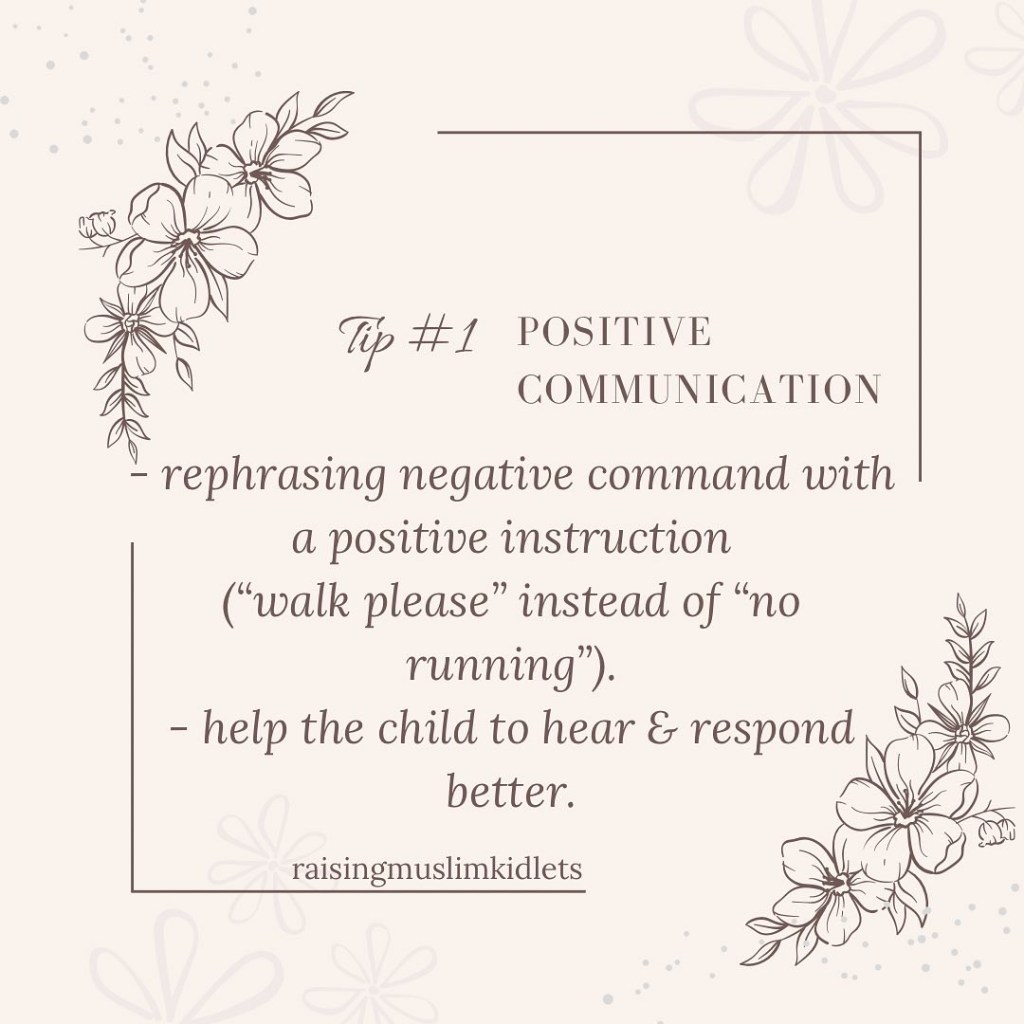
Tip #1 : positive communication

Children have poor logical reasoning skills. This is due to their less developed frontal cortex brain. A

simple “ do not run” might be an obvious instruction but a child might think “if I can’t run, do I skip? Hop? Jump?

That is why replacing a negative command with a positive one might help the child to hear and respond better

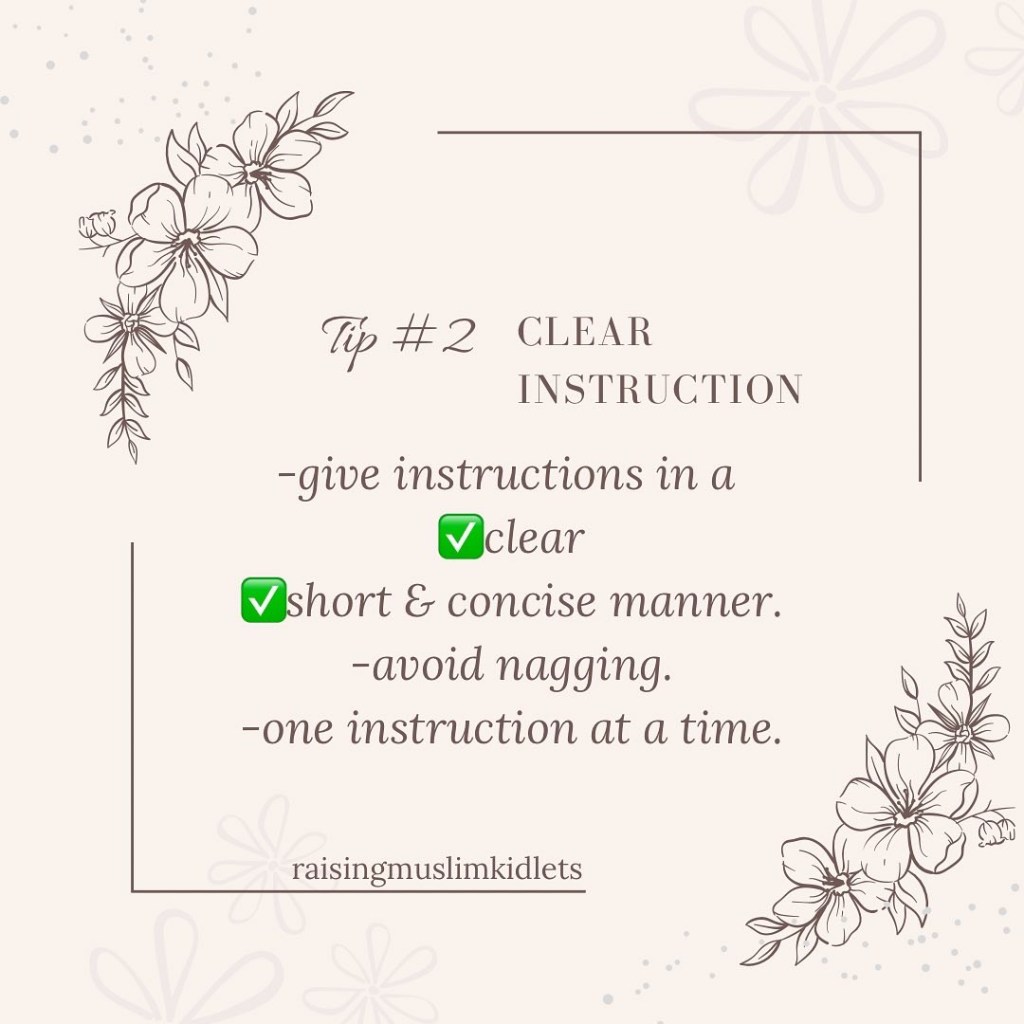
Tip # 2: clear instruction

Imagine hearing this request “ Marya, can you please pick up your toys now? Then go wash up it’s almost dinner time. Don’t forget to use shampoo! If you are done can you please hang your towel?”

The instruction is pretty exhaustive isn’t? Children will struggle to remember everything you asked them to do.

Communicate with your child at his level by giving them ONE thing at a time focus on.

Tip #3 age-appropriate

Imagine asking a 2 years old to sit still. The young child might adhere to your rules. But for how long?5 mins? 7mins?

Or imagine asking your preschooler to help you fold the laundry. He might be able to do it but do not expect him to fold as perfect as you always do! At least he is doing his chores!

Acknowledging your child’s abilities and closing one eye on his flaws can help ease your daily parenting’s woes

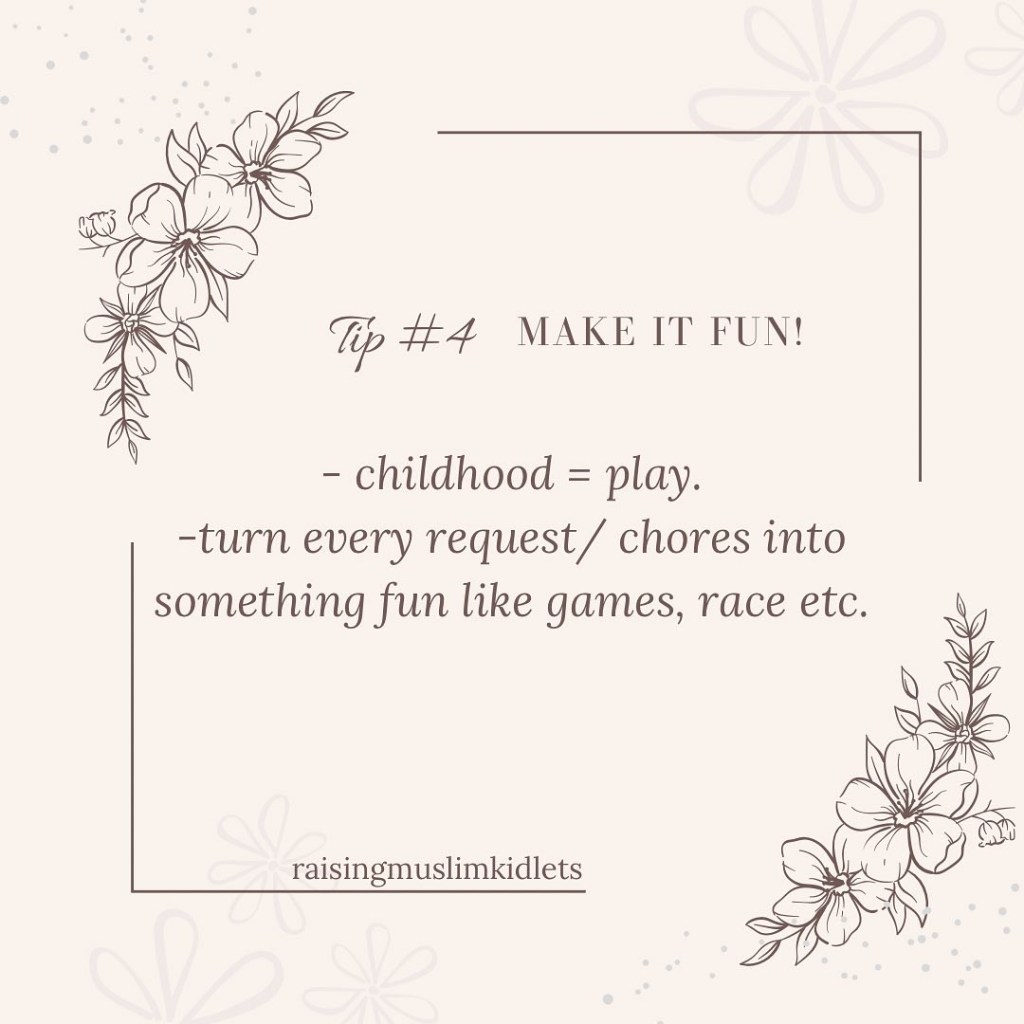
Tip #4 make it fun

Are u struggling with bedtime routine? Turn this daily routine into something fun! Ask your child to brush their teeth while standing on one leg. Or see who can change into his pyjamas faster.

I know at the end of the day, the last thing you want to do is just rest and make the kids sleep! But trust me, this “fun memories “ are what the kids will remember. And what a small price it is-making them smile at the end of their day instead of yelling at them before sleeping and leaving them laying on their beds with sadness/ hatred in their hearts.

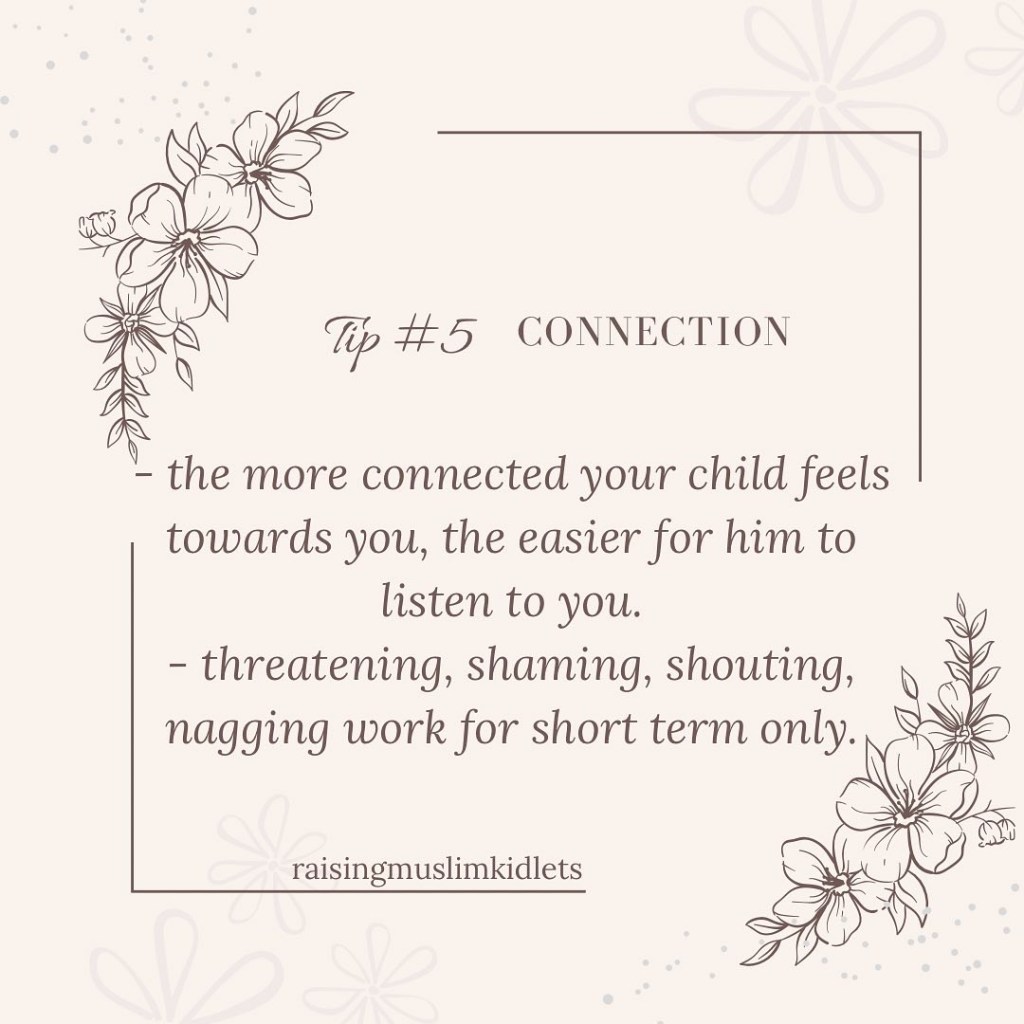
Tip #5 connection

The more the child feels connected towards you, the easier for him to listen to you.

Connect with them with rahmah!

Asking them to do something while you are yelling at them would only make them listen to you grudgingly. Sooner or later, the rebellion will kick in and they will stop listening at you.

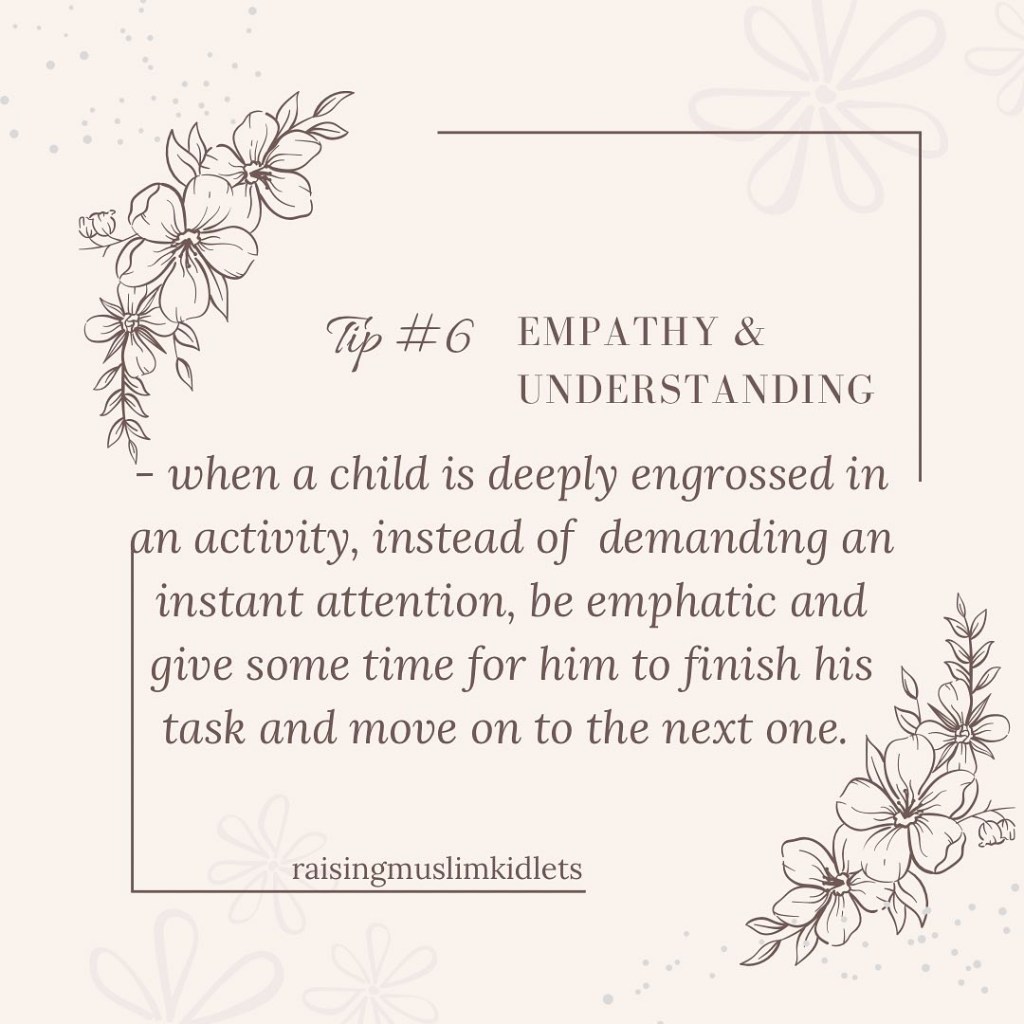
Tip #6 emphaty & understanding.

I know we live in a fast paced world now. We feel we need to do so many things in one day. But why don’t we let our child ( and ourself too!) to just pause and breathe in the moment?

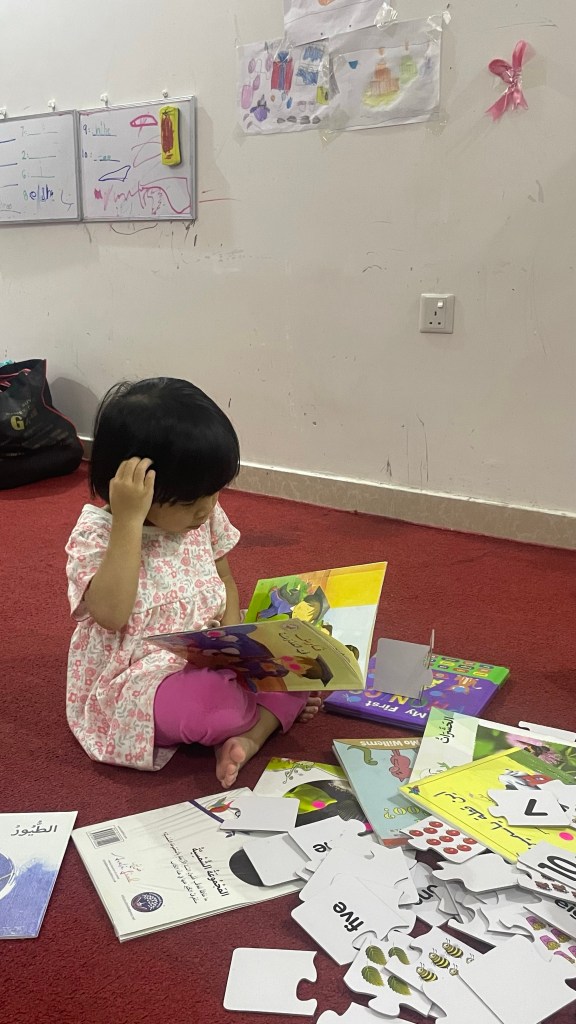
Instead of rushing your child to clean up his room NOW , see what your child is doing at the moment. Maybe he is engrossed in reading his favourite book. Instead of jumping in to him, you might want to sit down besides him, ask him what he is doing and gently remind him to please clean his room after he is done reading.

Usually, all this chores/ favours you asked from your child, it is not a life-threatening requests right? So why the rush?

I hope this small sharing helps you to connect and understand your child better inshaAllah!

Raising my introvert child.

Shy, quiet, reserved, thoughtful, calm- these are some of the characteristics being thrown to someone who has an introversion temparament.

And as much as I don’t like to put labels on my children- undeniably, acknowledging your child’s behaviour can actually help you to manage and nurture your child’s emotional growth.

Allow me to introduce you to my second born daughter. Maryam is 4 years old this year. She enjoys playing quietly with her sisters. During playground visits, she would rather play by herself rather than joining the other kids. While her elder sister jumps at the sight of her friends during playdates, Maryam would carefully tag along.

Maryam is an animal lover. She loves to cuddle and hug(!) her cat and play with the hamsters for a long time. But if you ask her to say Hi or give salam to a new friend, she would run away or hide under my scarf.

If you are lucky, you can hear her talking to some adults that she are comfortable with. But when kids her age try to make a conversation, she will avert her eyes. Oh and if you are a male above the age of 4, don’t bother asking her anything- she will not answer (that includes my brothers in law)

Maryam- my sweet little girl (not sweet when she is cranky or ‘hangry’)

I used to worry how her shyness can be perceived as rude. If we receive guests and she refuses to even make eye contacts. Would they think that I never teach my child about manners? Would they think that my child purposely do not want to interact? Am I even a good parent for letting her get her way?

I used to force her to shake hands with my friends who came over to my house. I will push her to play with kids at the playground. I even told her to be like her sister – outgoing and just enjoy the company of others.

Playing all by herself

Sometimes she will not budge. Sometimes she follows what I instructed her to do with tears swelling in her eyes. She will play for 5 mins and come running back to me.

Until I realise that this is affecting my relationship with her. She hated it when I force her to do something she is not comfortable. And i got worried for her behaviour. And guilty for forcing her. And she becomes more and more ‘reserved’

So I restrategise (yup parenting is like going on a battlefield , you need strategies!)

1) Accept and acknowledge.

First thing first, I accept the fact that Maryam has an introvert personality. I acknowledge all her temparements and embrace it with all my heart. I look at all the positive traits of introversion feeling.

And most importantly, I stop comparing her with my outgoing and social eldest daughter.

As I mentioned above, avoid using labels (shy etc) on our child because we don’t want them to use these labels as excuses to avoid real life situations (like meeting new friends, going to a new place). Labels=judgements.

When we remove these judgements and acknowledge that she might need more time to “warm up”, it helps us to accept them for who they are.

2) Provide understanding.

When we see things from our child’s perspectives, we can be their translator.

For example at a new playground, your child might resist going up the slide. Instead of pushing and saying “Don’t worry, it is going to be fun!” We can be more emphatic and say “Are you feeling scared/nervous about this?”

3) Prepare them in advance.

We are very big in doing prep talks with our children before going out of the house.

I will also try to bring some forms of distractions for her when we go out ( some papers , markers, coloured pencils, books, stickers etc). A light snack and water are important. And my most imortant tool? Essential oils! To calm those nerves and tame the feelings!

4) Feelings = behaviour ?

Often a child does not know how to express their feelings accordingly. This will then be reflected by their behaviour. See it like a coping mechanism.

Example :

When we are in a family gathering, Maryam might need some time to warm up and talk to others.

To avoid this tricky situation, she will disturb her baby sister, pulling her hairs, carrying her away from me etc.

I know she does not and will never mean to hurt her sister. But by doing this kind of behaviour, she knows she is going to get my full attention and she can now avoid whatever that is overwhelming her.

Solution?

Allow all feelings but not all behaviour.

My child is allowed to feel sad, scared , angry or nervous. But to channel the feelings to misbehaviour? That is where I draw the line.

I will gently talk to Maryam that I will not allow her to hurt her baby sister and I will invite her to sit with me for awhile while I tend to her crying baby sister. She can play with the stuffs that I brought from home to make her feel at ease.

5) Filling my own cup first.

I am a firm believer of meeting my own personal needs first in order for me to help fulfil my children’s needs. Guarding my sanity is important so I can nurture my children better.

6) Constant prayer to Allah.

And on top of all that, I believe in constant prayers to Allah to help me tarbiyah my children every single day.

There will be bad days but surely Allah will never abandon you in distress. Ask and seek solace from Him and only Him and inshaAllah your parenting journey will be eased.

Help! I don’t want to yell at my child ! (part 2/2)

I discussed two major points at the first part of this topic which can be read here: raisingmuslimkidlets.wordpress.com/2022/02/23/help-i-dont-want-to-yell-at-my-child/

Moving on,

3. Figure out the signs that make you angry.

In our effort of being a more mindful parent, before we start yelling at our child, we can try to recognise some of the early signs .

Some examples would be:

Breathing heavily, tensed muscles, Heart beats faster.

Even nagging can be an early sign! (This is totally me! I realised that if I start nagging- even though it seems harmless at the first place, it can lead to me yelling at my kids soon after!)

Imagine this situation. You just got off from an online meeting, you turn around and the room is turned upside down with toys and books strewn everywhere. You start to nag “Girls, what have you all done”? “That toy is supposed to be in that basket” “Can we all clean up”?

Pretty harmless right? but the nagging does not stop. In fact it gets longer!

“Girls come on! your father will be back soon. I need to get dinner ready. Your class will start in an hour’s time. Help me out here. I cannot do everything by myself”!

And on and on and on.

And the children are ignoring you.

And you finally yelled at them for not listening.

See what I mean?

If only you have stop and identify what are the early signs that your body or mind try to show you- you would have manage the situation better.

Have you heard the term “Fight, flight and freeze response” ?

When someone feels threatened or angry, his body and mind involuntarily went through physiological changes in order to react/reflect or feel safe from any danger.

So when you feel threatened or under stress, you body went into a:

Fight mode : You try to eliminate the danger

Flight mode : You try to escape from the danger

Freeze mode : Your mind and body become blank (unable to respond)

Researchers / Scientists named this as acute stress response.

This response caused your body’s autonomic nervous system to be activated. This nervous system is the one that controls rapid, unconscious responses, such as reflexes. It sends message to the body to be prepared and respond to the situation.

That is where the heavy breathing, tensed muscles and rapid heart beat come in.

So once you recognise the early signs, you can minimise yelling and tell your body “Look, this is not an emergency, no one is getting hurt, there is no need to go into the fight flight freeze mode. I can handle this situation calmly with a clear mind and heart “

You can also try to :

practice deep breathing like I mentioned in the first point.

-Find a calm place away from the chaos so you can think better.

and so many more.

4. Letting go of the past.

People may or may not realise that our behaviour is influenced heavily by how we were raised up. Sometimes we get triggered by past unsolved childhood experience.

Lu Hanessian said ” Unpack your emotional baggages, do not let your child carry it “

The brain is receptive/ open to new ideas at a young age. This means that our experiences (good or bad) will have a large impact on our emotional routines.

The parent’s early childhood memories may affect the early interaction with his child. So for example, if one were raised by parents who are fierce/ showing love in a tough way or choose physical punishments ( spanking or beating) to discipline, He will grow up either

a) resenting his parents

b)becomes timid and have low self-confidence

c) have anger issues

Which all these ultimately affect how he sees the world and thus affect his parenting style.

Have you heard the term “inner child”? For instance, you see a toy that you used to have and enjoyed it very much but have long forgotten about it- and suddenly it reminisces you with all the good memories? Your inner child is that part of you that still reacts like a child. That inner child who had experienced both good and bad memories may have buried some deep feelings that continue to shape his views.

That is what I meant by how we are indirectly influenced by how we were raised. Those past experiences lead us to how we are now. So imagine if you are raised in a violent household, that mindset continues even if you have your own children.

You don’t have to repeat history.

Solutions:

a) make peace with your past – accept the fact that you cannot change your past.

b) forgive your parents – they were from different generation thus different way of parenting or nurturing.

c) reflect on the consequences

d) break the cycle – “I was raised in a negative environment, I cannot change the past. Though it had shaped me, I HAVE THE ABILITY TO CHANGE MY WAY OF PARENTING.

5. Instead of solving the problem, find the root cause.

The most important point that I will stressed on is that, before we “blame” ourself on why our children are misbehaving, we need to realise that children communicate through their behaviours when they cannot find a way to verbalise it.

It could be that they are hungry, feeling tired, in need of sensory outputs, wanting attention from us, the list can go on! fulfilling their needs can help alleviate all those big feelings inside them. Teaching them how to express their feelings/emotions in a correct way can help them feel less overwhelmed/angry or irritated.

A 10 minutes undivided attention is enough to fill their emotion cups rather than an hour of us sitting with them -but with our hands scrolling down the phone.

Lastly, in Islam, while the parents have certain responsibilities towards the children (teaching correct Aqeedah, learning about the Deen upon the correct manhaj), they are not responsible for what their children do. Yes, parents get rewarded for their effort in raising their children. But to blame the parents if the children are astray (nauzubillah), that is not upon us to say that because ultimately Allah knows our intention and He is Al-Hakeem – The ultimate Judge.

May Allah help us to be a better parent and aid our journey. And remember even if you think you fail in parenting today, there is always tomorrow for you to learn and relearn inshaAllah.

How to build confidence in your child.

“Self-confidence is the foundation of all great success and achievement.” Brian Tracy (author of many self-development books).

Confident kids with positive self-esteem value their own selves. They know that they are capable of doing stuffs on their own and always try their best to achieve anything they set their mind into.
When kids are confident, they are more likely to have growth mindset- meaning they can motivate themselves to try new challenges, accept mistakes and learn from it.

Being self-confident does not mean thinking that the world revolves around you. You can build your child’s confidence and at the same time balance it with empathy, having good manners and being grateful with his surroundings.

Self-confidence is an acquired characteristic, and the Muslim needs help and support from Allah. The more he puts his trust in Allah, the greater his self-confidence will grow and reach the highest level. 

When prophet Musa (alaihi salam) and his people fled from Pharaoh and his troops, and the two sides saw one another, we see the trust that Musa had in his Lord. Allah says:
“And when the two hosts saw each other, the companions of Musa said: ‘We are sure to be overtaken.’ Musa said: ‘Nay, verily, with me is my Lord. He will guide me’”
[al-Shu‘ara’ 26:61, 62]. 

So here are 5 tips to build your child’s confidence.

  1. Be their guide and learn together.

When introducing new stuffs to your child, instead of shoving him/her into the unknown, be there as a guide for them. Learn and grow together as a team.

Example : When you want your child to memorise the Quran, start your hifz journey too!

Similarly, if you wish that your child will learn a new language, he will only absorb and immerse the language in his daily life if you are willing to take his hand and learn together.

2. Give age-appropriate tasks.

When you involve your child in daily household chores, it makes them feel included. Choose something that they can do by themselves confidently.

Example: Folding clothes. Your closet would never look Marie Kondo-ish but at least it teaches your child to be responsible and independent human.

Other simple examples would be: Letting them choose what clothes to wear daily. Making their own snacks. Helping you do grocery. Set the table during meal times. Water the plants and many more!

And do you know how Rasulullah (Peace be upon him) chose some of the young companions, placed his trust in them and invested in their youth to contribute something for Islam?

Despite their young age,Rasulullah (Peace be upon him) did not hesitate to assign them important roles. This makes the companions feel confident and special because of the trust that Rasulullah (Peace be upon him) have on them.

Entrusted to learn a new language:

Zayd bin Thabit was 13 years old when he went to Rasulullah (peace be upon him) to ask permission from Rasulullah (peace be upon him) for him to join the battle of Badr.

But Rasulullah (peace be upon him) did not grant his wish but instead instructed him to learn the hebrew language.

Rasulullah (peace be upon him) knew that Zayd had a sharp mind and a huge interest in knowledge- and so Zayd (RadiyaAllahu ‘anhu) learnt the language of the jews at that time and the syriac language and eventually served as a translator and scribe for the prophet.

During the time of Abu Bakar(RadiyaAllah ‘anhu), Zayd bin Thabit was chosen to lead the project of compilling the Quran in a book form.

Muadz bin Jabal (RadiyaAllah ‘anhu) was only 27 when he was appointed as the governor of Yaman. And during “fath-makkah” (conquest of Makah) he was chosen as the deputy of Rasulullah (peace be upon him).

Usamah bin Zaid was only 17 when he was chosen to lead the Muslim army. And behind him stood the greatest companions such as Abu Bakar and ‘Umar (RadiyaAllahu ‘anhuma)

After the pledge of Aqabah, Mus’ab bin ‘Umair a young man, was sent to yathrib (madinah) to be the first muslim ‘ambassador’ to teach the people about Islam.

Prophet Muhammad ( peace be upon him) was able to see the best in young people and hoped for a brighter future for them.

So to think, if we could only let our children do simple tasks from a young age, as they grow older, they will feel more empowered and confident to take up new tasks and face new and more difficult challenges. InshaAllah

3. Acknowledge their effort.

In Montessori, it is normal for parents/ guide to acknowledge what the child is doing rather than praising or offering rewards.

For example, a child who is trying to help set the table for the first time. His parents/ guide might have demonstrated on how to do it beforehand. However during the process of the child doing it, in order for him to focus on his effort, we try not to interrupt or give comments on what is going on.

But when he is done with his job, we acknowledge their effort by saying something like “you managed to set the table by yourself” or “I see you have placed the cup/bowl by the side”

Comments such as “ I can see you are very happy and proud of your work” “that was really helpful of you to help set the table” “thank you for helping” – these remarks are all acknowledging what the child accomplished rather than merely praising the child’s or offering rewards.

Acknowledgement helps children assess their work, they will feel more confident and proud of what they have achieved. The more specific our comments , the more easier for them to be able to better improve whatever they are doing.

(Read the next point to know more on why we should praise the effort more rather than the result )

4. Praise the effort not the result.

A renowned psychologist Carol Dweck wrote in her book “mindset” : people either have a fixed or a growth mindset, and the one that you adopt can affect every aspect of your life

Fixed mindset means that you believed that your skills and intelligence are fixed and cannot be developed. You have the constant fear of failure and hate challenges.

Growth mindset on the other hand is when you think your talents can be further honed with practice and preserverance.

So what does this got to do with building a child’s confidence?

A child with a growth mindset is not afraid of failure, he is willing to try and explore new stuffs.

When the child with a growth mindsets sees that his effort is noticed, even if the work is not “perfect”, he knows that can learn and do anything he put his mind into.

And in order for a child to have this mindset, he needs the support of his parents of course! His upbringing matters.

Praising your child’s effort encourages perseverance in them. Making them more resilient and be more confident when faced with new challenges.

Read more on Dweck’s study : “praise for effort not intelligence” here: http://mereworth.kent.sch.uk/wp-content/uploads/2015/04/growth_mindsets_dweck-praise-effort.pdf

5. Do not look down on the result.

Parents always want the best for their children. But setting realistic expectation is important.

Too high of an expectation? The child will feel demoralised when his effort is not as what he hoped for.

No expectation? The child will feel demotivated and not willing to try.

So finding a balance is essential to ensure that the child enjoys the learning progress more rather than focusing on the end result.

The more the child enjoys learning, the more he is driven to explore. This in turn helps boost his motivation and confidence.

Also it is equally important to encourage children when they have failed and not only when they have succeeded.

So that’s the 5 tips on how to boost your child’s confidence! Share your thoughts with us on the comment box below.

Happy parenting!

Help! I don’t want to yell at my child! (part 1/2)

Despite all your efforts in being calm when your kid is having a tantrum in the supermarket, sometimes you just want to scream at him for being embarrassing.

 I know most parents try very hard to stay calm and keep our cool, but when the pressure is on, we just blow it! We screamed at our kids for being late, we yelled at them when they are bickering with their siblings. We sometimes yelled for no apparent reasons (I know i do! And yes it happens a lot of time!).

I admit it is tough. (Very!) but yelling needs to stop (or minimise it). It makes us mothers unhappy and guilty and you know what they said. An unhappy mother is an unhappy household!

Angry is a normal feeling. It is a normal human emotion that all of us feel. But it needs to stop. And I am writing this for my own accountability!

So how do we do it? Where do we start?

1. Identify your triggers

The first step to stop yelling is to dig deep into your feelings and list down what makes you angry.

What exactly that makes you angry? What are the stuffs that you cannot tolerate?

Crying baby? Messy house? Bickering children with loud voices? Tiredness? Lack of sleep?

For me personally, I cannot stand loud noises. I grew up with my mother making sure we use our indoor voices even when we are outdoors! She is the kind that enjoys peace and calm. So anything that disrupts her serenity will caused her feeling triggered and thus scolding us.

And thus, that upbringing affects how I parent my own children. ( I will touch more on this issue on my last point-unsolved past childhood experience).

So anyway,

Finding your triggers is important, because when you manage to identify it quickly, you can react better.

Solution:

After identifying your trigger, FIND A SPACE BETWEEN YOUR TRIGGER AND YOUR REACTION.

What does that mean?

Simply put, When you start to feel angry; instead of lashing out to your child, think of any at-the-moment strategies.

Examples of these quick strategies (that you can choose and adopt to your own situation):

-Istighfar,remember to recite the ta’awudz

– Count to ten

-Drink water

-Go to the other room (Seclude yourself first)

-Take deep slow breaths

-Take some fresh air

-Use some essential oils

-Ask your partner to step in for a while

And remember how our prophet Muhammad Peace be upon him taught us when we are feeling angry?

حَدَّثَنَا أَحْمَدُ بْنُ حَنْبَلٍ، حَدَّثَنَا أَبُو مُعَاوِيَةَ، حَدَّثَنَا دَاوُدُ بْنُ أَبِي هِنْدٍ، عَنْ أَبِي حَرْبِ بْنِ الأَسْوَدِ، عَنْ أَبِي ذَرٍّ، قَالَ إِنَّ رَسُولَ اللَّهِ صلى الله عليه وسلم قَالَ لَنَا ‏ “‏ إِذَا غَضِبَ أَحَدُكُمْ وَهُوَ قَائِمٌ فَلْيَجْلِسْ فَإِنْ ذَهَبَ عَنْهُ الْغَضَبُ وَإِلاَّ فَلْيَضْطَجِعْ ‏”‏ ‏.

The Messenger of Allah (ﷺ) said to us: When one of you becomes angry while standing, he should sit down. If the anger leaves him, well and good; otherwise he should lie down.

Grade: Sahih

Reference : Sunan Abi Dawud 4782

حَدَّثَنَا مُحَمَّدُ بْنُ سَلامٍ، قَالَ‏:‏ أَخْبَرَنَا مُحَمَّدُ بْنُ فُضَيْلِ بْنِ غَزْوَانَ، عَنْ لَيْثٍ، عَنْ طَاوُسٍ، عَنِ ابْنِ عَبَّاسٍ قَالَ‏:‏ قَالَ رَسُولُ اللهِ صلى الله عليه وسلم‏:‏ عَلِّمُوا وَيَسِّرُوا وَلاَ تُعَسِّرُوا، وَإِذَا غَضِبَ أَحَدُكُمْ فَلْيَسْكُتْ‏.‏

Ibn ‘Abbas reported that the Messenger of Allah, may Allah bless him and grant him peace, said, “Teach and make things easy and not difficult. When one of you is angry, he should be silent.”

Grade: Sahih

Reference : Al-Adab Al-Mufrad 245

حَدَّثَنَا عَلِيُّ بْنُ عَبْدِ اللهِ، قَالَ‏:‏ حَدَّثَنَا أَبُو أُسَامَةَ قَالَ‏:‏ سَمِعْتُ الأَعْمَشَ يَقُولُ‏:‏ حَدَّثَنَا عَدِيُّ بْنُ ثَابِتٍ، عَنْ سُلَيْمَانَ بْنِ صُرَدٍ قَالَ‏:‏ اسْتَبَّ رَجُلاَنِ عِنْدَ النَّبِيِّ صلى الله عليه وسلم، فَجَعَلَ أَحَدُهُمَا يَغْضَبُ، وَيَحْمَرُّ وَجْهُهُ، فَنَظَرَ إِلَيْهِ النَّبِيُّ صلى الله عليه وسلم فَقَالَ‏:‏ إِنِّي لَأَعْلَمُ كَلِمَةً لَوْ قَالَهَا لَذَهَبَ هَذَا عَنْهُ‏:‏ أَعُوذُ بِاللَّهِ مِنَ الشَّيْطَانِ الرَّجِيمِ، فَقَامَ رَجُلٌ إِلَى ذَاكَ الرَّجُلِ فَقَالَ‏:‏ تَدْرِي مَا قَالَ‏؟‏ قَالَ‏:‏ قُلْ‏:‏ أَعُوذُ بِاللَّهِ مِنَ الشَّيْطَانِ الرَّجِيمِ، فَقَالَ الرَّجُلُ‏:‏ أَمَجْنُونًا تَرَانِي‏؟‏‏.‏

Sulayman ibn Surad said, “Two men abused one another in the presence of the Prophet, may Allah bless him and grant him peace, and one of them began to get angry and his face got red. The Prophet, may Allah bless him and grant him peace, looked at him and said, ‘I know some words that, if he says them, will remove this from him. They are:

I seek refuge with Allah from the Accursed Shaytan.”‘ The man went to that man and said, ‘Do you know what he said? He said, “I seek refuge with Allah from the Accursed Shaytan.”‘ The man retorted. ‘Do you think me mad?'”

Grade : Sahih

Reference: Al-Adab Al-Mufrad 1319

I always feel moved and humbled whenever I see how modern daily issues resonate well with what Islam had taught us. We don’t even need modern parenting advices when we have the Quran and Sunnah subhanaAllah.

Continuing on, we can apply what Rasulullah (peace be upon him) taught us in the ahadith above and use it as a quick at-the-moment strategies.

Kids getting on your nerves and you are about to explode?

Stop.

1) Keep silent

2) if you are standing up, go find a place to sit, or get out of the room. Just walk away from the situation for a while.

3) Ta’wudz and dzhikir dzikir dzikir.

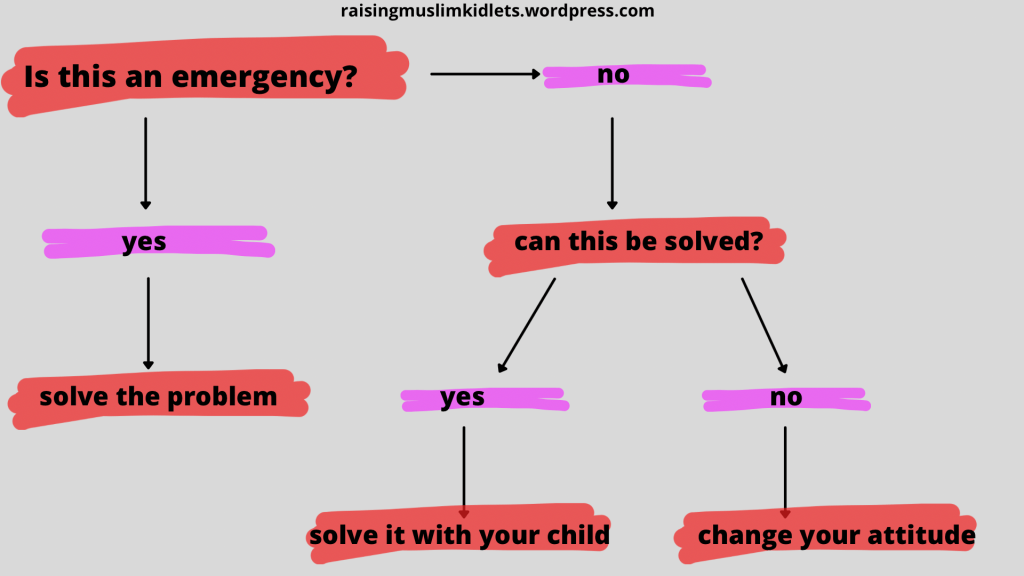
2. Ask yourself “is this an emergency”?

Emergency in this case means:

Someone / something will get hurt/ harmed or against the Deen

So if it is an emergency, stop the behaviour.

Without yelling.

Tell the child “l’m sorry but I would not let you hurt your sister”

If it is not an emergency, think – can this be solved?

If yes, solve the problem together with your child . Example, your child spilled milk all over the floor. So instead of you yelling at your child, take a deep breath and remind yourself this is not an emergency and can be solved easily with your child. Invite him to take a towel or cloth and wipe it together with you.

If this is not an emergency but it cannot be solved, change your attitude towards it.

Example, my daughter have problem sleeping at night. Yes sleep is important for the growth and health of our children. But resisting sleep is not an emergency case, but can it be solved? Sure, you can have a slow winding before- sleep routine, put on some essential oils in a diffuser, tone down the lights. But let’s face it, some nights, it just does not work.

Remember if you can’t change something, all you have to do is change your attitude towards it. Instead of reeling at your child, try to not let it get to you. Remember your child is not intentionally pushing your button. If he is misbehaving, there is always something deeper underneath his behaviour. So our job as a parent is to help navigate our child and ensure that his needs are met so he can express his feelings better and in a more positive way.

I am not saying that we should ignore or dismiss our child’s misbehaviour. That will be a permissive parenting. What I mean is we need to CHOOSE OUR BATTLE WISELY.

Children having a hard time to sleep – is it worth your battle? Do you really want to yell at your child for not sleeping?

It might take you 10-30 mins maybe for you to accompany him and wait for him to sleep. Cuddles, bed-time story or if you have a long day, explain to him firmly yet nicely “you need to sleep so you can rest. I need to rest too“ .

That 10-30 minutes can feel so tiring especially when you had a long day. But your presence at that moment is nothing because mending your relationship with your child after being yelled or scolded at takes longer time and a difficult journey too!

To be continued for part 2

Gentle Parenting

Real talk ; Parenting can be the hardest job you ever have. Sometimes as parents, it can be overwhelming and hard in figuring out how you are supposed to be calm and collected when your child has trouble regulating his emotions.

If you yell at your child today, does that mean you are a bad parent? Have you failed parenting totally? If your child made a mistake today and you take away her screen time, does that mean you are punishing her? Does being strict means you are not doing gentle parenting?

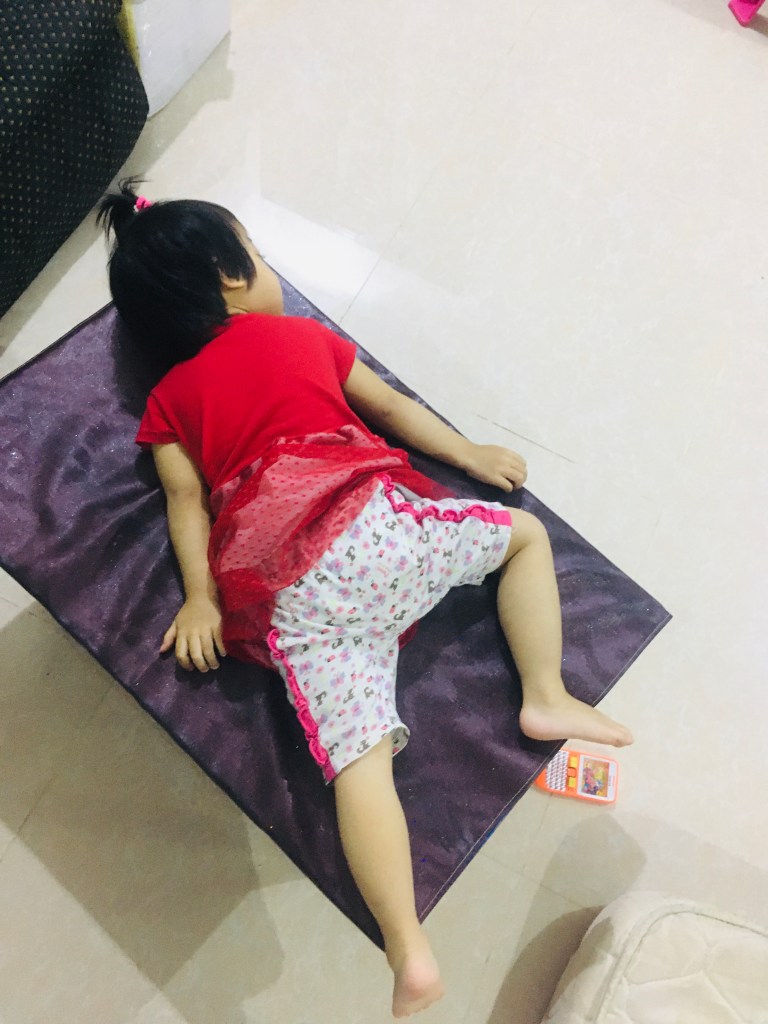
Maryam having a bad day and end up sleeping on the table

Many people think that gentle parenting means letting your child get away with anything. No rules or boundaries and routines. Some might even think that gentle parenting means the parent are soft,they never get angry or hit their child at all.

But that is not true. Parents who adopt gentle parenting can have rules and boundaries in their household but at the same time they put in much more effort (physically and emotionally) to be more conscious in their way of reacting to their children, how they take care of both their needs and the children’s.

Parenting is hard. Gentle parenting ?Even harder.

Reality check: There is no such thing as a perfect parent. No matter how many parenting books you read, attend talks by experts, you are bound to make mistakes. Because that’s the nature of humans!

But the beauty of making mistakes is that you acknowledge and try to ammend it as best as you can.

Sarah Ockwell-Smith, a parenting expert and writer of “the gentle parenting book” summarised that there are four key principles in gentle parenting:

1)empathy

2)respect

3)understanding

4)boundaries

Empathy:

Your child is pushing your button this morning? Instead of you labelling him as “naughty” or “bad”, why not try to understand why he is behaving that way. Finding the cause or trigger of your child’s misbehaviour is a form of emphaty.

Respect:

The first stage of education is observe! Young children might not be able to easily understand instruction. But they observe, look and watch people around them (especially parents) – that is how they learn. Respect is a two-way street. If we want our children to be respectful individuals, we need to model polite behaviour first and discuss why it is important.

Understand :

Acknowledge that the child is still growing and his brain ‘s pre-frontal cortex is not fully developed yet thus he might make wrong choices or react unaccordingly. This part of the brain is only fully developed by the age of 25! So when you feel that your 5 years old is purposely misbehaving, sympathise with him and try to understand that he is just having difficulties expressing his feelings.

Boundaries:

Discipline is vital in parenting. In gentle parenting, discipline aims to:

1. guide/teach the child respectfully and with understanding

2. Take into consideration their age, brain development

Which means, if a child for example hits another child, does that mean we ignore this bad behaviour?

Nope! We need to teach them that we don’t hit because hitting hurts.

Do we punish them? Would a 2 years old who had hit his friend understand that hitting hurts when you “punish” him by giving him a time-out?

Nope!

So choose your boundaries wisely with the neurological capabilities of your child in mind.

So back to my question, if I yell at my child today, does it mean I have failed?

Of course not! Acknowledge that you are not doing it on purpose, identify your triggers and let go of the guilt!! Make peace with your heart. Forgive yourself and start again. And again. And again. And when you are feeling better, try to adopt the 4 principles that Sarah Ockwell shared! You will certainly fell in love with gentle parenting!

How do I tell my children that we do not celebrate birthdays?

This topic might seems ‘off’ or preachy for some. But in this trying times where fitnahs are all around us, this issue needs to be brought up. And as my children grow, they see how some people around them celebrate birthdays or they see in their “innocent” storybooks on birthday parties, I believe it is about time we have a true discussion.

A short introduction:

From Collins’s dictionary: birthday is defined as the anniversary of the date that you were born. While celebration is a special enjoyable event that people organize because something pleasant has happened or because it is someone’s birthday or anniversary.

Why birthdays are not celebrated in Islam:

1. Celebrating birthday is bid’ah or innovation in Islam which has no basis in the law of Islam (Sharia’h)- not in the Quran nor in Sunnah.

“Whoever innovates something in this matter of ours (Islam) that is not part of it, will have it rejected.” (Narrated by al-Bukhaari and Muslim).

2. It involves the imitation of the people of Jahiliyyah or any other groups of non-muslims.

The Prophet (peace and blessings of Allaah be upon him) said: “You would follow the ways of those who came before you step by step, to such an extent that if they were to enter a lizard’s hole, you would enter it too.” They said, “O Messenger of Allaah, (do you mean) the Jews and Christians?” He said, “Who else?”

(Reported by al-Bukhaari and Muslim).

The Prophet (peace and blessings of Allaah be upon him) also said: “Whoever imitates a people, he is one of them”.

With that being said, how do we deal with this issue should our children ask?

1. Tell them as it is and what kind of celebration is allowed in islam.

عَنْ أَبِي عَبْدِ اللَّهِ النُّعْمَانِ بْنِ بَشِيرٍ رَضِيَ اللَّهُ عَنْهُمَا، قَالَ: سَمِعْت رَسُولَ اللَّهِ صلى الله عليه و سلم يَقُولُ: “إنَّ الْحَلَالَ بَيِّنٌ، وَإِنَّ الْحَرَامَ بَيِّنٌ، وَبَيْنَهُمَا أُمُورٌ مُشْتَبِهَاتٌ لَا يَعْلَمُهُنَّ كَثِيرٌ مِنْ النَّاسِ، فَمَنْ اتَّقَى الشُّبُهَاتِ فَقْد اسْتَبْرَأَ لِدِينِهِ وَعِرْضِهِ، وَمَنْ وَقَعَ فِي الشُّبُهَاتِ وَقَعَ فِي الْحَرَامِ، كَالرَّاعِي يَرْعَى حَوْلَ الْحِمَى يُوشِكُ أَنْ يَرْتَعَ فِيهِ، أَلَا وَإِنَّ لِكُلِّ مَلِكٍ حِمًى، أَلَا وَإِنَّ حِمَى اللَّهِ مَحَارِمُهُ، أَلَا وَإِنَّ فِي الْجَسَدِ مُضْغَةً إذَا صَلَحَتْ صَلَحَ الْجَسَدُ كُلُّهُ، وَإذَا فَسَدَتْ فَسَدَ الْجَسَدُ كُلُّهُ، أَلَا وَهِيَ الْقَلْبُ”.

[رَوَاهُ الْبُخَارِيُّ]، [وَمُسْلِمٌ] .

On the authority of an-Nu’man ibn Basheer (ra), who said: I heard the Messenger of Allah () say, “That which is lawful is clear and that which is unlawful is clear, and between the two of them are doubtful matters about which many people do not know. Thus he who avoids doubtful matters clears himself in regard to his religion and his honor, but he who falls into doubtful matters [eventually] falls into that which is unlawful, like the shepherd who pastures around a sanctuary, all but grazing therein. Truly every king has a sanctuary, and truly Allah’s sanctuary is His prohibitions. Truly in the body there is a morsel of flesh, which, if it be whole, all the body is whole, and which, if it is diseased, all of [the body] is diseased. Truly, it is the heart.”

[Bukhari & Muslim]

Hadith 6, 40 Hadith an-Nawawi

https://sunnah.com/nawawi40:6

The earlier our young children are taught, the more they will feel submited to the rules. Will children feel left out or ocstracised if they do not celebrate birthday? To be honest, they will only feel that way if YOU (parents) let them feel that way. Guide our children that Allah has set some guidelines / rules in Islam. Thus as Muslims, we are obligated to follow these rules in order to attain His mercy, love & ultimately His Jannah.

2. Maximise the celebration in Islam.

In Islam, there are 2 celebrations that are allowed:

أَخْبَرَنَا عَلِيُّ بْنُ حُجْرٍ، قَالَ أَنْبَأَنَا إِسْمَاعِيلُ، قَالَ حَدَّثَنَا حُمَيْدٌ، عَنْ أَنَسِ بْنِ مَالِكٍ، قَالَ كَانَ لأَهْلِ الْجَاهِلِيَّةِ يَوْمَانِ فِي كُلِّ سَنَةٍ يَلْعَبُونَ فِيهِمَا فَلَمَّا قَدِمَ النَّبِيُّ صلى الله عليه وسلم الْمَدِينَةَ قَالَ ‏ “‏ كَانَ لَكُمْ يَوْمَانِ تَلْعَبُونَ فِيهِمَا وَقَدْ أَبْدَلَكُمُ اللَّهُ بِهِمَا خَيْرًا مِنْهُمَا يَوْمَ الْفِطْرِ وَيَوْمَ الأَضْحَى ‏”‏ ‏.‏

It was narrated that Anas bin Malik said: “The people of the Jahiliyyah had two days each year when they would play. When the Messenger of Allah (ﷺ) came to Al-Madinah he said: ‘You had two days when you would play, but Allah (SWT) has given Muslims something instead that is better than them: the day of Al-Fitr and the day of Al-Adha.'”

Sunan an-Nasa’i 1556

https://sunnah.com/nasai:1556

grade: Sahih

And on these days, Muslims are encouraged to glorify Allah, enjoy and celebrate the occasion with family and friends (as long as it is not against the guidelines given).

Children will not feel like they miss out on birthday celebration when we go “all-out” during Eid occasions.

The 2 Eids belong to Muslims, so why not make a big deal out of it? As long as it is not:

-imitating the non-muslims

-no wastage is done;

Celebrate the joyous days and make your children happy, enjoy your eid! Include them in the preparation, ask their opinions on what they want to do during eid, which clean beautiful clothes that they can wear, the decoration and many more.

3. Do not limit present/ cakes for birthdays only.

Children always associate birthdays with cakes, presents and parties. So why not we reward them with presents/treats on “normal days”. A reward for sharing their toys, for memorising a particular surah, a treat for doing the housework maybe? The reward does not have to a lavish one.

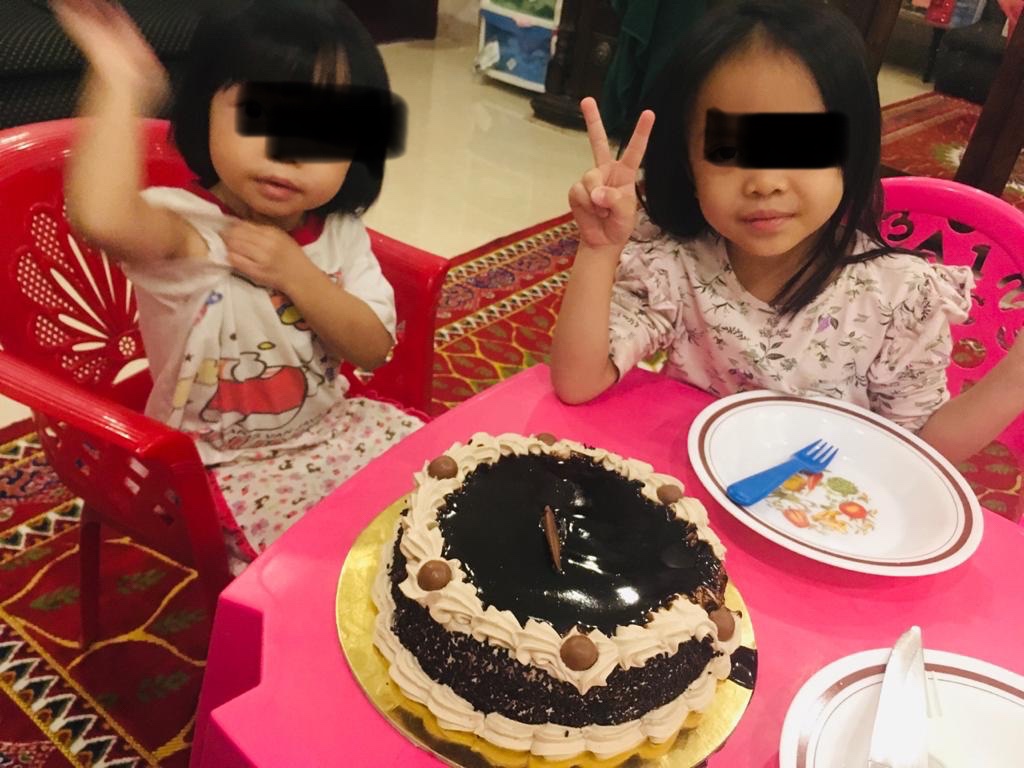
A cake does not need to be elaborate with fancy decorations (I mean, we are normal moms here who have a pile of dishes to do) , a simple store-bought pre-mix cake that you can bake together with your child is more than enough!

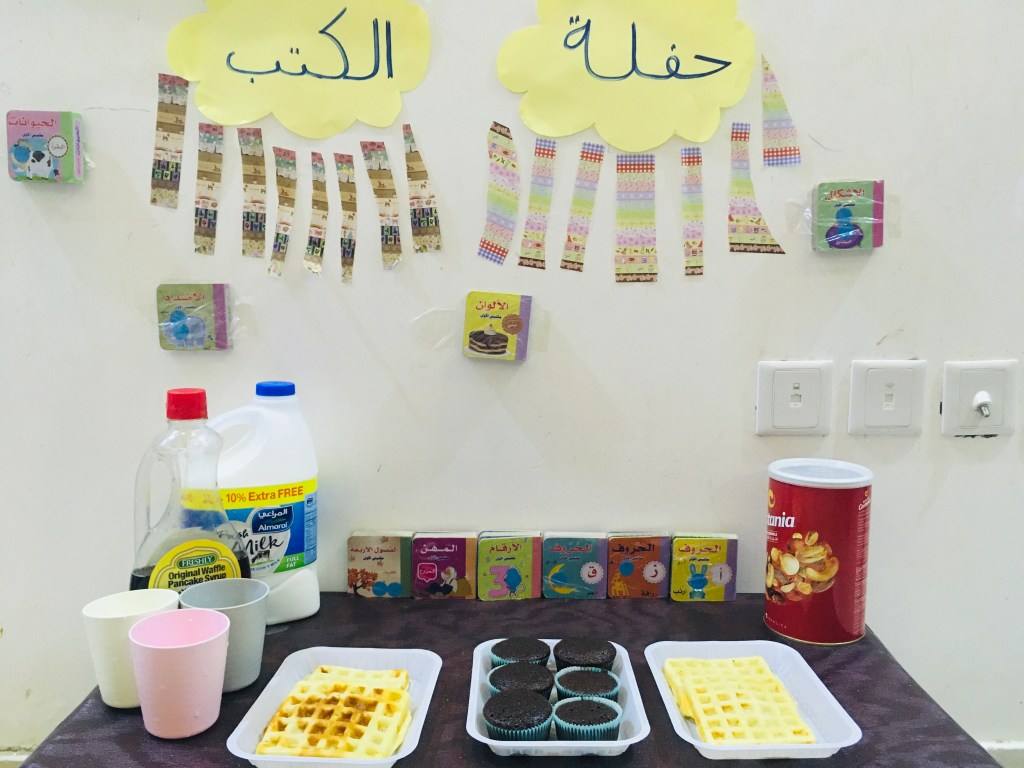
We made a book party before. My girls decorated and set up the table. We ate, read books together and simply enjoy each other’s company.

Have an outdoor party for no apparent reason – you do not need a reason to spend time with your kids ; invite some friends over too!

4. Teach them love is not materialistic.

Children need to know that our love for them is beyond tangible stuffs. We do not necessarily equate love with materials stuffs. Not celebrating birthdays does not mean we love them less, but instead; we love them so much for the sake of Allah and the hereafter that we steer them away from wordly affairs. Attaining Jannah is our goal and to attain that, we need to attain Allah’s Redha first.

حَدَّثَنَا مُحَمَّدُ بْنُ عَبْدِ اللَّهِ بْنِ نُمَيْرٍ، حَدَّثَنَا أَبِي وَمُحَمَّدُ بْنُ بِشْرٍ، قَالاَ حَدَّثَنَا إِسْمَاعِيلُ بْنُ أَبِي خَالِدٍ، عَنْ قَيْسِ بْنِ أَبِي حَازِمٍ، قَالَ سَمِعْتُ الْمُسْتَوْرِدَ، أَخَا بَنِي فِهْرٍ يَقُولُ سَمِعْتُ رَسُولَ اللَّهِ ـ صلى الله عليه وسلم ـ يَقُولُ ‏ “‏ مَا مَثَلُ الدُّنْيَا فِي الآخِرَةِ إِلاَّ مَثَلُ مَا يَجْعَلُ أَحَدُكُمْ إِصْبَعَهُ فِي الْيَمِّ فَلْيَنْظُرْ بِمَ يَرْجِعُ ‏”‏ ‏.‏

Mustawrid, a brother of Banu Fihr, said: “I heard the Messenger of Allah (ﷺ) say: ‘The likeness of this world in comparison to the Hereafter is that of anyone of you dipping his finger into the sea: let him see what he brings forth.’”

Sunan Ibn Majah 4108

https://sunnah.com/ibnmajah:4108

Grade: Sahih.

5. Never reprimand those who celebrate, but pray for their guidance.

حَدَّثَنَا مُحَمَّدُ بْنُ حَاتِمِ بْنِ مَيْمُونٍ، حَدَّثَنَا يَحْيَى بْنُ سَعِيدٍ، حَدَّثَنَا يَزِيدُ بْنُ كَيْسَانَ، عَنْ أَبِي حَازِمٍ الأَشْجَعِيِّ، عَنْ أَبِي هُرَيْرَةَ، قَالَ قَالَ رَسُولُ اللَّهِ صلى الله عليه وسلم لِعَمِّهِ ‏”‏ قُلْ لاَ إِلَهَ إِلاَّ اللَّهُ أَشْهَدُ لَكَ بِهَا يَوْمَ الْقِيَامَةِ ‏”‏ ‏.‏ قَالَ لَوْلاَ أَنْ تُعَيِّرَنِي قُرَيْشٌ يَقُولُونَ إِنَّمَا حَمَلَهُ عَلَى ذَلِكَ الْجَزَعُ لأَقْرَرْتُ بِهَا عَيْنَكَ فَأَنْزَلَ اللَّهُ ‏{‏ إِنَّكَ لاَ تَهْدِي مَنْ أَحْبَبْتَ وَلَكِنَّ اللَّهَ يَهْدِي مَنْ يَشَاءُ‏}‏

It is narrated on the authority of Abu Huraira that the Messenger of Allah said to his uncle (at the time of his death): Make a profession of it that there is no god but Allah and I will bear testimony (of your being a Muslim) on the Day of judgment. He (Abu Talib) said: Were it not the fear of the Quraysh blaming me (and) saying that it was the fear of (approaching death) that induced me to do so, I would have certainly delighted your eyes. It was then that Allah revealed: ” Verily thou canst not guide to the right path whom thou lovest. And it is Allah Who guideth whom He will and He knoweth best who are the guided” (xxviii-56).

Sahih Muslim 25b

https://sunnah.com/muslim:25b

Taking one small step at a time- let us all strive to achieve Allah’s redha/pleasure and unite us all in the highest Jannah inshaAllah!
حَدَّثَنَا سُوَيْدُ بْنُ نَصْرٍ، أَخْبَرَنَا عَبْدُ اللَّهِ بْنُ الْمُبَارَكِ، عَنْ عَبْدِ الْوَهَّابِ بْنِ الْوَرْدِ، عَنْ رَجُلٍ، مِنْ أَهْلِ الْمَدِينَةِ قَالَ كَتَبَ مُعَاوِيَةُ إِلَى عَائِشَةَ أُمِّ الْمُؤْمِنِينَ رضى الله عنها أَنِ اكْتُبِي إِلَىَّ كِتَابًا تُوصِينِي فِيهِ وَلاَ تُكْثِرِي عَلَىَّ ‏.‏ فَكَتَبَتْ عَائِشَةُ رضى الله عنها إِلَى مُعَاوِيَةَ سَلاَمٌ عَلَيْكَ أَمَّا بَعْدُ فَإِنِّي سَمِعْتُ رَسُولَ اللَّهِ صلى الله عليه وسلم يَقُولُ ‏ “‏ مَنِ الْتَمَسَ رِضَاءَ اللَّهِ بِسَخَطِ النَّاسِ كَفَاهُ اللَّهُ مُؤْنَةَ النَّاسِ وَمَنِ الْتَمَسَ رِضَاءَ النَّاسِ بِسَخَطِ اللَّهِ وَكَلَهُ اللَّهُ إِلَى النَّاسِ ‏”‏ ‏.‏ وَالسَّلاَمُ عَلَيْكَ ‏.‏ حَدَّثَنَا مُحَمَّدُ بْنُ يَحْيَى، حَدَّثَنَا مُحَمَّدُ بْنُ يُوسُفَ، عَنْ سُفْيَانَ الثَّوْرِيِّ، عَنْ هِشَامِ بْنِ عُرْوَةَ، عَنْ أَبِيهِ، عَنْ عَائِشَةَ، أَنَّهَا كَتَبَتْ إِلَى مُعَاوِيَةَ فَذَكَرَ الْحَدِيثَ بِمَعْنَاهُ وَلَمْ يَرْفَعْهُ ‏.‏

‘Abdul-Wahhab bin Al-Ward narrated from a man among the inhabitants of Al-Madinah who said: “Mu’awiyah wrote a letter to ‘Aishah, that: ‘Write a letter to advise me , and do not overburden me.'” He said: “So ‘Aishah [may Allah be pleased with her]wrote to Mu’awiyah: ‘Peace be upon you. As for what follows: Indeed I heard the Messenger of Allah (s.a.w) saying: Whoever seeks Allah’s pleasure by the people’s wrath, Allah will suffice him from the people. And who ever seeks the people’s pleasure by Allah’s wrath, Allah will entrust him to the people. And Peace be upon you.'”

Jami` at-Tirmidhi 2414
https://sunnah.com/tirmidhi:2414

Grade: Hasan