The aim of a successful Islamic parenting is to raise God-conscious (taqwa) children with strong creed (aqeedah).
عن أبي ذر جندب بن جنادة، وأبي عبد الرحمن معاذ بن جبل، رضي الله عنهما، عن رسول الله صلى الله عليه وسلم، قال: “ اتق الله حيثما كنت واتبع السيئة الحسنة تمحها، وخالق الناس بخلق حسن” ((رواه الترمذي وقال حديث حسن )).
Abu Dharr and Mu’adh bin Jabal (May Allah be pleased with them) reported that: Messenger of Allah (ﷺ) said, “Fear Allah wherever you are, do good deeds after doing bad ones, the former will wipe out the latter, and behave decently towards people”. [At- Tirmidhi, who categorized it as Hadith Hasan].
Riyad as-Salihin :61
Grade : Hasan
And it starts from our own household. Begin creating “kindness culture” in the house. But how?
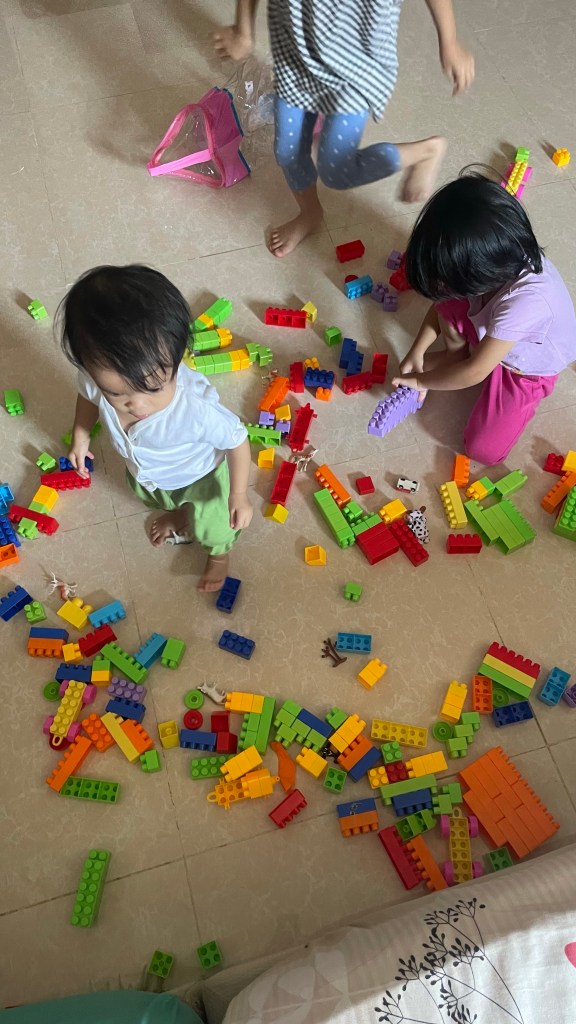
Sharing toys
1)Help them understand what is kindness all about.
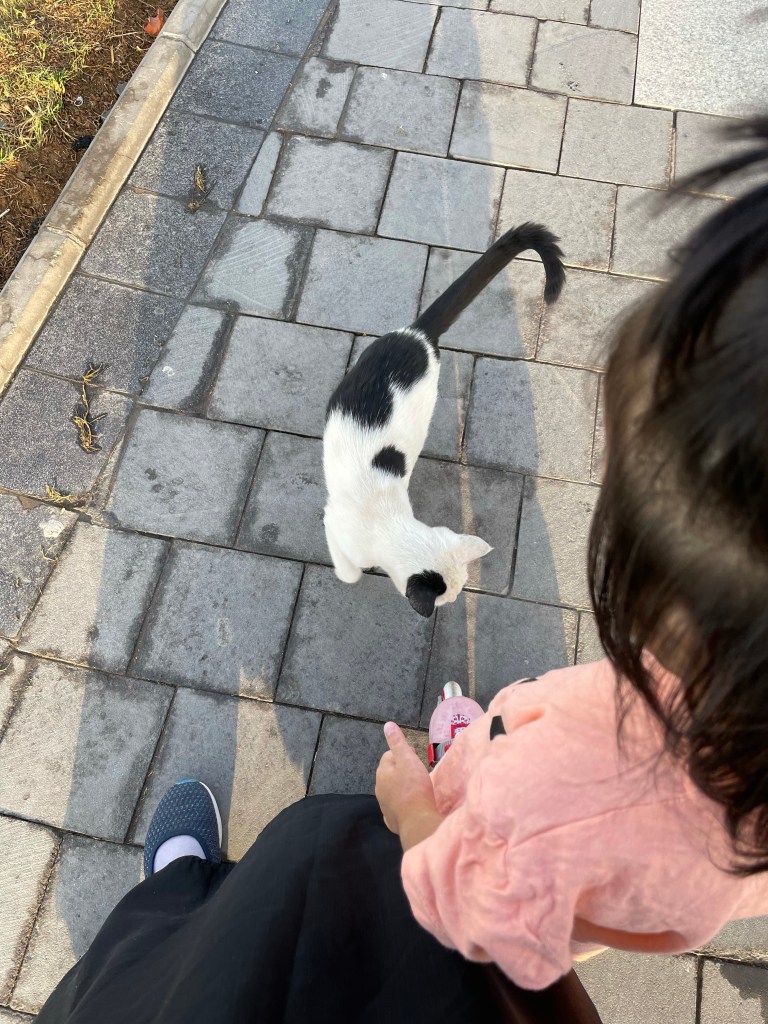
Start small- Sharing toys is a form of kindness. Feeding stray animals is also a simple act of kindness. Encourage them to do good. Share with them the virtues of kindness, the rewards that Allah had prepared for His servants who have kind hearts.
Maryam trying to skate and feed the cat at the same time
2) Model it to our children. Even if it is a simple action, it matters.
Children learn best through imitating. Show them from an early age how kindness looks like. Hugging a younger sibling who do not want to leave the playground is an act of kindness too.
3) Acknowledge that kindness is not always easy. There will be days that your toddler find it difficultto share her toys. What we can do is, coach/ remind them gently how other people might be feeling when we don’t treat them nicely. Children need time to grow. And so does kindness.
Jarir b. ‘Abdullah reported Allah’s Apostle (ﷺ) as saying: He who is deprived of tenderly feelings is in fact deprived of good and he who is deprived of tenderly feelings is in fact deprived of good.
In this second part of Arabic in our home series, I am sharing a few fun and hands on activities that we did in our house. Most of the activities are catered for my 3 years old daughter so these are very easy, no mess, quick and fuss-free ones inshaAllah.
What I would like to highlight is that, in setting up any activities for your child, lower your expectation. You might think that you had put in so much effort in setting up the materials, yet your child is only interested in doing it for 5 minutes! It is really okay! Let your child lead you to his own interest. Maybe you present it when he is occupied with something else, maybe he has unmet needs, maybe it is too easy/ too advanced for him. At the end of the day, learning should be fun , and if you as a mother stresses out, your child can sense it and no learning will be done.
Secondly, just like how different plants need different times to bloom, our children bloom at different time. You might think “Why is my child has the same age as someone else’s child yet that child can read books and our child is still learning ABCs? That is also something that I struggle with but really though, if maybe we focus more on our child instead of silently comparing him to others, we can actually see how our child progresses daily. How our child amazes us every single day (even though it is a hard work and you just need coffee to make the day passes by).
Ok, that is a long rant, but really though, I need that prep talk more than anyone else. I mean, Pinterest can give you a lot of ideas but take everything with a pinch of salt; learning can still be done without any activities- learning can be done with us-mothers- being present -be there for our children to live their childhood.
Moving on, I hope these activities can help you out during rainy days or during the days that you run out of idea. Please keep me and my family in your dua’s
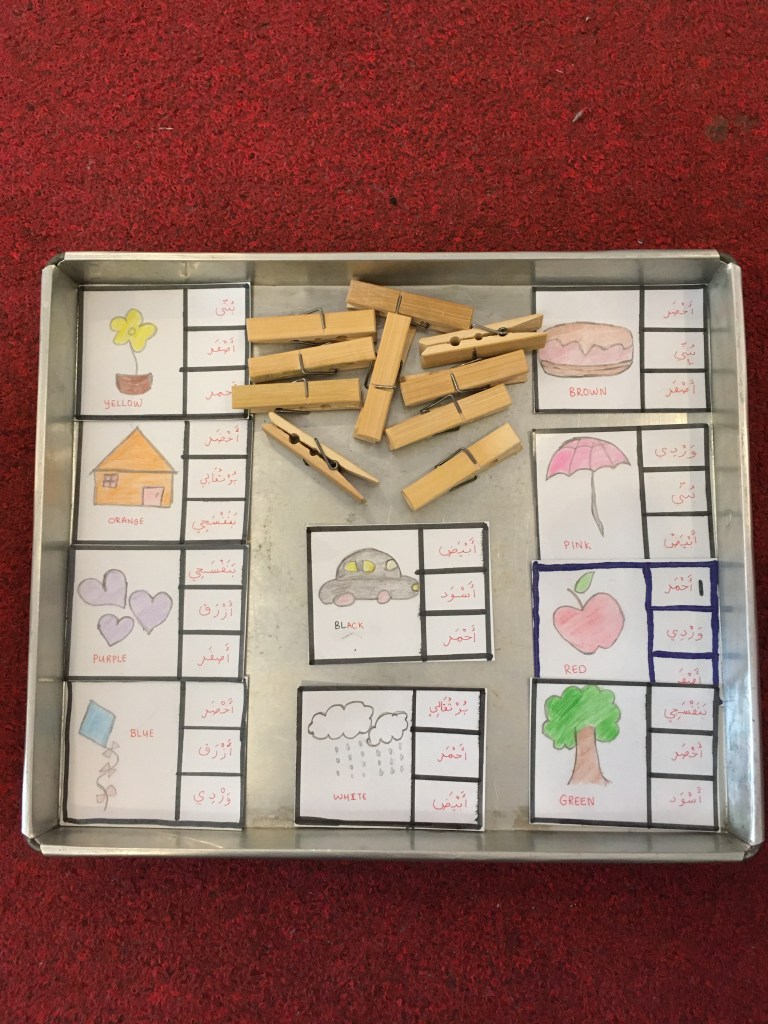
I made a clip cards for Maryam to learn arabic. Besides learning about colours, she is practicing her pincer grasp by using the pegs (Pincer grasp is important for writing – read more on this here )
I also made a few printables that you can purchased from our shop :
1) Arabic Hijaiyyah clipcards (you can view it here)
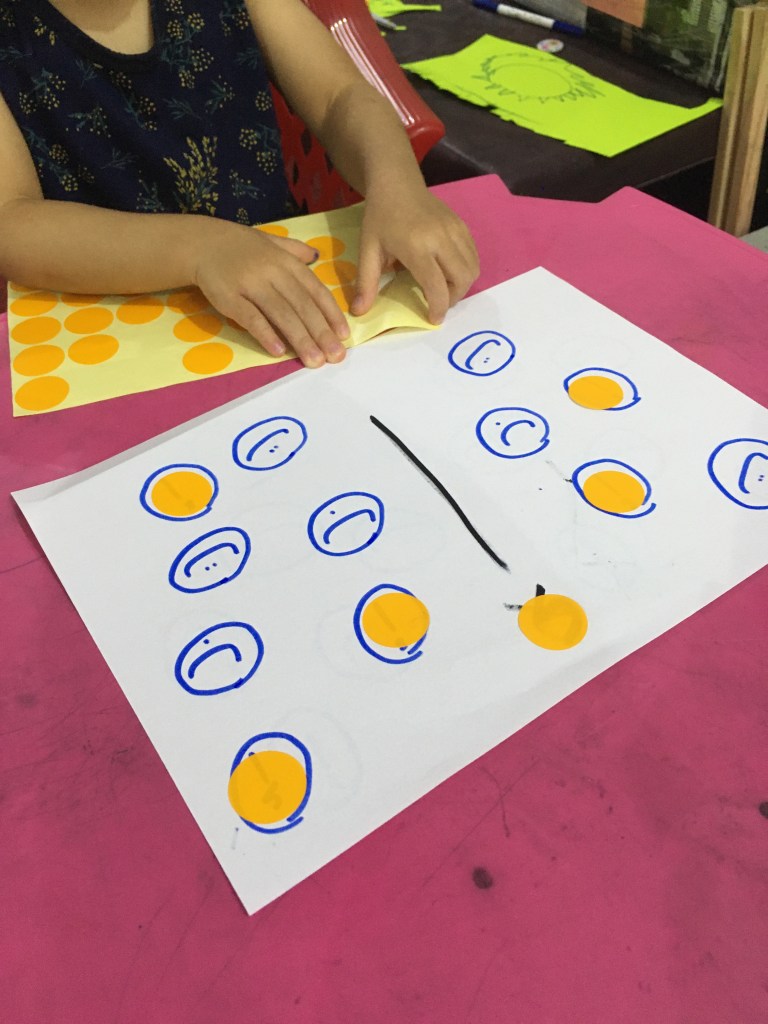
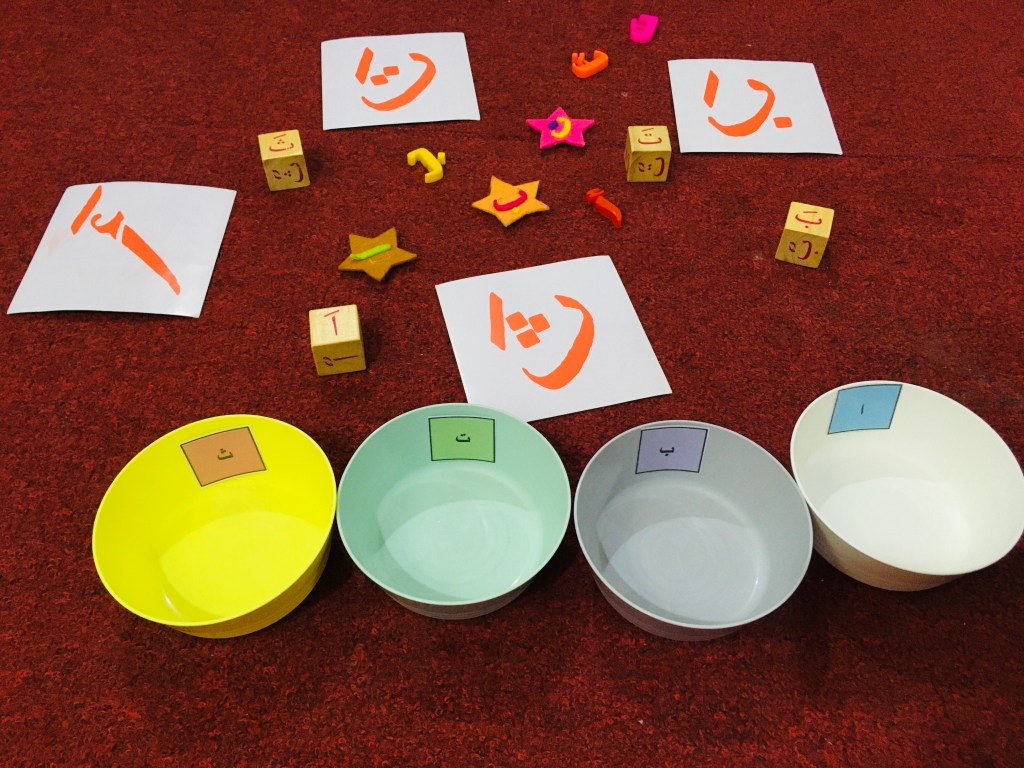
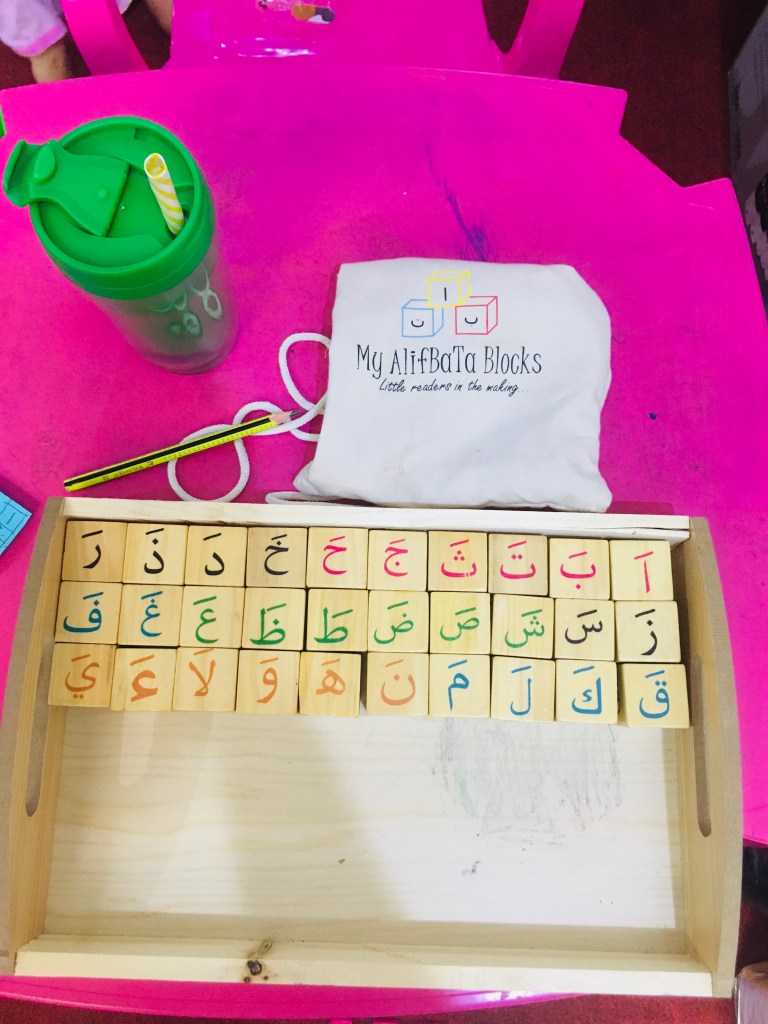
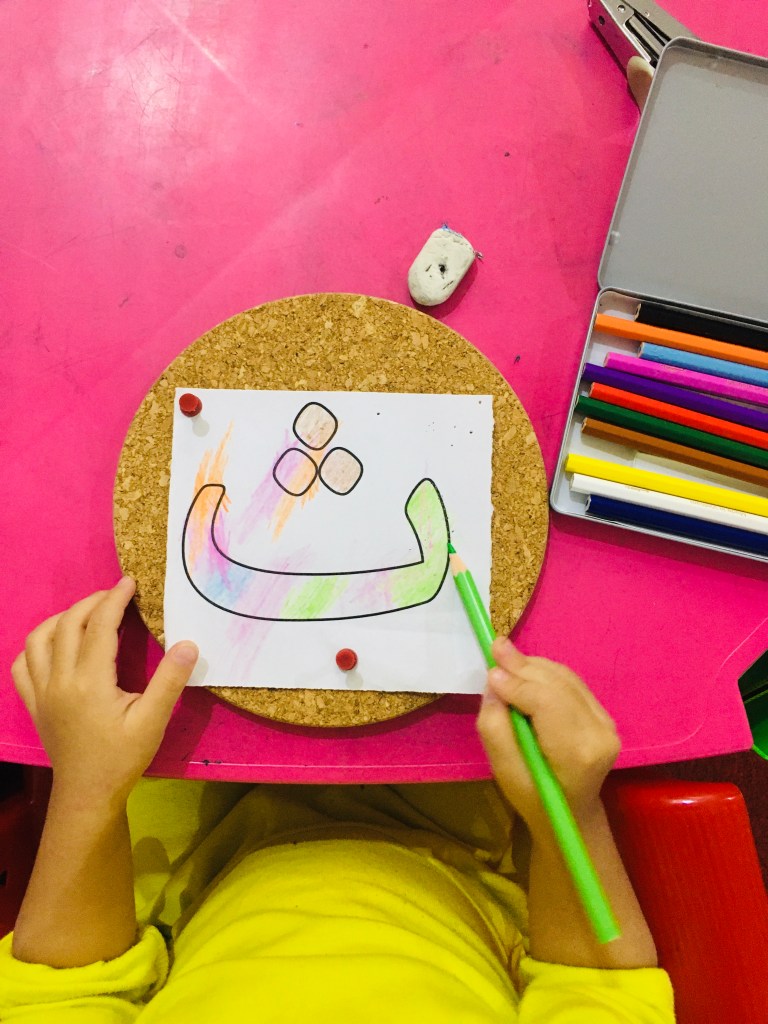
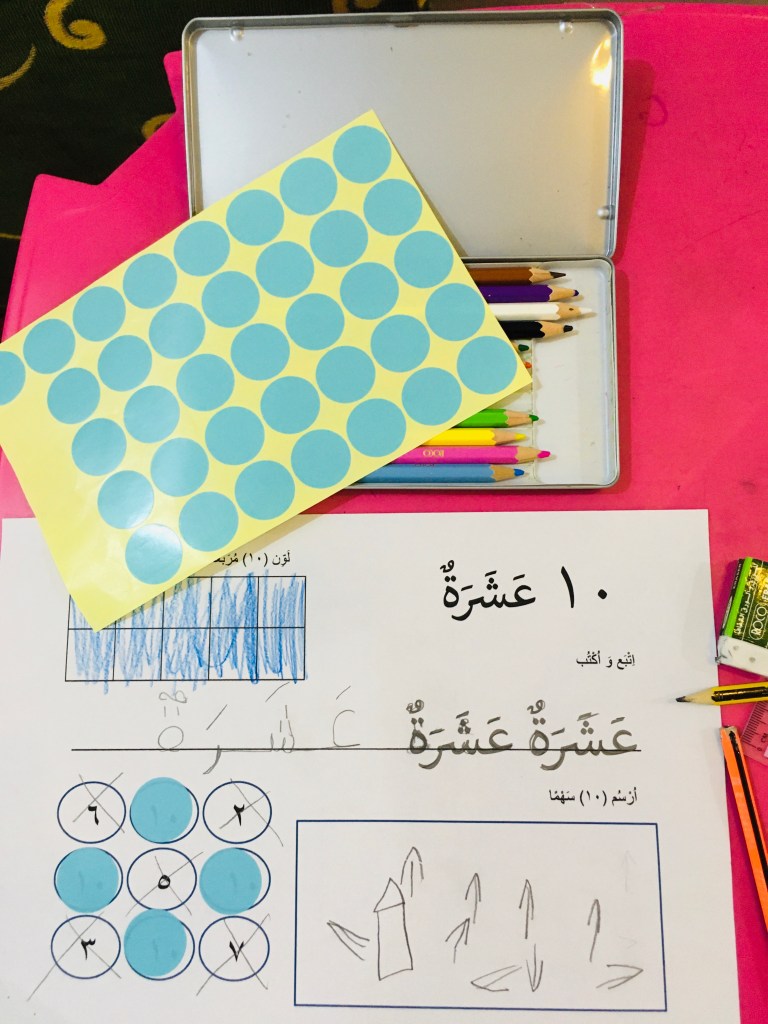
Huruf recognition through visual processing skills.Hijaiyyah sequenceLearning about arabic numbers with concrete materialsThe easiest, no-prep activity : Coloring!
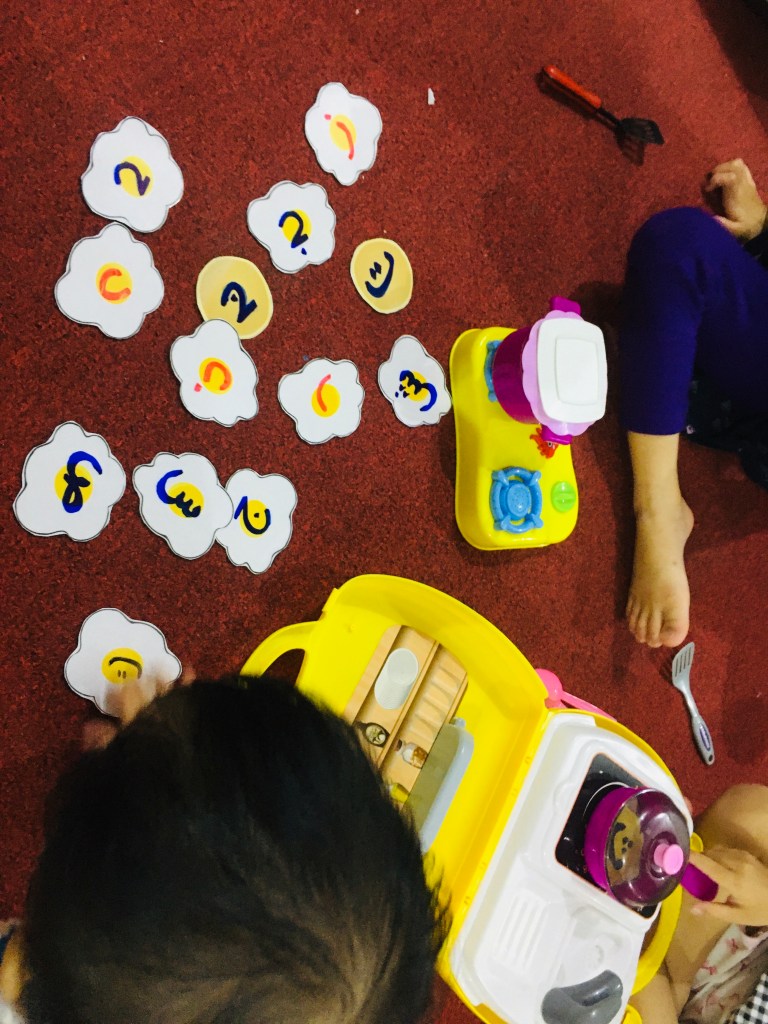
My girls love to play cooking, they can go on for hours. So I searched some clip arts from google , printed and laminated them and wrote the hijaiyyah hurufs. So we role-played making some hijaiyyah pancakes and eggs! also not in picture : some cookies clip art that I printed too- the children learnt arabic numbers by counting the cookies and baking them!
some art & craft time (please pardon my writing and drawing!)A bookish activity.
I hope you enjoy watching these activities as much as we enjoyed doing it! Please keep my children in your dua’as always.
We always believed that choosing the right books are very important for our children.
Good quality books not only help your children to read and gain knowledge but it widen their imagination and creativity, inculcate good moral values. All that without compromising our beliefs in Islam.
There are many best selling books written by renowned authors, but the content might not be aligned to our belief and cultural standards. ( for example do you know that Dr Seuss is actually racist? And Curious George series too- maybe I will write about it later).
But how do I help my child learn to read? And how do I expose him to different literature or readings?
Well I am sure there are many different types of books that we can get our hands on. Some important points that we need to look out for when choosing books for our children:
1. Books that are aligned to our moral values and standards.
Choose wisely and try to read the books first before you introduce it to your children. I would really suggest reading the whole book instead of just reading the synopsis at the back of the book. At this period of times where some books are written to embrace “diversity” or “ freedom of choice” (think LGBTQ ), these “movement” are being slipped into these innocent young adult books without the parents/schools/ society even realising it.
There are a few books whose characters are openly bisexual and it is not mentioned at all at the synopsis. And the worst part is? Some of the books are written by Muslim authors! Allahul mustaan!
As muslims parents aiming to raise your children with strong Aqeedah, try to provide reading resources and materials which resonates our Islamic method of Tarbiyah (upbringing).
Books that promote good characters are truly gems! These books help to instill and build strong personality in our children.
2. Books with no sorcery or fairytales influences.
Fairytales princesses in exiled waiting to be saved,or children studying in a sorcery boarding school might seem harmless. But why contradict yourself when you are teaching the Oneness of Allah and magical fiction books are in your household?
Tawheed in Arabic means attributing Oneness to Allah and describing Him as being One and Unique, with no partner or peer in His Essence and Attributes.
The opposites of tawhid is shirk. Magic contains shirk which is something Allah warns us against.
If you grow up reading HP books or watching disney princesses, stop the trend there. Don’t let your child continue that shirk culture. You might think that it is harmless and these kind of books are just for casual reading. But I don’t think you should negotiate anything when it comes to our Aqeedah. These books are not befitting for muslims. They contain magic which are not permitted in Islam.
Here I will attached a link on the opinions of the Scholars of Islam in this matter:
I would like to add that choosing the right level of early reader is equally important too. You do not want something that is too easy that your children get complacent in reading or too difficult that they despise reading. Early reader books should grow with your child. Going up stage by stage slowly but surely.
4. Picture books.
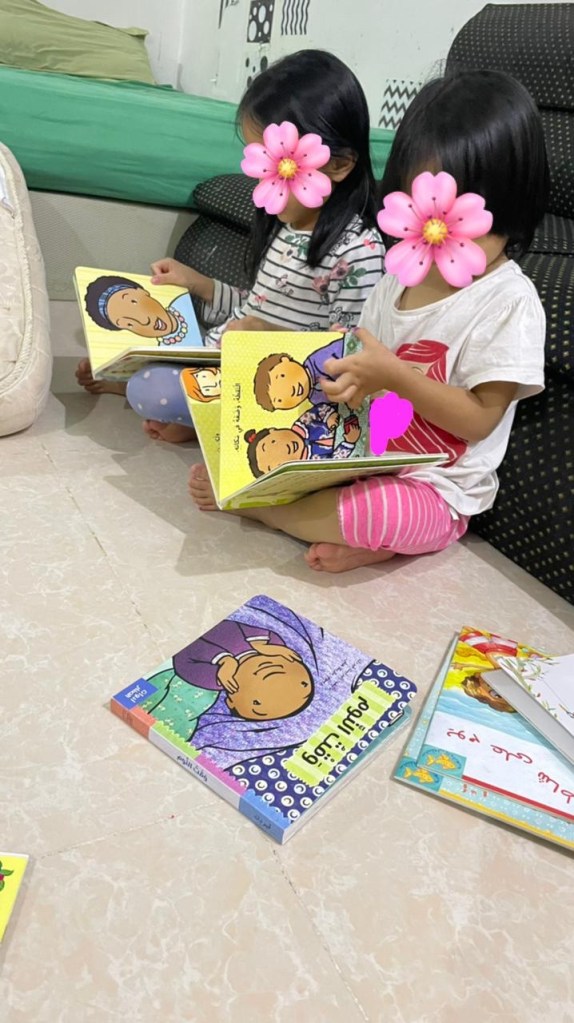
Picture books are usually targeted for kids from 2 years old to maybe around 7 years of age. They use pictures or illustrations to tell the story. Usually the storyline is something relatable to the daily lives of the children. The author might touched on life lessons like forgiveness, kindness , helping each other etc).
5. Fiction vs Non-Fiction books.
Personally I love to introduce to my children non- fictional books. Reading about the world, the space and under the sea confirm what Allah has revealed in the Quran 1400 years ago yet the scientists only discovered it now.
Book: begins here Ummi series (an amazing series that explain the attributes of Allah)
Non fictional books focus on important and beneficial things in terms of science, literature and arts.
Stories from the Quran, stories about the prophets (Peace be upon them all) Seerah Nabawiyyah, the lives of the companions (Radiyallahu ‘anhum)- all these are great reading resources. Children learn about their deen, about Islam and learn about the virtues of these amazing characters.
Do however take note of the sources of these stories. Make sure that they come from an authentic source (Al-Quran and Sunnah). Also I avoid showing books that illustrate the Prophets’ images. I strongly feel that it is not appropriate at all.
Biographies are great too. More so if it is about Muslim greatest people (example would be Ibn Batuta, Ibn Al-Haitham and more).
There are a few scholars who adviced that reading or writing fictional books are considered lies therefore should be avoided.
Introducing fictional books for the purpose of education and enhancing reading skills might be less damaging ( أخف الضررين) if the books are morally sounds so it is really important that we are cautious in giving fictional books for our children. I think it is easier for younger kids but for young adults , try to steer them away slowly inshaAllah.
I hope our children grow up to become book lovers and reading becomes a connection between us (parents and our children) and ultimately learn to be a true ‘Aabid (servant) of Allah.
We have been doing the one parent one language method. Though it helps a lot, it occurs to me that my daughter’s vocabulary is not expanding as much as we hope. Also, she had been trying to avoid using Arabic language whenever my husband speaks to her. Which I think is because of her lack of confidence and maybe she sees how both of her parents communicating to each other in Malay. So she came to a conclusion “oh I am going to speak in Malay/English too since that is what I heard mostly in this house”
So we restrategise.
Continue with the one parent one language method. Consistently!
Pique their curiosity.
This is actually my husband’s plan. Both he and I try to speak Arabic at some random time of the day. We will break into arabic language in a middle of a conversation. Like randomly. Make the “staged” conversation as lively and funny as possible. You should see how the kids literally dropped their toys,come closer to us and went “what did you say to Ayah?” Or “why are you laughing??”
And then we just continue the act.
The idea is to make them listen . Kids are inquisitive people. (Mine especially) They want to know every single stuff that happens around them. They want to be included. So we always tell them, “ok lets try to talk in Arabic so you will understand what we are talking about.”
The other day, my husband said to me in arabic that he wants to go buy some ice-creams. The kids were playing legos and Marya literally shouts “i want one too!” So i think this tip might works!
Introduce “speak only arabic” day on weekends.
Exposing her to new arabic immersion environment. How does it works?
Fortunately walhamdulillah, we got an offer to move to an apartment building which houses students from Islamic University of Madinah. Most of our neighbours are native arabic speakers (mainly from Egypt, Yaman, Lebanon, Algeria). There are a few non native speakers too. So every evening, the children in this building will play at the roof-top together. So that is how my kids acquire Arabic language – speaking and listening. The progress from this method is so much faster compared to our other previous methods. This is due to the same age peer communicating in a fun playful environment. (Learning is easier when it is fun!) 2 weeks of only playing with the neighbours, my daughters came back home every day spewing arabic words / phrases . They made mistakes but are more confident in speaking and responding. MashaAllah tabarakallah.
This new method reiterates my view that you can teach your child by doing “sitting down” works, flashcards drills, daily worksheets. But kids must still be allowed to be immersed in an unstructured play and be in a laid back environment.
We also have allocate a 20 mins screen time where the kids can watch arabic shows. We hand picked and checked/verified these cartoon shows before showing it to our kids. These cartoon shows must have : minimal music, use proper arabic language (fusha), no violence/shirk contents. Difficult? Yes! But there are a few reliable ones in youtube alhamdulillah.
Reinforce read aloud session.
Read aloud sessions are a must in our house. However this time round, we allocate more time and revamped our book shelves. This means that :
1)more arabic books are displayed on the shelf (as compared to english books)
2)choosing arabic books with simpler texts and good illustrations.
Below I will share some snippets that I got from a workshop organised by sister aisha from arabicwithkids(instagram)
Takeaways from “storybook reading strategies for non-native families” workshop by arabicwith kids.
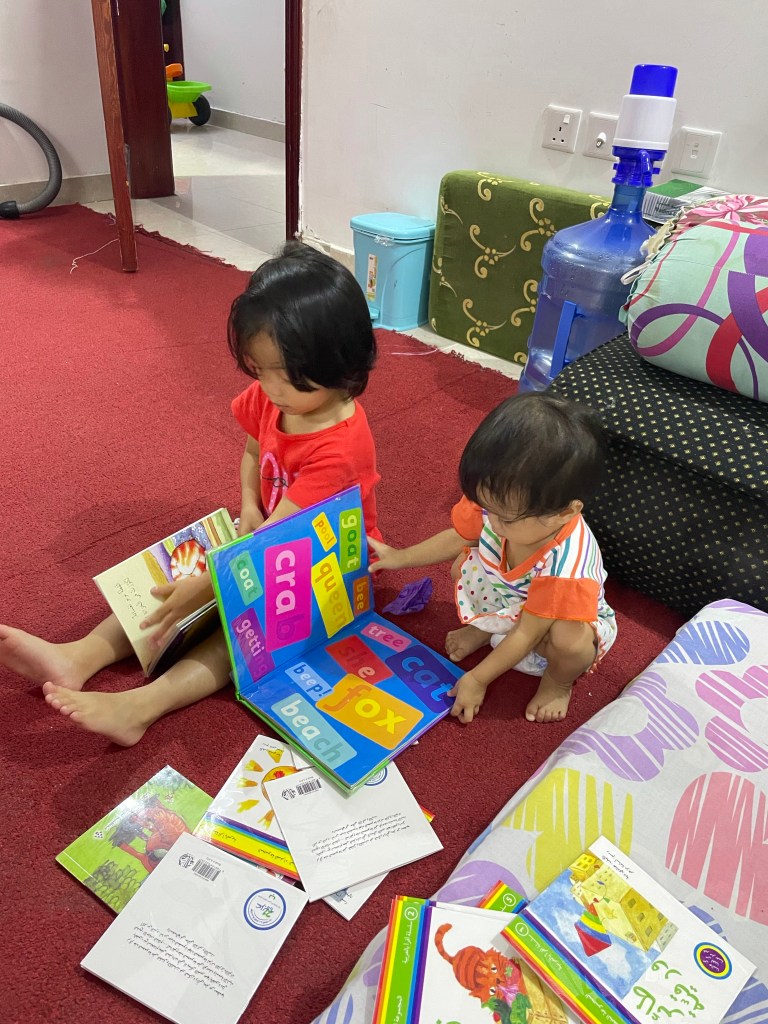
One way to teach arabic language is to expose them with arabic story books. So they will be familiar with arabic texts.
In choosing books: choose books that are designed for us to learn the language well.
(Think: simple repetitive texts and engaging illustrations)
If you want to focus on arabic language, place the books that are accessible for your children. Choose where to display them in such a way that the arabic books are not mixed or “overshadowed” by books with other languages.
Read beforehand . To familiarise yourself with the storyline and practice on your own’s pronounciation.
Start reading. Put down the pressure of them sitting down in front of you to read. Just read out loud even if they seems unattentive or playing (passive exposure)
There is no need to translate word by word. The idea is to let them hear arabic words more.
Use finger to point. This way the more you repeat the story, the more they are familiar with the word.(indirect way of learning vocabulary through sight words)
Illustrations are important. Make use of the illustrations (if you do not understand the meaning, let the picture helps to explain the storyline. talk to your children about the picture, include in simple phrases)
Include books in study unit. (Bringing the story out of the book).
Lastly, we are trying to implement Brave writer method in our homeschooling.
Brave writer method bu Julie Bogart is a program that helps both parents and child to be ‘writing partners’. It guides parents to be their children’s writing coach.
So the first natural stage of growth in writing is the JOT IT DOWN program aimed at 5-8 years of age.
This program encourages parents to transcribe whatever the child says.
Have something exciting to share?
Grab a pen and paper and write it down!
Went on a holiday? Jot it down!
So what I did was, whenever we went out as a family outing, I invite my daughter to recount her best memory of the trip and I write it down for her. I then make it into a mini-book.
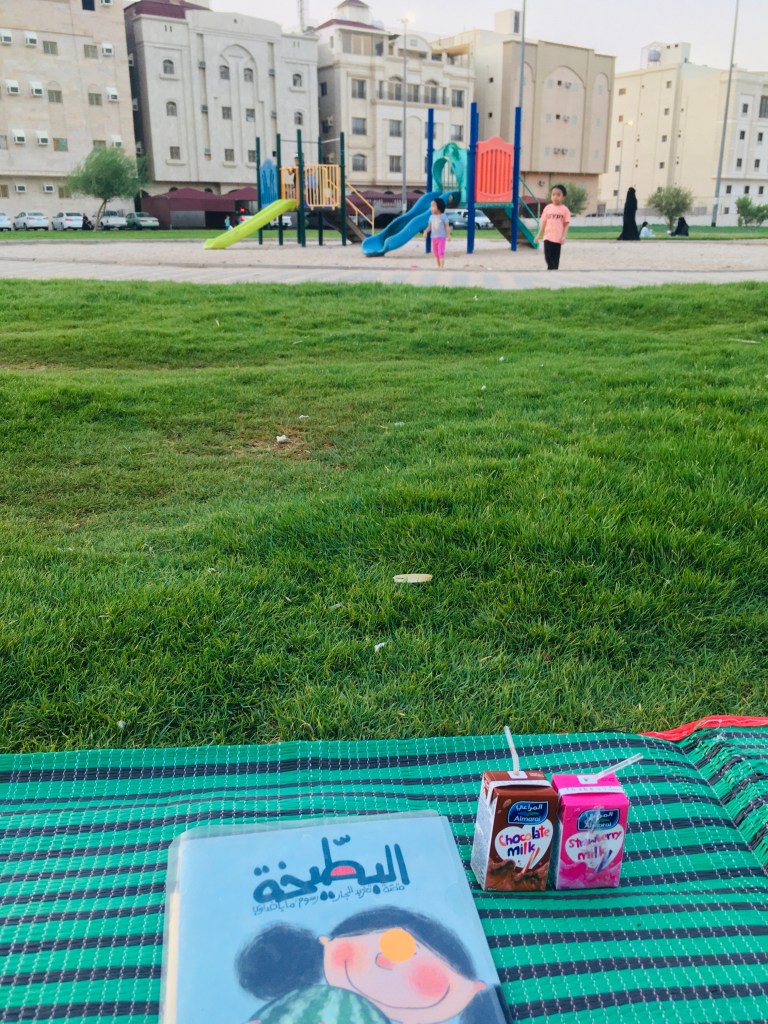
An example : a picnic at the park written by Marya Noura
The words are hers , i merely transcribed her words. There are grammatical errors and sometimes she forgot certain words. But I encourage her to continue telling me her story.
She will then draw or colour in the pages and when she is satisfied, we read it together.
I do not change her storyline. I leave it as how she recounts it to me. If she is stuck, I prompt her by asking questions. I do however make grammatical changes ONLY and AFTER she is done.
So that’s about all. Hopefully my little sharings benefit us all. If you have ideas on how to make learning language more interesting, share it with me!
These past few weeks had been rough in our household. Both of my daughters had trouble channeling their emotions in the correct way. They get irritated and triggered easily. To be honest, There were days where I lose my cool Allahul Mustaan. But as the days go by, things are getting better and a lot calmer. Here I will share a few important points that I took to manage our household.
Finding the root cause.
Toddlers are impulsive which means they cannot control themselves . So when they are angry or frustrated, they would just burst. I mentioned before that a part of a child’s brain which control his impulsiveness has not fully developed and is under construction until he is in his early 20s. Thus they find it difficult to reason out their actions. They tend to act emotionally.
So if a child misbehaves, it is most certainly they feel threatened by something and could not express it to adults.
In my case, the major reason for the misbehaviour is their sleeping pattern which changed during Ramadhan. Ramadhan during summer in Saudi Arabia would mean longer day times and since it is Ramadhan, no one sleeps after taraweeh. Daily lives begin after ‘Asar . Bustling activities starts after taraweeh right until fajar. Its normal to do your grocery after midnight. No shops were opened until zuhur. Even office hours are pushed back from 10am to 2pm only.
Ramadhan in Saudi is very “alive” in the sense that people maximise their time doing ibadah yet it distrupt our sleeping patern. Adults can easily adapt but kids (mine especially) struggle with it. Post ramadhan, they would only wake up after Asar. This means that they are so refreshed all the way past their pre ramadhan bedtime.
A change in sleeping times mean major emotional turbulence for the kids.
Another major reason for this instability of emotion is the lack of outdoor activities. I always believed that outdoor play is very important for children’s mental and health beings. Being outdoor -in nature- just ignites all the senses in our children. They can see smell hear and touch the environment outdoor. They can run free. This is a channel for them to release all of their feelings/thoughts safely.
Research shows that children who play outside are more happier, more focused,more attentive and less anxious than children who spend their days indoor.
In my case, I believe that lack of outdoor activities due to the pandemic and extreme hot weather during this summer in Saudi contribute to my children being emotionally drained.
So how do we do it?
Connect before correct.
If you want your child to cooperate, you need to connect first. The more the kids feel connected to you, the easier they will cooperate with you.
Connecting with your child means offering safety and a sense of “openness”. While punishment or scolding can lead to more power struggles and create fight, flight or freeze.
Connecting means you are telling your children “I know what you are feeling and I am here to help you”
So how do we connect with our children? We connect with rahmah- being merciful to them. And what better example than our beloved prophet Muhammad PBUH.
Rasulullah PBUH as our role model.
Prophet Muhammad PBUH was gentle and loving to others especially children. Have you heard about the story where Rasulullah PBUH kissed his grandchild Hasan RA when he came to him PBUH?
“Rasulullah PBUH kissed his grandson Hasan when a man named Al-Aqra was sitting with him. Al-Aqra said, “I have ten children and have never kissed one of them.” The Prophet looked at him and said, “Whoever is not merciful to others will not be treated mercifully.” (Al-Bukhari)
Be emphatic.
Parenting expert Dr. William Sears cites numerous studies that show that the two most important enhancers of a child’s brain development are the quality of the parent-child attachment, and the response of the caregiver to the child’s emotions.
So during the emotional outbursts of our child, how we react/our response matters.
Try this: the next time your child comes to you complaining that her younger sister does not want to share her toys, instead of you shushing her off or tell her to let the matter go and give in, be emphatic and validate their feelings.
Go down to their level, hold their hands and look into their eyes and empathise by saying “you really want that toy isn’t? You feel sad that your sister wants the same toy that you are holding? Hmm I wonder what we can do”
You can offer suggestions on what they can do and wait for them to figure out themselves.
One major benefits of being an emphatic parents is that not only you try to help improve your relationship with your child, the child himself learns that he is loved and cared for and thus easier for him to “set boundaries and solve problems”.
A point to note, in order to empathise to our children, we as parents must learn first how to be self emphatic on ourselves. This means giving own selves breaks when things get a bit too much. You listen to your own feelings and be aware of it. You find ways to cope and manage your emotions. And I believe self empathy can be mold by improving our relationship with our Creator. Reading Quran, reciting the Azkar, doing Nawafil – all these help you become more calm and composed. Filling your child’s cup is much easier this way when your emotional cup had been filled with all this goodness.
Be calm.
Author of gentle parenting books, Dr Laura Markham said that : “your number one job as a parent after assuring the safety of your children is to manage your own emotions”
Trust me, I struggle a lot with this! Subhanallah. When my child gets cranky or they are fighting over something, i really try to stay calm. I try not to let their squabbles get to me . It takes a lot of practice and effort on my side to remain calm and collected whenever the kids are having a hard time managing their emotions. There are days when I succeeded and there are days where I believed that my emotions get the better of me and my neighbours can even hear my yelling.
But one thing’s sure, your kids would never listened to you when you are yelling. Emotional outbourst from them and emotional reaction from you, are not going to help anyone in the household. So the key is to seek refuge with Allah from syaitaan and take deep breaths before any actions.
Rasulullah PBUH never acted out of anger or harshness- not to any adults nor children even.
Abu Hurairah said: “A Bedouin entered the mosque when the Messenger of Allah (peace and blessings be upon him) was sitting there, and (the man) said: ‘O Allah, forgive me and Muhammad, and do not forgive anyone else with us.’ The Messenger of Allah smiled and said: ‘You have placed restrictions on something that is vast.’ Then the Bedouin turned away, went to a corner of the mosque, spread his legs and began to urinate. After he had a better understanding, the Bedouin said: ‘He (peace and blessings be upon him) got up and came to me, and may my father and mother be ransomed for him, he did not rebuke me nor revile me. He (peace and blessings be upon him) said: “This mosque is not for urinating in. Rather it is built for the remembrance of Allah and prayer.’” Then he (peace and blessings be upon him) called for a large vessel of water and poured it over the place where I had urinated.” (Sunan Ibn Majah)
Subhanallah! What a beautiful character shalallahu alaihi wasaalam! Now do you remember the time when you are toilet training your toddler? Do you remember how many times you lose control of the situation when the kid accidentally urinates on the floor? Compare that situation with how Rasulullah PBUH reacted back then.
Speak slowly and instruct with clear and concise sentences.
Abu Abdullah Al-Khadali reported: I asked Aisha about the character of the Messenger of Allah, peace and blessings be upon him. Aisha said, “The Prophet was not indecent, he was not obscene, he would not shout in the markets, and he would not respond to an evil deed with an evil deed, but rather he would pardon and overlook.” (Tirmidhi)
Anas ibn Malik reported: I served the Prophet, peace and blessings be upon him, for ten years. By Allah, he never even said to me, “Uff!” He never said harshly for anything, “Why did you do that?” or, “Why did you not do that?” (Bukhari and Muslim)
The greatest man ever walked on earth, Rasulullah PBUH speaks with a quiet voice, he never shouts. So why, we as his ummah,would resort to shouting when our children makes mistakes?
The Quran also mentioned in surah Luqman about how we need to lower down our voice.
And be moderate in your pace and lower your voice; indeed, the most disagreeable of sounds is the voice of donkeys. (Quran, Luqman 31:19)
I am not going to sugarcoat this sharing by saying that I never shout at my children. I shouted before and I am pretty sure I am going to shout again in the future. I am far from perfect. But I hope this sharing would at least motivates me personally to always try to be better for my children.
Shouting can be seen as the easiest and fastest way to attract your kids attention. They made a mistake, you shout at them. They got scared and they grudgingly follow your instruction. End of story. Right? Nope! It may quiet them and make them obedient for a short while but it won’t make them correct their attitudes or behaviour.
Shouting teaches your kids to fear you instead of them understanding the consequences of their actions.
Shouting makes children feel insecure and anxious,they feel more aggressive while calmness makes the children feel loved and accepted even if they misbehave
Another point to add, whenever Rasulullah PBUH gives out instructions, he would give it in a clear way. Short and concise.
Umar ibn Abu Salamah reported: I was under the care of the Messenger of Allah, peace and blessings be upon him, and my hand used to roam about the dish. The Prophet said to me, “O young man, mention the name of Allah, eat with your right hand, and eat what it is front of you.” (Bukhari and Muslim)
From this hadith we can derive that Rasulullah did not scold the sahabah for his mistakes, instead he PBUH focuses on what is the correct way – with clear & short sentences.
I am trying to implement this in our household too. For example, Marya always forget to hang her clothes after use. So whenever she wants to change clothes, I’ll give her a few minutes (without reminding) to see if she remembers to pick it up from the floor. After a few minutes she might pick it up. At times when she needs a reminder, I will save my energy from yelling by just tapping her on her shoulder and say “ you forgot something” she will realise soon after. If not i will change my words by saying “marya, you need to hang this pants here” and show her where- a direct and specific instruction.
Kids need constant reminder. That’s how they work things out. Be patient. We were once young too.
Acknowledge good behaviour.
When we acknowledge positive behaviour, it is most likely to repeated. They will be encouraged to do good when they are noticed. So the cycle will continue inshaAllah.
Conclusion.
Gary Chapman, author of the book The Five Love Languages, and he quoted a psychiatrist named Dr. Ross Campbell. “Inside every child is an ‘emotional tank’ waiting to be filled with love. When a child really feels loved, he will develop normally, but when the love tank is empty, the child will misbehave. Much of the misbehavior of children is motivated by the cravings of an empty ‘love tank.’”
It takes a lot of time and effort from our side as parents to take charge of our household positively. On days where you reacted unaccordingly, know that Allah will always help you and that you will always have the time and space to improve. Better days ahead ummis!
I pray that Allah guides and eases our journey to be a better parent for our children inshaAllah.
Schedules. Routines. To-do lists. Daily organisers. You name it. It is so common to see how people in general try to have a structured planning in their lives daily. On today’s topic, I would focus more on how Stay-at-home mothers can manage their day constructively without having a burn out.
Truth to be told, Stay at home mothers’ daily schedule can be mundane. I can attest to that. Waking up at Fajar, Quran time, making breakfast, doing the dishes and laundry, homeschooling the kids, outdoor activities, doing lunch and dinner -all that while making sure the kids are behaving and healthy- every.single.day.
I mean, it is not like we have an urgent meeting to go or an important client to meet. But all those daily to do lists can be overwhelming especially when the mother had no proper daily schedule. She definitely would have a meltdown(just like her toddler who is around her leg all day while She is busy doing her household chores).
You might have seen or buy those daily planner where you can jot down your to do lists. You can chunk everything in one day. But sometimes it can be unbearable. Too many things to do that you just don’t know where to start!
My number one tip is : relax! Take a deep breath, sit down and drink that coffee before it gets cold again(it’s ok to have a second cuppa even though it is not even lunch time yet).
The next thing i would suggest is finding your purpose and setting your priorities.
In Islam humans are created for the sole purpose of Ibadah.
“And I did not create jinns and men except for My worship alone. I did not create them to make a partner for Me” (Az-Zariyat:56)
And the first thing you will be asked upon at the hereafter is Solah.
It was narrated from Abu Hurayrah that the Prophet (peace and blessings of Allaah be upon him) said: “The first thing among their deeds for which the people will be brought to account on the Day of Resurrection will be prayer. Our Lord will say to His angels, although He knows best, ‘Look at My slave’s prayer, is it complete or lacking?’ If it is complete, it will be recorded as complete, but if it is lacking, He will say, ‘Look and see whether my slave did any voluntary (naafil) prayers.’ If he had done voluntary prayers, He will say, ‘Complete the obligatory prayers of My slave from his voluntary prayers.’ Then the rest of his deeds will be examined in a similar manner.”
(Narrated by Abu Dawood, 864; classed as saheeh by al-Albaani in Saheeh Abi Dawood, 770).
So if you now know your purpose in life is for the worship to Allah; does vacumming the house twice a week be one of your main priorities? I am not saying that it is not important- but really,
You can have a million thing to do in a week, but does it matter as how you try to find perfection in your Salah times?
Let me put if this way, if you try to put Salah on your top priority and perform it at the earliest time , you can definitely conquer your day. Because there is barakah in your time. And that is what we want- a productive day filled with the remembrance of Allah.
Abdullah ibn Muhammad reported: My father and I departed to see our father-in-law from the Ansar, visiting him as he was ill. The time for prayer arrived and he said to some of his relatives, “Young lady, bring me water for ablution that I might prayer and be comforted.” We objected to that from him, but he said, “I heard the Messenger of Allah, peace and blessings be upon him, say: Stand, O Bilal, and comfort us with the prayer.”
Source: Sunan Abī Dāwūd 4986
Grade: Sahih (authentic) according to Al-Arna’ut.
Prayer is the most important pillars of Islam. There is a spiritual relationship between you and Allah, where the heart becomes at ease – an escape from the troubles of the world.
Let the 5 daily prayers be a breather for your busy day. See it this way, Allah calls upon you to “meet” Him 5 times a day in which you can “talk” to Him about your daily struggles. Some sort of winding time.
What we can do is, make our 5 daily prayer as 5 different periods of “recess time”.
That brings us to our next point which is to list down our other daily routines. And where to shuffle it around our Salah times.
This “method” might seems more relaxed and manageable because you don’t rigidly put a specific timing for specific chores.
After listing down your to do lists; you can see that between Fajar prayer and Zuhr prayer is a big chunk of time where you can put in major daily chores at a bigger time frame. Chores that require you to be more physically active. Like doing the laundry, vaccum, prepping meals etc.
Between Zuhr and Asar prayers are a shorter period of time so choose chores which is more laid back and does not require much energy. I also do homeschool during this period because I am the type of person who can only teach wholeheartedly when my major chores are ticked off. Younger kids are getting their nap times too so less distraction for the older kids.
Between Asar and Maghrib time is more suitable for outdoor trips/activities. Let the kids release their energy during this time. So they will get tire of easily and sleep earlier.
Between Maghrib and Isya should always be Quran family time because it is such a short period of time that you can do revision on the surahs you memorised.
After Isya would best be bedtime routines, reading session with the kids, folding laundry kind of stuffs.
Before and after Subuh is actually the perfect me-time for stay at home mothers. You know how you spent the rest of the days with the kids listening to their stories that you can’t even hear yourself? This is the perfect time to clear your thoughts. Do something enjoyable for yourself. Make your own morning routine. Review your planner on what you are going to do that day- See how you can blend it in your daily prayers.
On days that you can’t manage it all, find solace in the next daily praye and drop that chore that bugs you at the back of your mind. You can just move it to another “recess time” or you can postpone it to other days
The key here is just to work your daily schedule into your daily prayers- everything will then fall into places beautifully. Putting Allah as your main priority, Allah will then ease your other affairs inshaAllah
May Allah make our days productive and filled with barakah and may Allah always lighten the burdens of mothers trying to raise their children to be more God-concious .
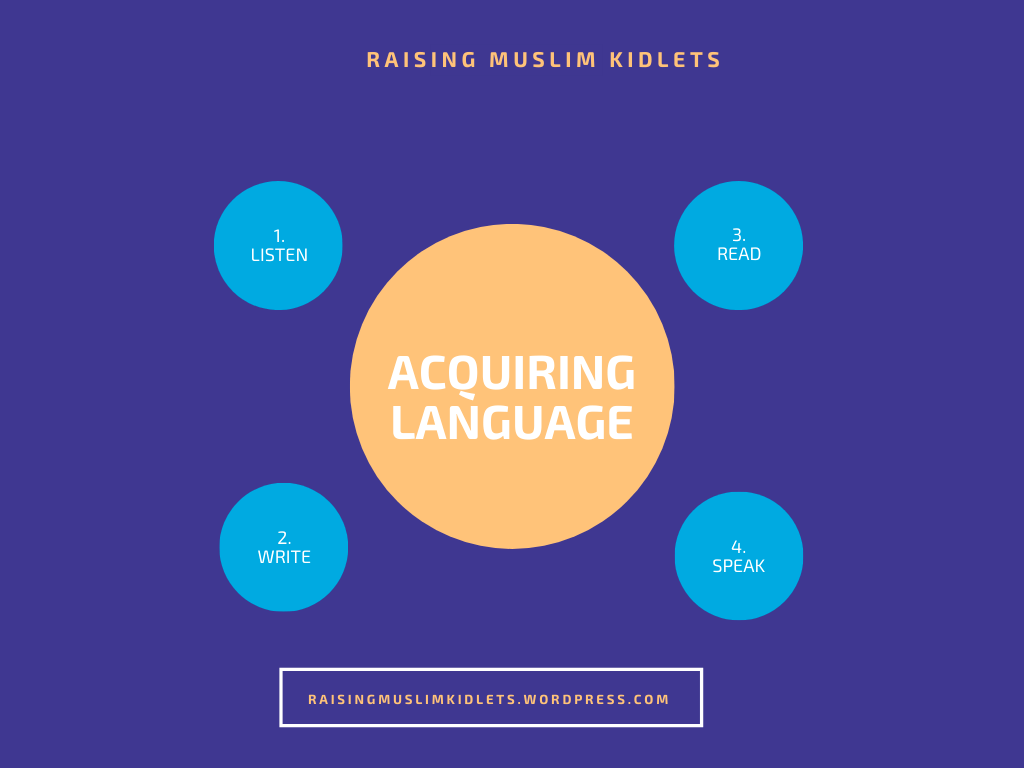
Children take up languages through interaction. Be it from their parents, other adults or even with their friends. Learning a second language can be intimidating. But do you know that giving an early head start proves to be beneficial because children below the age of 5 use the same part of their brain to acquire another language just as they learn their mother tongue.
Children also learn faster because they are more confident and are not afraid/shy when making mistakes.
Learning language through listening can be divided into two; passive listening and active listening.
Passive listening:
Giving audio materials without properly listening to it/not paying close attention.
This type of listening is very controversial and some may think that it won’t work.
Personal view: Quran recitation has always been played in the background every time my children are playing. We turned on the Quran on the road in the car. We even downloaded a few of the children’s cartoon and muted the characters’ voices and switch on the Quran audio. And I can safely say that this method has a big role in helping my daughter’s first step in Quranic memorisation. They passively listen to the recitation when they are playing and slowly pick up the verses and are able to follow the recitation.
Passive listening can actually benefit you in such a way that you do not put in much effort yet somehow whatever you are listening to gets into the back of your head and you get used to the sound pattern.
Active listening:
Active listening is when you put your focus and listen carefully the words being told. You are engaged and can even interact upon hearing those words.
Ideas:
Download audio books that your child can hear the stories being told. To familiarise them with the sound. Podcasts work too. But you have to find a suitable material for your child’s level. Don’t find something too difficult lest it might bores your child.
Personal view:
I downloaded the KUTUBEE app (http://www.kutubee.com) which carries hundreds of e-books for children (English, Arabic and french). This apps allows you to choose and download a book, record your own voice to read or listen to it. You need to purchase it though but they have a free one month trial. My children love it.
At first they just listen to the audio book and after a few sessions they can follow the reading Alhamdulillah. It is extremely helpful if you are trying to find early reader books in Arabic.
Our child can learn a new language when they hear we speak to them. So yes parents! We are the ones who need to start the ball rolling. At first they might seem nonchalant but the words are being absorbed without us realising it. Don’t be afraid to make mistakes. I think it is quite adorable when we learn together with our child and pick up a new language.
2. Write
Many of us grew up learning to read first and then write. But from Montessori point of view, writing comes first before reading. Of course there are many views on it but personally I resonate well with what Dr Maria Montessori said.
Why is this so?
If you think it this way, reading is actually more difficult than writing. Reading is like an external thing for your child- a whole different world for them. They have no idea on the words in the book unless they decipher the meaning- by sounding out the words and blending .
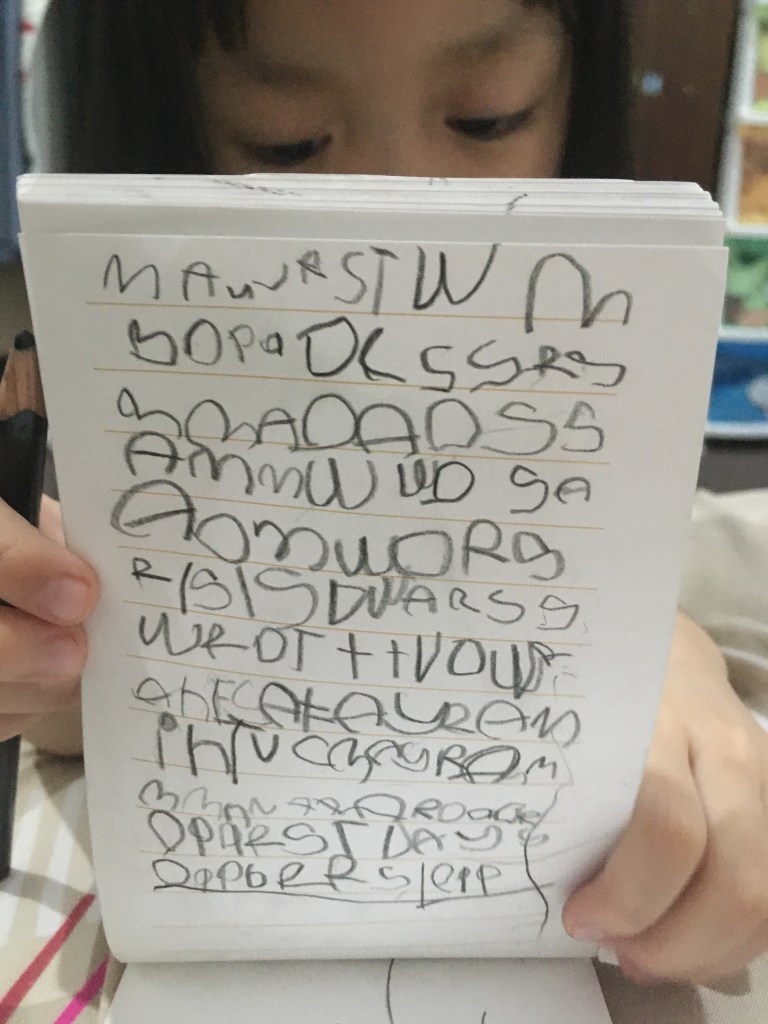
While writing comes naturally to us. It is like transforming our thoughts into words on a paper. So do children. Have you seen how a child scribbles gibberish words and try to explain it to you? They are simply expressing their thoughts and jotting it down on paper. As lessons are spread onto them, they will learn to spell out the words in a more accurate way.
In Montessori, children are taught the sounds of the alphabets letters first. And not the names of the letters. As the child learns to sound the letters (by listening from their guide/teacher etc), they begin to see the relationship between the sounds, identifying the letters and try making words.
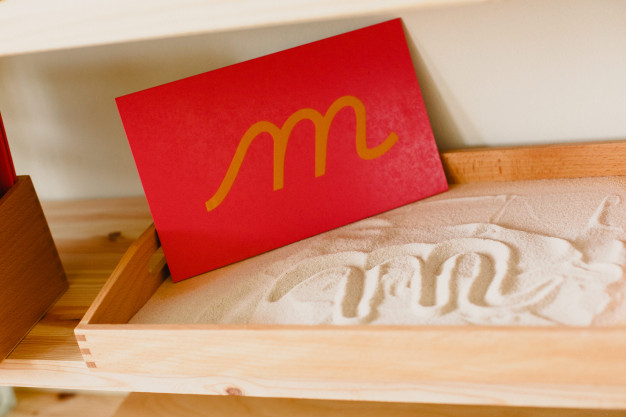
There are a few steps of pre-writing skills that a Montessori environment offers such as using sand-paper cards, moveable alphabets etc. This hands on approach let the child to form words based from what they sound out. They then continue writing what they learn. Yes the child might misspell some words due to similar sounds (kat instead of cat). But that is where the natural learning comes from- learning from mistake.
Once your child starts using letters to write, they’re going to begin to read at their pace.
3. Read
There is definitely a big reason why the first verse of the Quran is “Read!”
Reading opens up the gate of knowledge. Have you seen how a young child who had just learn the sounds of the letters, start to blend the letters to form a word? Oh how their eyes sparkled in delight when they managed to spell out the words!
Reading requires skills to master. But it is not impossible. Even reading at a slow pace helps your child to expand their vocabulary and introduce them to grammar and language structure.
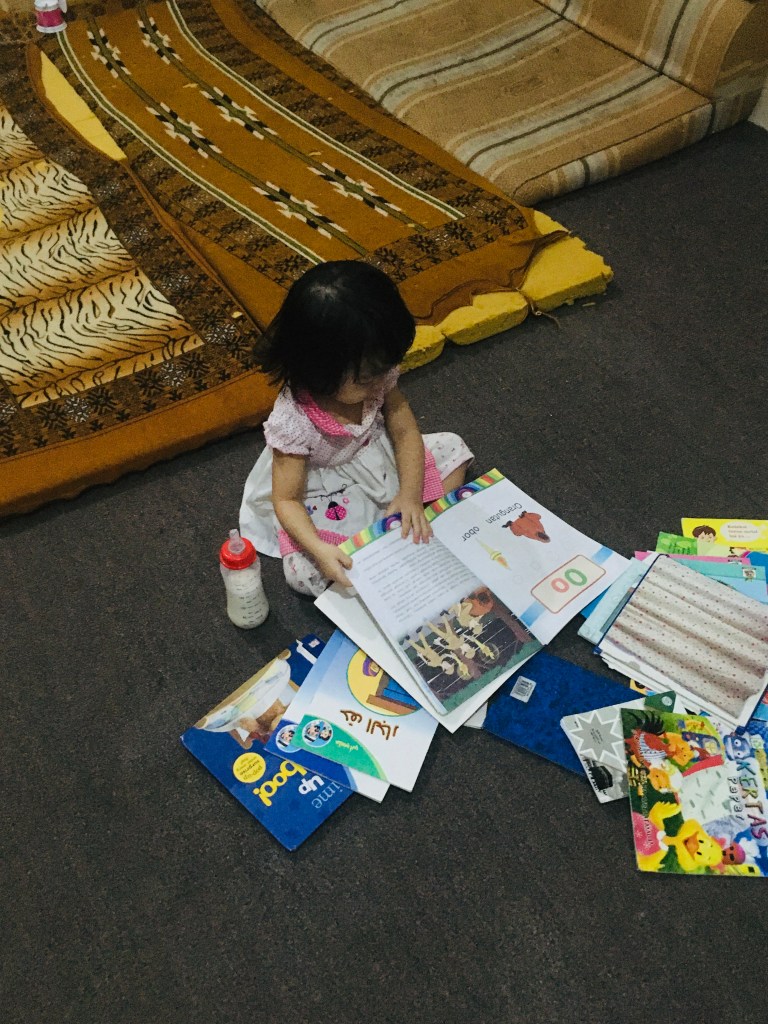
Reading a foreign language book helps widen the child’s ability to speak the language more fluently.
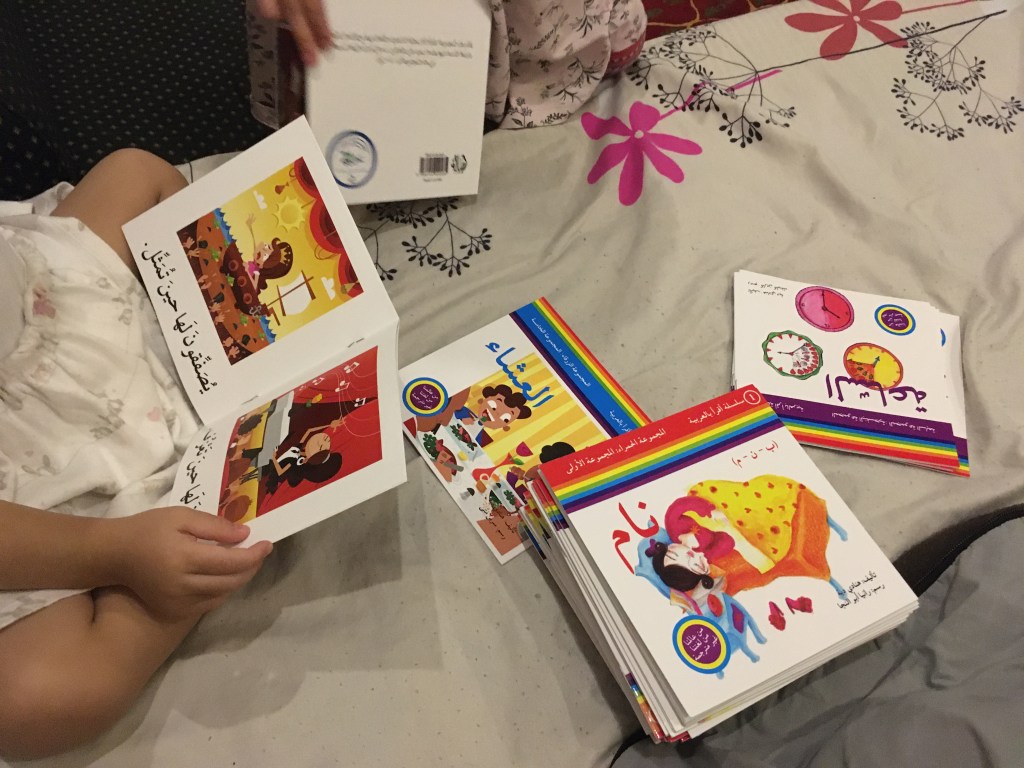
That is why i highly recommend early reader books for our young children. The repetitive sentences help our child retain the vocabulary gained and mould them into confident readers.
our children with Arabic early reader books (ascend with asala series from Asala publisher
4. Speak
This last step in acquiring a language requires us as parents to speak as normally as possible to our young babies. This means, no baby talk and speak to them as if they are a real talker. If they are cooing, respond animatedly and clearly with real words and not repeat their “ba -ba ” and “da da”. Expand their vocabulary and once your child can talk, they can speak clearly inshaAllah. When your child starts making sentences, encourage them to speak more by expanding the conversations. For example, your child might say “I want to go to the park” Respond by asking a few questions “What shall we bring to the park?” or “What time should we go out?”
This positive response encourages them to keep communicating and developing their language skills.
May Allah ease our journey of supporting our children to be a true khalifah in this world and may Allah grant us the goodness in this world and the Hereafter.
Raising grateful children in this materialistic world is no easy feat. How many of us (mothers especially) spend most of our days doing “stuffs” for the household, and the children particularly? From waking up in the morning, feeding them, sending them to school with warm meals in their lunchboxes, doing their laundry , fetching them from school, going over their homeworks and many more. Your kids might offer their help in doing the chores (or you might assign chores onto them), they might give their thanks to you for the great day when you put them to bed. But while basic “thank yous” are wonderful and appreciated, how do you identify a grateful child?
A child who is able to show appreciation and return the kindness, who have the quality of being thankful- for all the good things they have in life and be able to do that even when bad times came. And as Muslim, being grateful for all the good and the bad because he believes that everything is from Allah and Allah wants only the best for His servants. This attitude need to be nurtured and sowed from young. It is certainly a never ending process. It is not something that you possess overnight. Parents play an important role in raising grateful Muslim children.
So how do you do it?
Here are 5 tips in raising grateful Muslim children. 1. Express gratitude to Allah and other people.
One main reason why we want to raise grateful children is because we want them to be thankful servants of Allah.
(27:19) So [Solomon] smiled, amused at her speech, and said, “My Lord, enable me to be grateful for Your favor which You have bestowed upon me and upon my parents and to do righteousness of which You approve. And admit me by Your mercy into [the ranks of] Your righteous servants.”
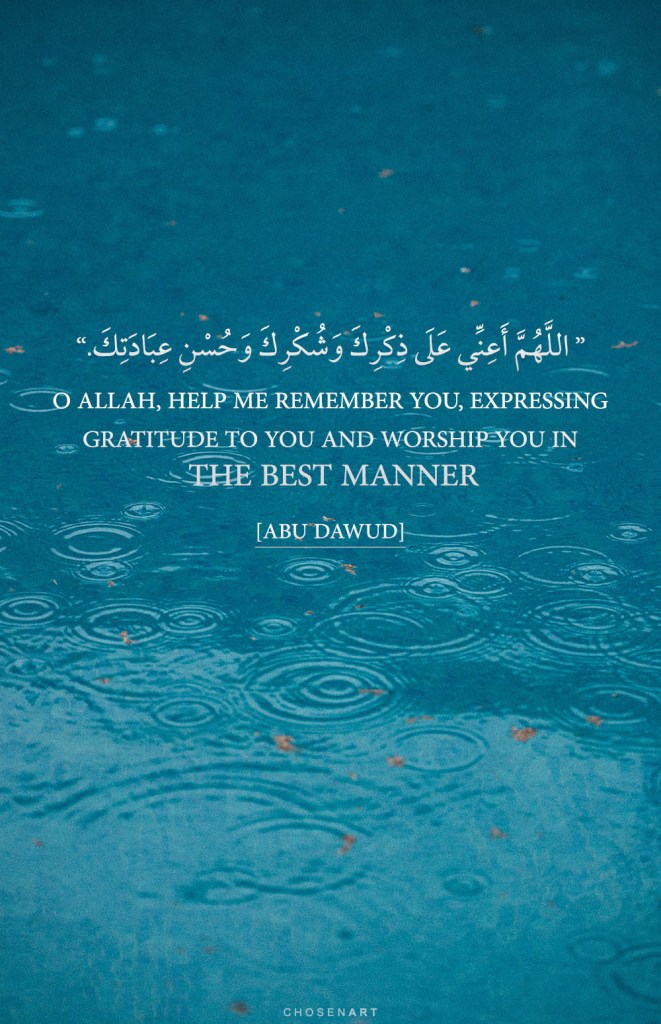
The first tip to achieve this is to teach them to always express gratitude to Allah. Teach them to praise Allah, to give thanks to Him for all the blessings given.
They must also be taught to show gratitude towards other people. Even if it is a small gesture from a younger sibling, teach them to always show their appreciation.
2. Parents be the role model
I can never stress more on this. Children learn best from modeling and through observing their surroundings and since parents are the first teachers for their children, children will ultimately follow the parents’ leads.
Model the grateful attitude by saying thanks to your partner for helping out around the house for example. Saying thank you for the garbage man who collects the garbage. Simple things like these go a long way. And when children see us doing this, they will subconsciously follow suit.
As Muslims, what better ways to find stories of the believers than going back to Quran and Sunnah. Teach your children the verses from the Quran that talked about gratitude and its virtues. How Allah promised His servants that whoever gives thanks/ appreciate His blessings, then He will add more.
And remember! your Lord caused to be declared (publicly): “If ye are grateful, I will add more (favours) unto you; But if ye show ingratitude, truly My punishment is terrible indeed.”
Read stories from the seerah of the Prophet PBUH and other messengers. How the beloved prophet still bowed down to Allah and prostrate to Him even though he is promised the highest rank of Heaven.
Al-Mughirah ibn Shu’bah reported: The Prophet, peace and blessings be upon him, would pray until his feet were swollen. It was said to him, “Why do you do this when Allah has forgiven your past and future sins?” The Prophet said, “Shall I not be a grateful servant?”
Source: Ṣaḥīḥ al-Bukhārī 1078, Ṣaḥīḥ Muslim 2819
Parents too need to be specific in showing gratitude. They will feel much more appreciated when they know that you approve that specific action.
For example when i saw my eldest cleaning up after playing, I would say something like “MashaAllah I see you are picking up your legos from the floor. This way no one would hurt their feet. Rasulullah PBUH said “ Removing harmful thing in the path is an act of charity”.
Besides relating their daily actions with what Rasulullah PBUH said, the children will feel appreciated that this particular is praised upon and when they feel appreciated , it makes it easier to feel and express gratitude to others. (Trickle-down effect)
3. List down everything that they are grateful for.
In our household, before sleeping we try to make a habit of talking about how the day went. We will summarise the day by listing down our favourite things that happened that day and how grateful we are. Even if it is just a simple thing. For example today my daughter said that she is happy that my husband bought her an orange juice and she thanked him for that. This simple stuff that we might overlook is actually big for little kids and it makes them feel contented.
I know some people have “grateful jar” in their home where they write things that they are grateful for and they will read it together. I think that is a briliant idea too. Check out pinterest for more exciting ideas.
4. Expose our children with different cultures and status quo.
Recently we are doing a unit study on water and its importance in human’s lives. We talked about how certain countries do not have an easy access to clean water in their homes. And we discussed on how lucky we are to have an easily accessible clean drinking water right from our tap.
Seeing challenges that other people faced can instill a sense of gratitude in our children. And that can make them more proactive to help others in need.
5. Teach them accountability
My daughters have a daily one hour screen time after they have done their homeschooling session. We downloaded Zaqy and friends in our Ipad. One day Marya accidentally deleted all of the videos. I was mad at first because she is not supposed to touch the Ipad even. Marya asked her father to “put back”(her words) the videos back. But we told her that we can’t and that is the consequence of her touching the Ipad and not listening to us.
Our kids need to know that they are accountable of their actions. They can cry and feel upset . But actually not giving in to every of their requests can make them appreciate more of what they have. Of course you as a parent know what your child really needs. So if you think that your child can live without the things they demand, then be steadfast in teaching them that not everything they want is granted upon. Teach them to take care of their things and be grateful with whatever they have in their lives.
To sum it all up, the sense of gratitude starts from our own home. Life is too short to be “whiny”. Appreciate and be thankful with whatever Allah gives us and life will surely be more positive inshaAllah.
Sight words or high frequency words are words that are commonly used and seen in our reading and writing.
Usually these words do not have a concrete image that accompanies them. (Example: “the”-“or”). Sometimes these words cannot be spelled out or blend phonetically. They are mostly adjectives, adverbs, pronouns, prepositions, conjunctions and the most common verbs. They are the service words in the language. They give meaning and direction to language.
As such, these words are simply memorised and understood.
Children need to immediately recognise, read and understand them upon seeing. This way they can approach a text confidently and read with more fluency and better comprehension.
A number of sight word lists have been compiled and published; among the most popular are the Dolch sight words(first published in 1936) and the 1000 Instant Word list prepared in 1979 by Edward Fry.
There are 220 Dolch Words that comprise about 60 to 85% of the text that you find in children’s early reading books and materials. The list can also help anyone starting to learn the English language.
Dolch sight words are based on high-frequency words that students in kindergarten through second grade typically would be reading. They are listed by age group.
Fry sight words have a total of 1000 words where the first 300 Fry words are listed by order of frequency. They are broken down into groups of 100 because Fry advocated focusing on a few words at a time until a student memorized the entire list.
How to teach:
Start with only five to ten words. Once a your child masters that list, add five to 10 more, but continue to review the previously mastered words.
You can use flashcards, play games like bingo and “swat the words”(our favourite!) Spell read the words and many more.
The kids playing “swat the words” game. I called out the word and they have to find it and swat it with a hand-fan 🙂
Also known as early readers / beginning readers/ easy readers/ kindergarten readers.
Characteristics of these kinds of books:
-suitable for kids who are learning to read and decode words
-large font
-short sentences
-repetitive texts
-pictures provide clues
-usually arranged by the publisher according to levels (beginner, intermediate, advanced)
Benefits of emergent readers:
-build confidence for the child who is beginning to read
-sharpen their reading skills and improve fluency
-help foster the love of reading in your child
If your child is beginning to read, choosing suitable books that can support their reading journey is very important. Children need to be confident in picking up words and decoding them. They will not feel frustrated if they come across new words because early readers books can help them in such a way that it is short, simple and engaging.
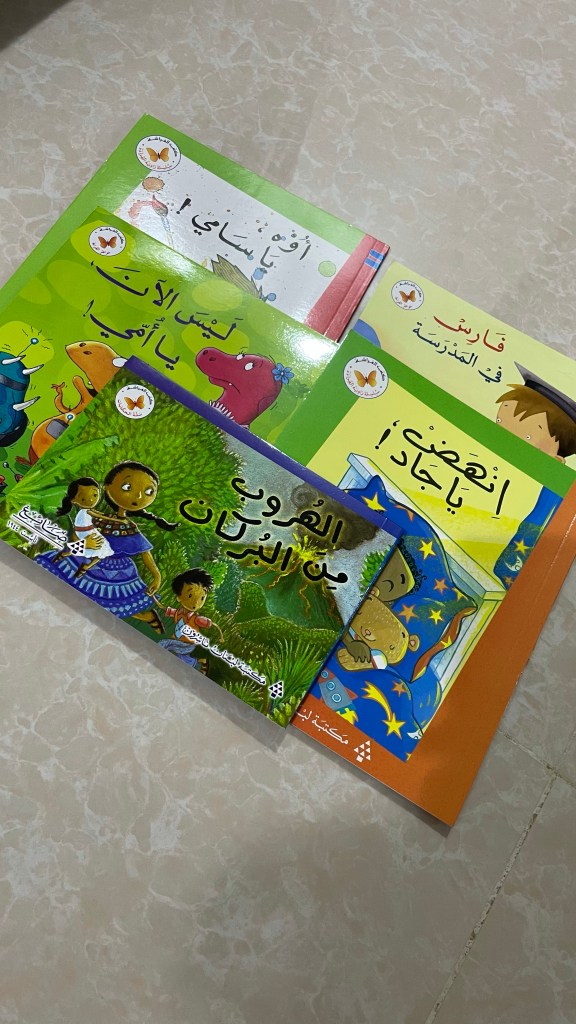
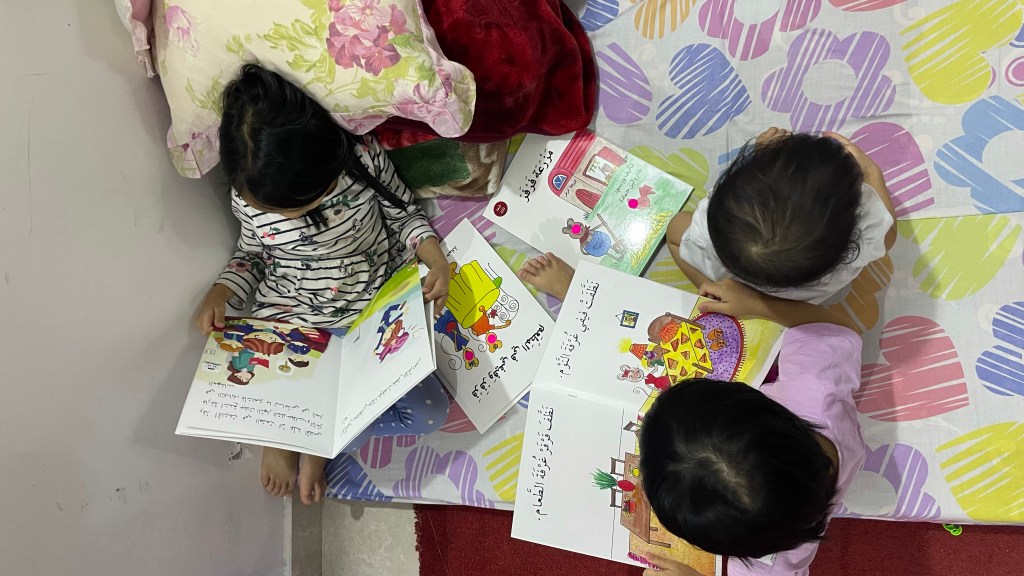
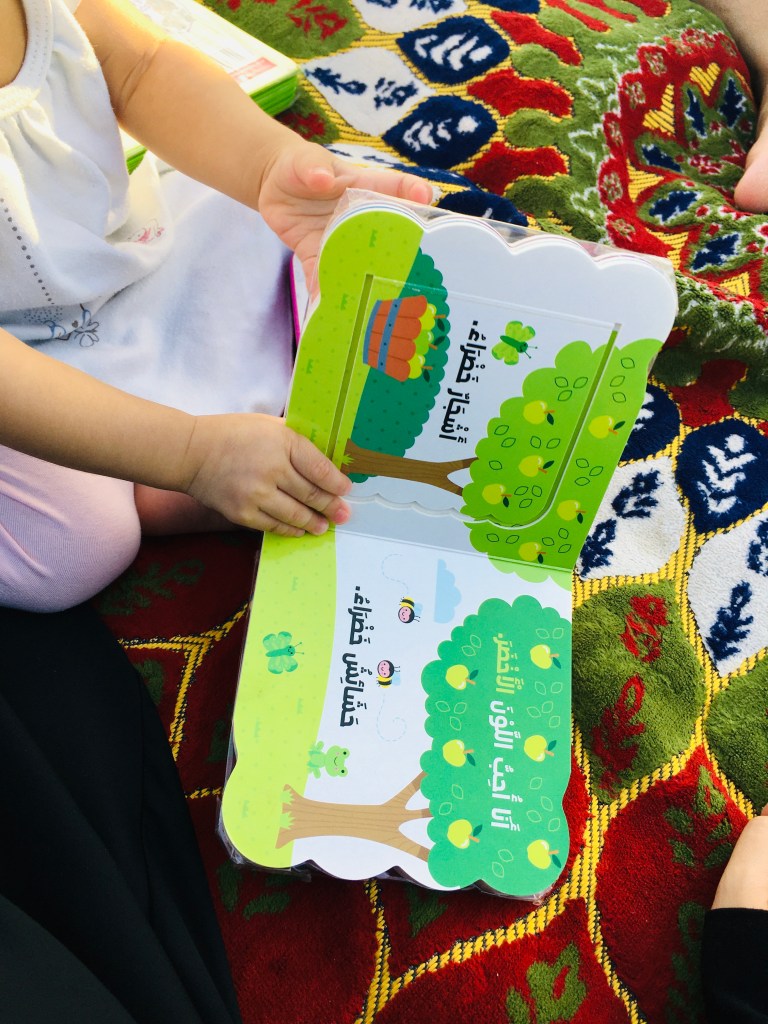
For arabic language, we have a few favourites early reader books which are mostly from Dar Asala from Lebanon. Look out for our next post as we share more on that inshaAllah!
As for english, Becky spence from (www.thisreadingmama.com) have plenty of good early reader books. We also frequently read from (www.progressivephonics.com)
Another favourite author of ours is Bruce Larkin. Many of his books,published by willbooks; are simple and repetitive. Check out ( http://www.willbooks.com) where you can read the books online for free!
I hope this posts can help parents out there trying to find resources on teaching their children. May Allah facilitate our children’s learning journey.















 Raising muslim kidlets