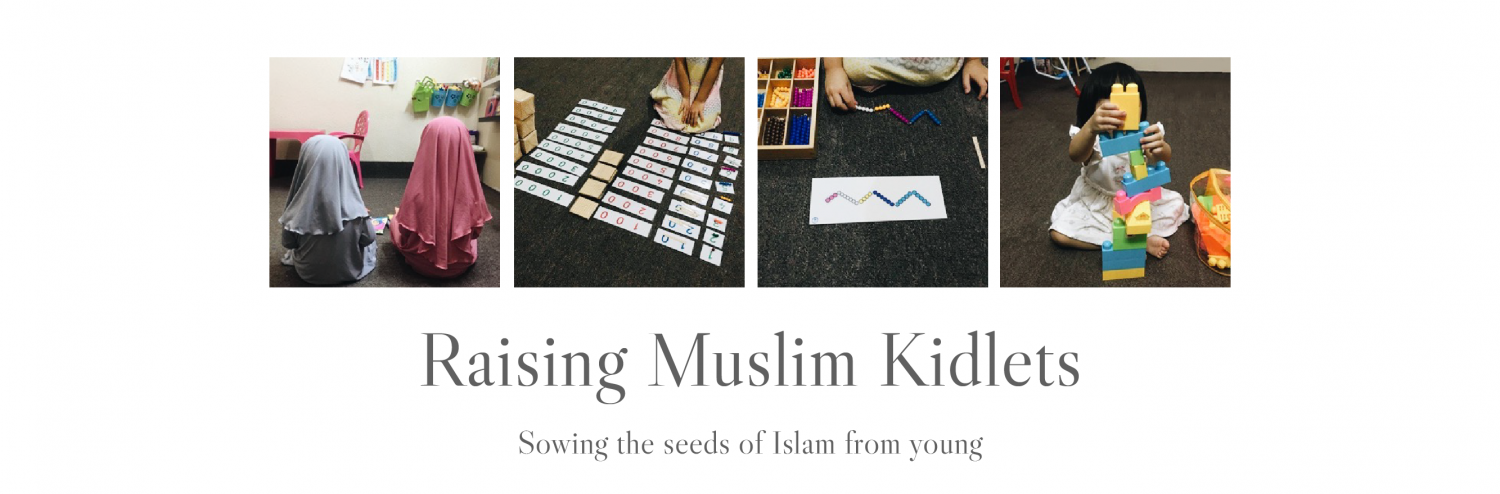
NOTE: I am not a Montessori certified teacher, this series is simply my insights and personal opinion and how I apply it to our children’s education method. Most of the points in this series are based on my reading and attending online Montessori courses.
Credit : For this particular post, most of the points are from Madam Nusaybah from Rumi Montessori (https://instagram.com/rumi_montessori?igshid=uq1btjbsj6f3 ) She oftens make IGLive at her instagram page and has a whole load of Montessori Parenting Series there. The way she presents her points is very concise and clear and it is so beneficial, I recommend everyone interested in Montessori to follow her instagram page. Barakallahu feeki Madam Nusaybah for developing Islamic Montessori school in Malaysia and making such a big big change in early childhood education in Malaysia.
Credits must also be given to Esraa Haidar (https://instagram.com/esraahaidar?igshid=197gc0k25fv7t ) a Montessori trained guide from Lebanon living in USA. She inspires me to teach Arabic to my kids and developing the love of it from an early start. She was invited by Maktabatee ( https://instagram.com/maktabatee?igshid=g9779b8dlsim in their Maktabatee Talks: Using the Montessori method to teach Arabic. Do follow them in Instagram for amazing ideas and resources. Jazakumullah khairan.
Arabic Language is neither my first language nor my husband’s. Fortunately however, we began learning Arabic Language when we were both in elementary level. But it was just that. No one spoke with us in Arabic at home. Even in classroom, most of the time the Arabic teacher used either Malay or English as a medium and Arabic vocabulary is peppered somewhere along the lines. It was just limited between the walls of the classroom. We studied simply for the yearly examination. So when we further our studies in the Middle East, it was then the love for Arabic Language finally blossomed.
Hence, when we had our first born, we agreed to cultivate Arabic language into our children’s lives.
Raising bilingual kids the Montessori way.
Children have an absorbent mind. Which refers to the mind’s capacity to take in information and sensations from the world that surrounds it.
A baby is born without language, and with few skills other than their survival instinct. From birth to three years they use their senses (hands, eyes, ears, nose, and tongue) to soak in everything that surrounds them. The child does this naturally, and without thought or choice. Maria Montessori referred to this period as the ‘unconscious creation’. Hence, how they can involuntarily learn to kick their legs, crawl etc; they can also absorb languages during this time.
Start as early as possible. It is this crucial time that we introduced any language to our children’s everyday lives. Never ever baby talk with them! It can cause detrimental development in the language part. Don’t be scared to use big words. Yes, they are sill young to respond. But language is about expression and communication.
What we can do is, one parent can choose one specific language and the other parent with another language.
The child usually associates one language with each parent, and will communicate with each of them in their corresponding languages. It is not recommended that a parent attempt to teach their child a primary language they are not familiar with, without exposing them to any other. This can result in confusion and language delay in the child.
In our case, my husband focus on conversing in Arabic language with our children while I communicate with them in English. Try not to mix between these two. The key here is Consistency. Be consistent in your chosen language; it might cause a lot of confusion in the child if you mix it up.
Conversing in more than one language would not cause speech delay if the parents are consistent in their own corresponding language.
Imagine this scenario, If I have always been using English with my 1 year old daughter and one day I speak to her “ Marya do you want halib “? (halib= milk in Arabic) while holding a cup of fresh milk. The child might or might not understand, she might think “Hmm, is Ummi offering me milk (Since she can see the cup in my hand) or something else”? What does halib means”? So there is where the confusion lies.
It is then our responsible to be consistent every day. Personally, this is quite a struggle for us. We tend to slip off and use the wrong language. But with persistent and dua’ everyday to Allah, everything will go smoothly.
Experts also suggest using sign language to expand our young children’s vocabulary. Hand gesture with repeated and consistent word can go a long way to develop the child’s language.
Introducing Arabic in a Montessori way.
But first, why Arabic?
For one simple reason, to learn the language of the Quran immensely.
There are 3 basic Montessori principle in teaching children- Experience, explore and expression.
So what we did was, we introduce Arabic language to our child as early as possible. We create a beautiful relationship between the child and the language- no pressure, no pushing but slowly articulating every sounds with love . Let them experience the love of Arabic Language themselves. Speak/Sing/Talk/Read to your children in your corresponding language.
Next let them explore and express their feelings with Arabic language using materials and resources you have around the house.
Starter: Language box.
We have small items and miniatures in a basket and we introduce it to our child. For example a small lion miniature toy; we then present it to our child and say “Marya, haza asadun” (this is a lion).
What we need to do is spark the interest in our child. Simplify the process by presenting few pieces at one time so that they can be familiar with it. Break down the process into smaller pieces so that your child would not get overwhelmed.
Note: You do not need to go out and buy all the materials. Find alternatives around your house; look at the resources you have, be aware of the Montessori principles and just apply it! Start with whatever you have.
Next: Introduction to hijaiyah letters.
- Sandpaper letters.
In Montessori, sandpaper letters are always used where the child would use their fingers to trace and ‘feel’ the letters.
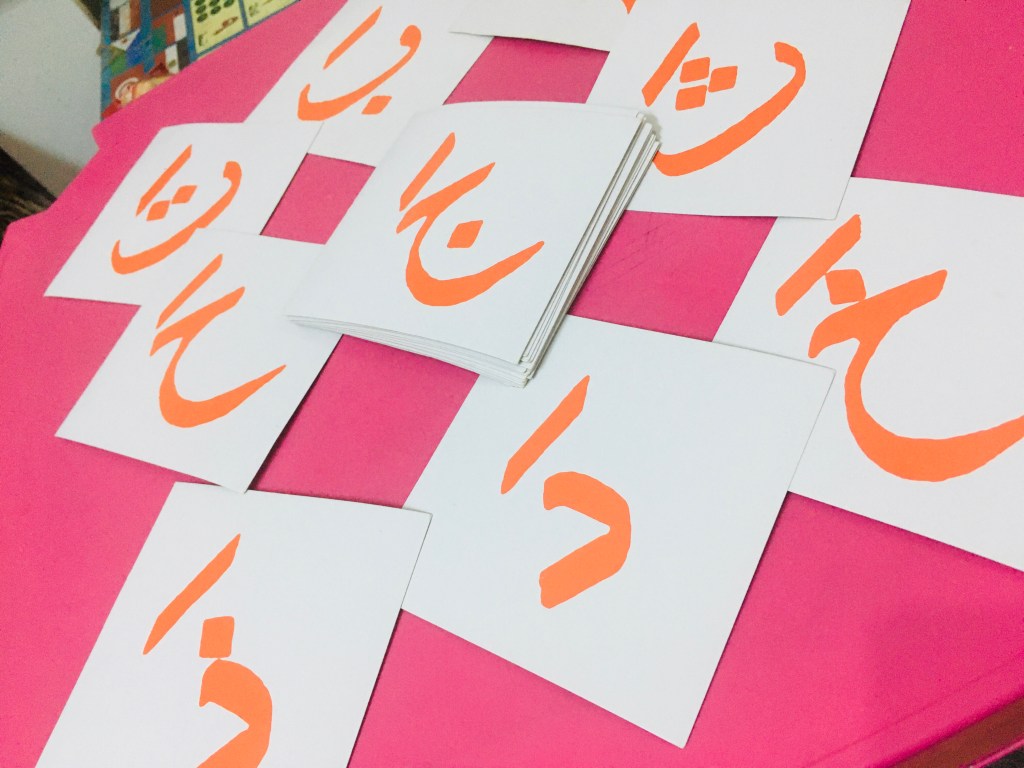
However since we don’t have that, we used a felt flashcard instead. We then show our daughter the letter one by one and let her touch the word and sound the word to her.

2. Sensory writing tray.
Next we introduced the Montessori sensory writing tray. This lesson involves sight, touch and sound. Children love to touch and feel different textures, and the fingertip is the most sensitive part of the body. Each fingertip has thousands of touch receptors. When the receptors are stimulated by touch, neurons fire signals via nerves to the spinal cord, brain stem, thalamus, and finally the cerebral cortex for processing.
We presented our child with a tray filled with sand, she then proceed to follow the shape of the letter by “writing” on the sand.
And at the same time, we paste around the houses small hijaiyah letters at her height so she can always see it. We also use flashcards.

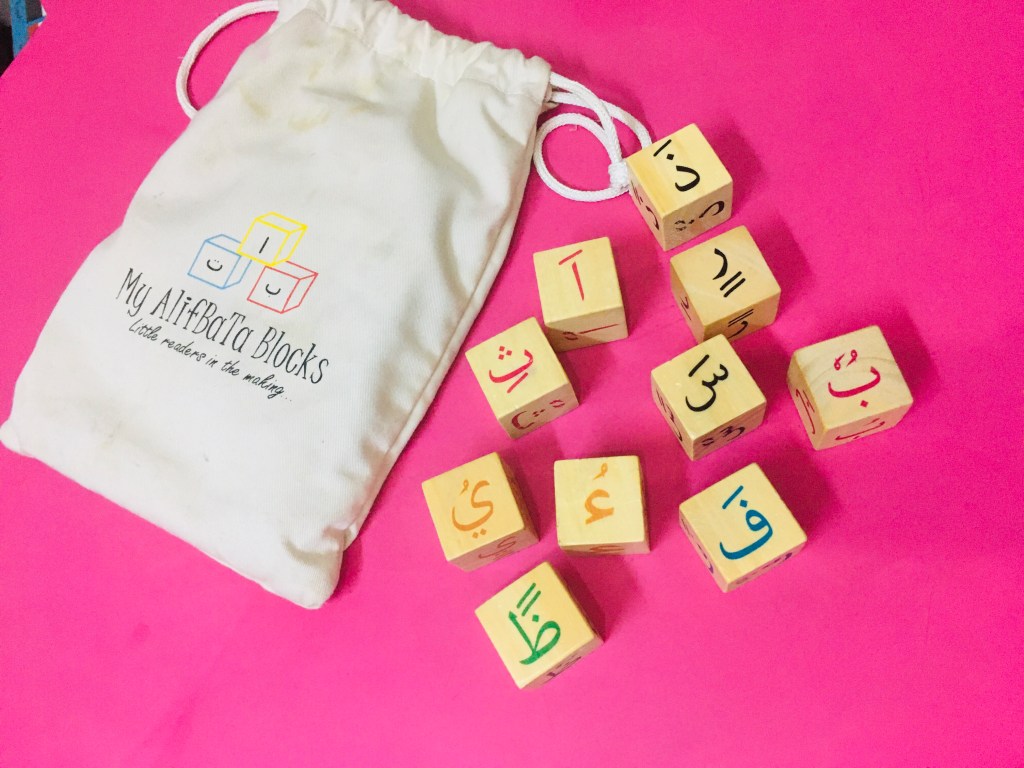
We also use manipulatives such as this amazing hijaiyyah wooden blocks
3. Moveable alphabet letters.
What is moveable alphabet letters?
A moveable alphabet is a tool used in a Montessori learning environment to teach reading, spelling, and writing. It is a wooden box containing 26 wooden letters. Vowels are in blue and consonants are in red.
Thus, using the same principle, moveable hijaiyyah letters are produced too. See pictures from google:
Scrolling through Pinterest offers you a lot of DIY version. I managed to print off one of it from : http://noorjanan.blogspot.com/2013/02/arabic-letters.html

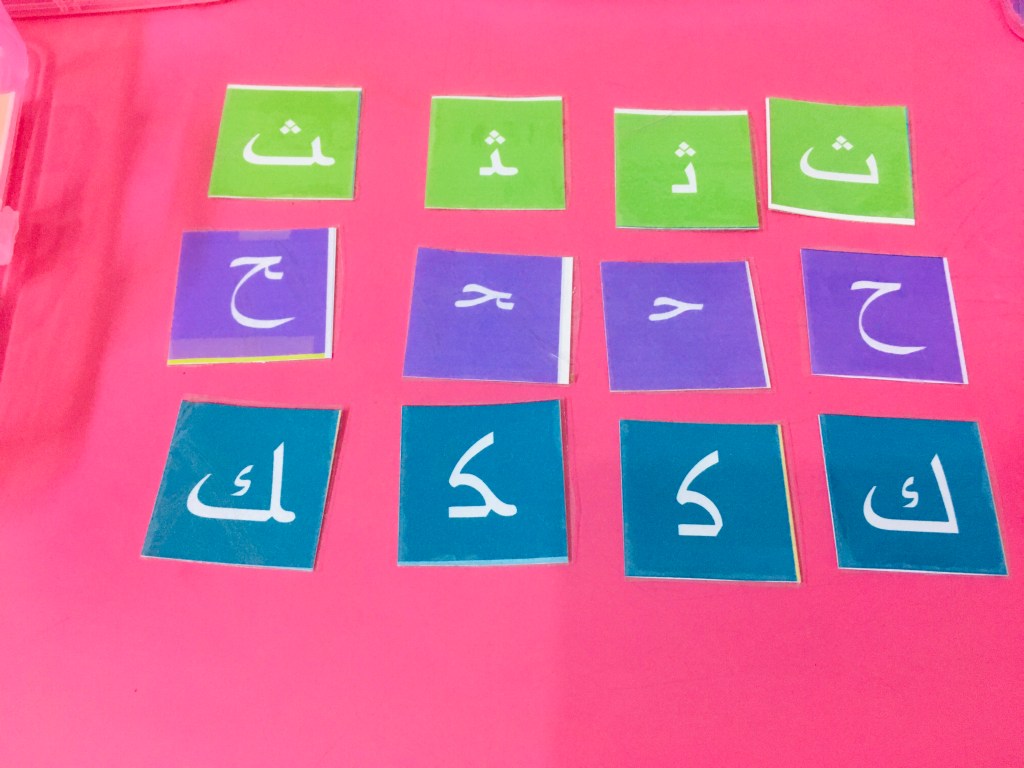
A cheaper version of the wooden moveable hijaiyyah letters, this printable is amazing because it not only offers separated hijayyah letters, it also comes in different positions of the letters – initial, middle and end position.
After our daughter has familiarised herself with all the letters, we begin reading Qiraati book with her. This Qiraati series has 6 levels beginning from beginners all the way to advanced levels. The beginners level start with 3 separated hijaiyyah letter, then it moved to combining those letter with fathah as its tashkeel. And so on so forth.
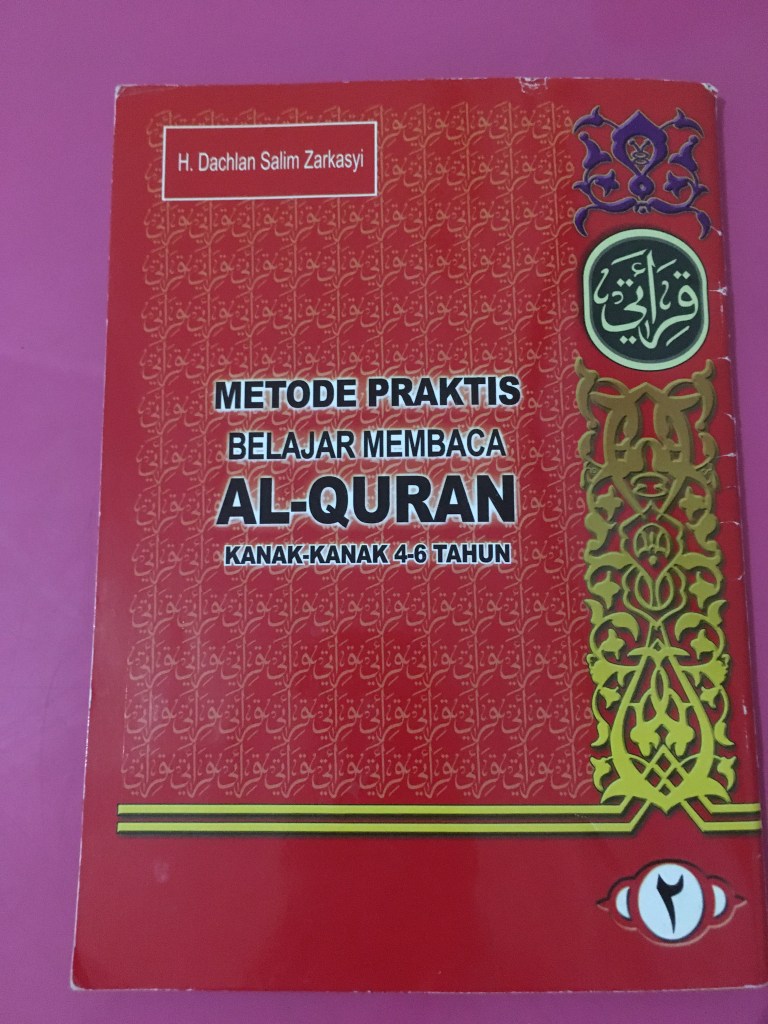
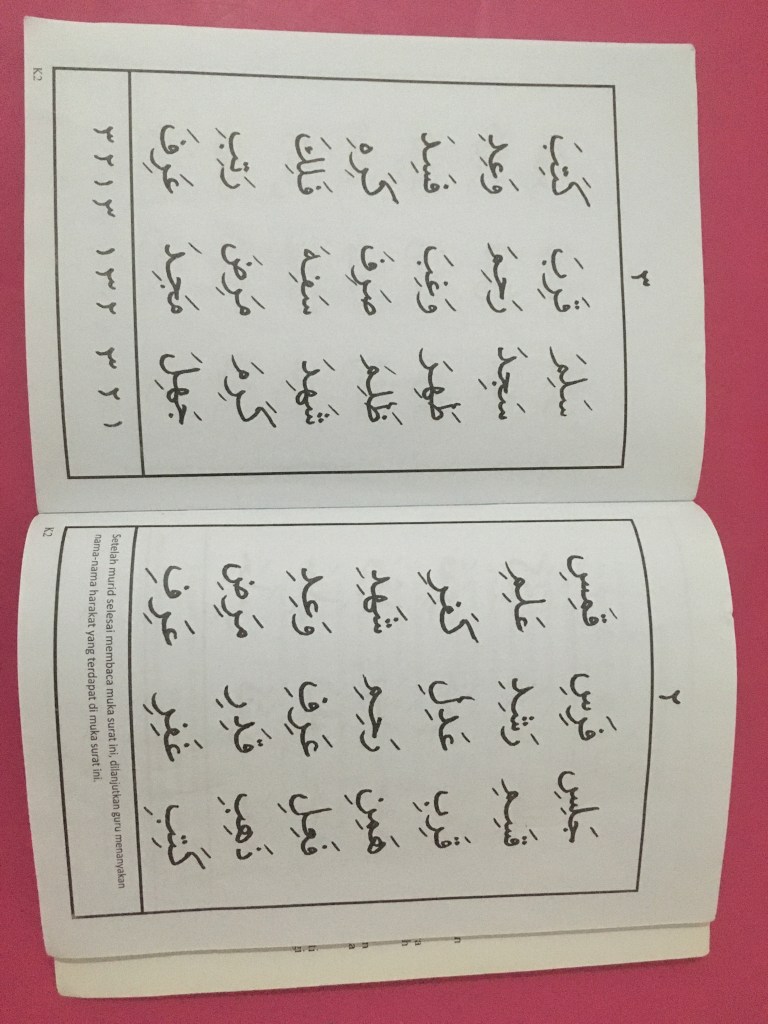
Apart from that, we make some practice papers and activities to spark more interest in her and just to keep the learning more fun.
Conclusion: As much as our daughter is learning everyday with all these materials, unravelling the beauty of Arabic language, I believed this learning journey is equally shared with me and my husband. Every single day, we learn something new, Alhamdulillah and every single day we affirm our intention of learning Arabic language together as a family just for the sake of attaining Allah’s blessings and His ridha.
In the next part of this series, I hope to share on how we teach Al-Quran to our child , inshaAllah.
 Raising muslim kidlets
[…] you are trying to bring up your child in a multi-language household, read more on our post here : https://raisingmuslimkidlets.wordpress.com/2020/07/01/montessori-at-home-series-teaching-arabic-lang… to see how you can support your child to speak more […]
LikeLike
[…] https://raisingmuslimkidlets.wordpress.com/2020/07/01/montessori-at-home-series-teaching-arabic-lang… […]
LikeLike