Children take up languages through interaction. Be it from their parents, other adults or even with their friends. Learning a second language can be intimidating. But do you know that giving an early head start proves to be beneficial because children below the age of 5 use the same part of their brain to acquire another language just as they learn their mother tongue.
Children also learn faster because they are more confident and are not afraid/shy when making mistakes.

So how do we as parents encourage this learning process?
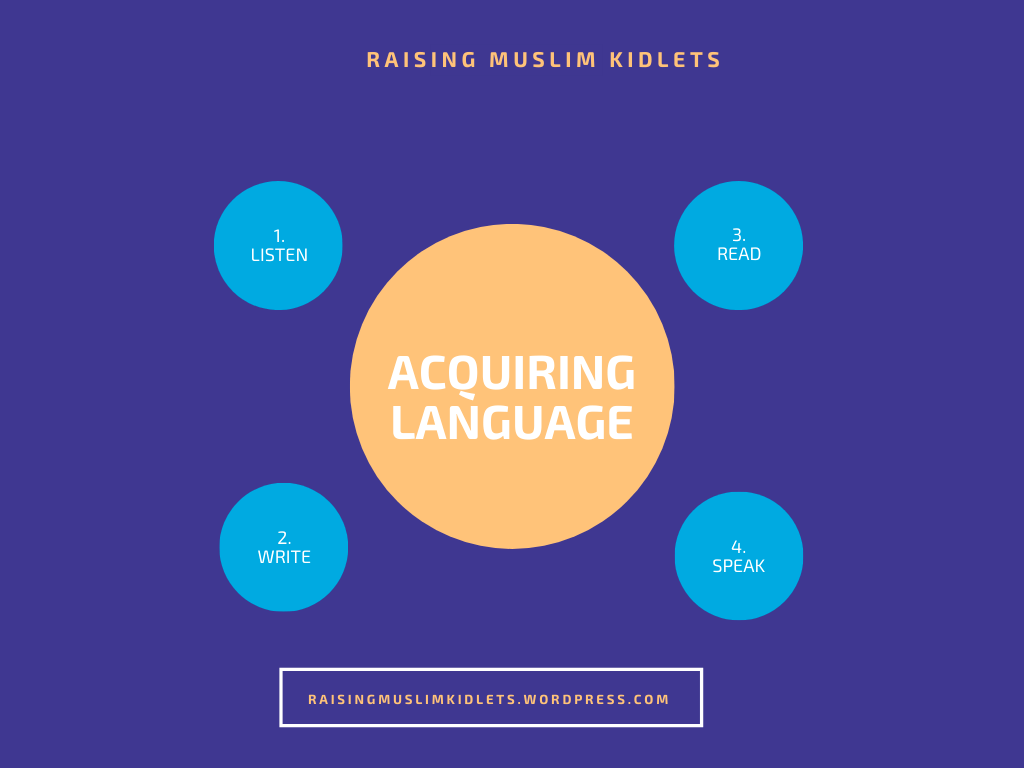
1. Listen

Learning language through listening can be divided into two; passive listening and active listening.
Passive listening:
Giving audio materials without properly listening to it/not paying close attention.
This type of listening is very controversial and some may think that it won’t work.
Personal view: Quran recitation has always been played in the background every time my children are playing. We turned on the Quran on the road in the car. We even downloaded a few of the children’s cartoon and muted the characters’ voices and switch on the Quran audio. And I can safely say that this method has a big role in helping my daughter’s first step in Quranic memorisation. They passively listen to the recitation when they are playing and slowly pick up the verses and are able to follow the recitation.
Passive listening can actually benefit you in such a way that you do not put in much effort yet somehow whatever you are listening to gets into the back of your head and you get used to the sound pattern.
Active listening:
Active listening is when you put your focus and listen carefully the words being told. You are engaged and can even interact upon hearing those words.
Ideas:
Download audio books that your child can hear the stories being told. To familiarise them with the sound. Podcasts work too. But you have to find a suitable material for your child’s level. Don’t find something too difficult lest it might bores your child.
Personal view:
I downloaded the KUTUBEE app (http://www.kutubee.com) which carries hundreds of e-books for children (English, Arabic and french). This apps allows you to choose and download a book, record your own voice to read or listen to it. You need to purchase it though but they have a free one month trial. My children love it.
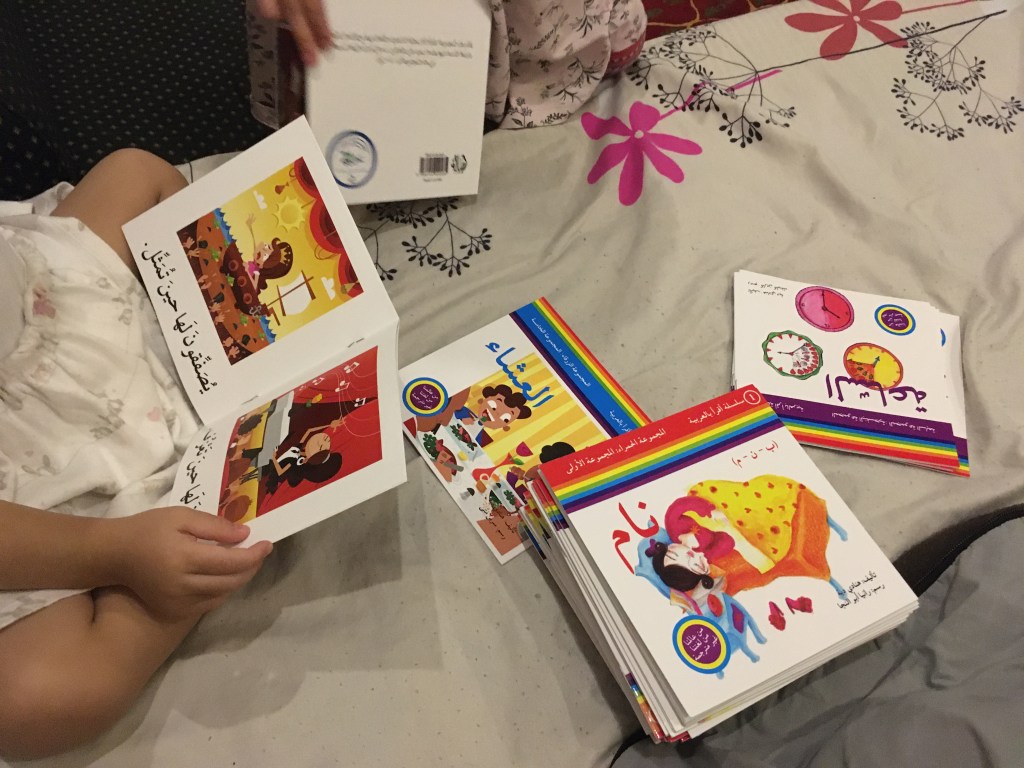
At first they just listen to the audio book and after a few sessions they can follow the reading Alhamdulillah. It is extremely helpful if you are trying to find early reader books in Arabic.
Our child can learn a new language when they hear we speak to them. So yes parents! We are the ones who need to start the ball rolling. At first they might seem nonchalant but the words are being absorbed without us realising it. Don’t be afraid to make mistakes. I think it is quite adorable when we learn together with our child and pick up a new language.
2. Write
Many of us grew up learning to read first and then write. But from Montessori point of view, writing comes first before reading. Of course there are many views on it but personally I resonate well with what Dr Maria Montessori said.
Why is this so?
If you think it this way, reading is actually more difficult than writing. Reading is like an external thing for your child- a whole different world for them. They have no idea on the words in the book unless they decipher the meaning- by sounding out the words and blending .
While writing comes naturally to us. It is like transforming our thoughts into words on a paper. So do children. Have you seen how a child scribbles gibberish words and try to explain it to you? They are simply expressing their thoughts and jotting it down on paper. As lessons are spread onto them, they will learn to spell out the words in a more accurate way.
In Montessori, children are taught the sounds of the alphabets letters first. And not the names of the letters. As the child learns to sound the letters (by listening from their guide/teacher etc), they begin to see the relationship between the sounds, identifying the letters and try making words.
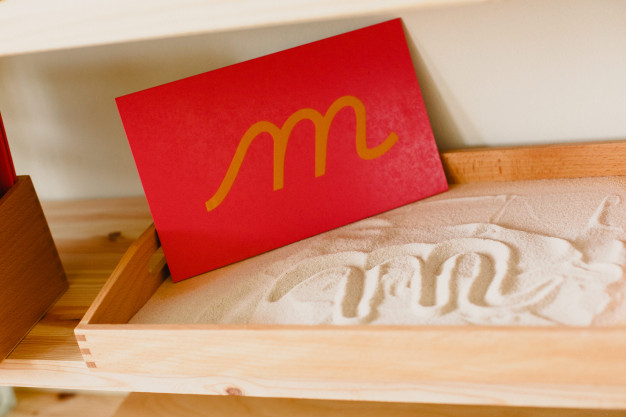
There are a few steps of pre-writing skills that a Montessori environment offers such as using sand-paper cards, moveable alphabets etc. This hands on approach let the child to form words based from what they sound out. They then continue writing what they learn. Yes the child might misspell some words due to similar sounds (kat instead of cat). But that is where the natural learning comes from- learning from mistake.
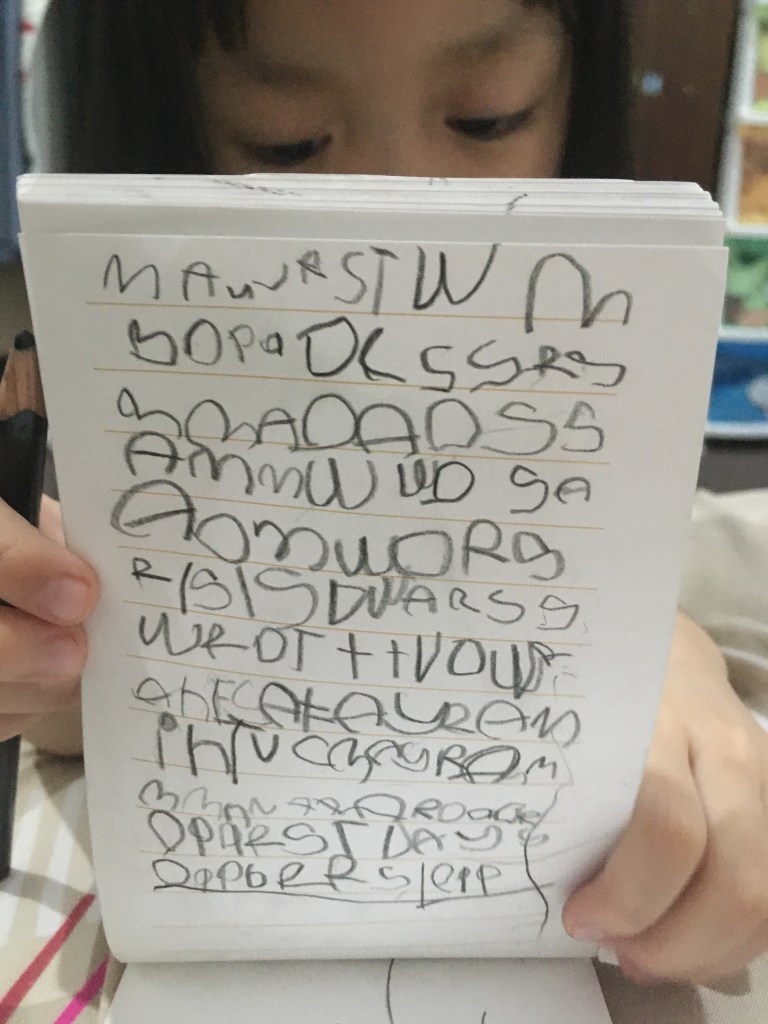
Once your child starts using letters to write, they’re going to begin to read at their pace.
3. Read
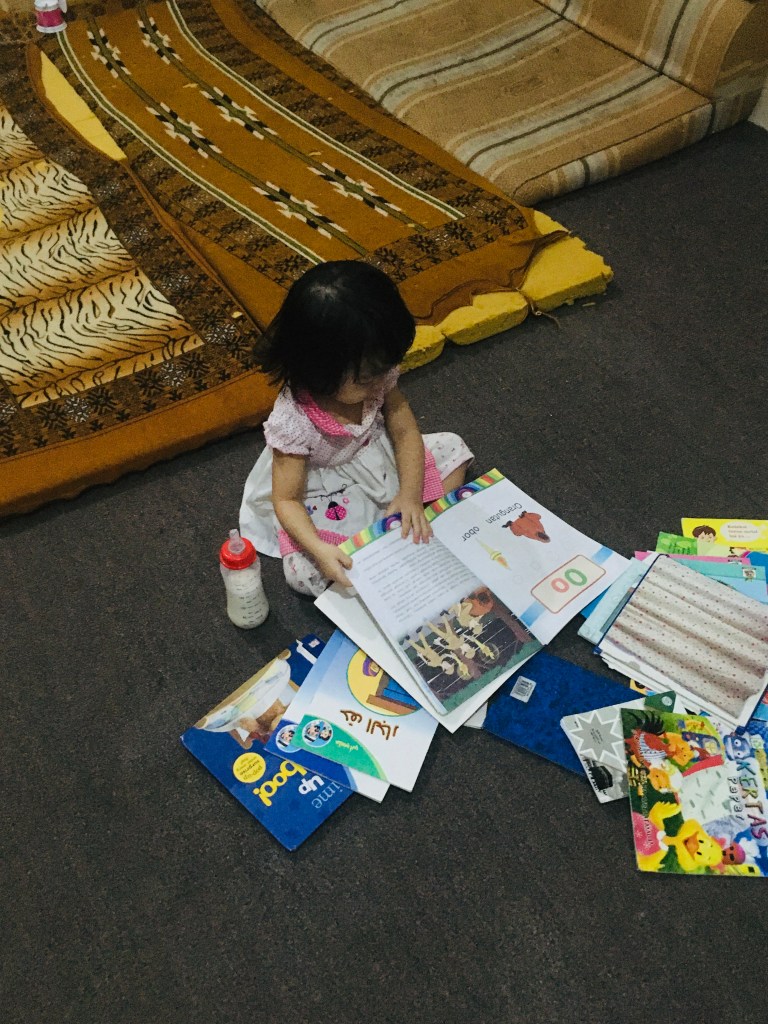
There is definitely a big reason why the first verse of the Quran is “Read!”
Reading opens up the gate of knowledge. Have you seen how a young child who had just learn the sounds of the letters, start to blend the letters to form a word? Oh how their eyes sparkled in delight when they managed to spell out the words!
Reading requires skills to master. But it is not impossible. Even reading at a slow pace helps your child to expand their vocabulary and introduce them to grammar and language structure.
Reading a foreign language book helps widen the child’s ability to speak the language more fluently.
That is why i highly recommend early reader books for our young children. The repetitive sentences help our child retain the vocabulary gained and mould them into confident readers.
4. Speak
This last step in acquiring a language requires us as parents to speak as normally as possible to our young babies. This means, no baby talk and speak to them as if they are a real talker. If they are cooing, respond animatedly and clearly with real words and not repeat their “ba -ba ” and “da da”. Expand their vocabulary and once your child can talk, they can speak clearly inshaAllah. When your child starts making sentences, encourage them to speak more by expanding the conversations. For example, your child might say “I want to go to the park” Respond by asking a few questions “What shall we bring to the park?” or “What time should we go out?”
This positive response encourages them to keep communicating and developing their language skills.
If you are trying to bring up your child in a multi-language household, read more on our post here : https://raisingmuslimkidlets.wordpress.com/2020/07/01/montessori-at-home-series-teaching-arabic-language-as-a-second-language/ to see how you can support your child to speak more confidently.
May Allah ease our journey of supporting our children to be a true khalifah in this world and may Allah grant us the goodness in this world and the Hereafter.
 Raising muslim kidlets
[…] https://raisingmuslimkidlets.wordpress.com/2021/03/07/acquiring-language-part-1/ […]
LikeLike